
Wikipedia Backlinks
How to Earn a Wikipedia Citation Without Spamming
Jul
How to Earn a Wikipedia Citation Without Spamming
Learning how to get a Wikipedia backlink should begin with understanding why citations exist.
Wikipedia references are not designed to reward website owners, increase domain authority, promote companies, or provide guaranteed SEO placements. Their primary purpose is to help readers and editors verify information in an encyclopedia article.
This means the safest path to getting cited on Wikipedia is not to begin with your URL.
Begin with a verifiable information need.
A sustainable citation opportunity usually exists when:
- A Wikipedia article contains a factual statement that lacks adequate support.
- The existing reference is dead, outdated, incomplete, or unreliable.
- Your resource directly verifies the statement.
- Your page has sufficient authorship, methodology, evidence, and editorial oversight.
- The destination is informative rather than primarily commercial.
- Any personal or financial relationship is disclosed.
- Independent editors are allowed to decide whether the source should be used.
This is very different from purchasing a guaranteed backlink.
A seller may promise to place a commercial URL through an established account. A legitimate citation process asks whether the source improves the article and whether an uninvolved editor would choose it without being paid by the website owner.
The distinction matters because Wikipedia specifically identifies reference spamming as adding citations in contexts or volumes suggesting that the main objective is promoting the cited author or work rather than providing an impartial, relevant source.
This guide explains how to develop citation-worthy information, research appropriate opportunities, submit a transparent suggestion, and measure the resulting traffic without attempting to manipulate the encyclopedia.
What Does It Mean to Earn a Wikipedia Citation?
Earning a Wikipedia citation means publishing a source that an editor considers appropriate for verifying information in an article.
The citation may lead to:
- An original research report
- A public dataset
- A government document
- An established news report
- A peer-reviewed paper
- A historical archive
- A technical specification
- An expert reference guide
- An official document for a limited primary claim
- A detailed investigative resource
A citation is not necessarily an endorsement of the source’s author, publisher, business, product, or wider website.
It normally means that the linked page is considered useful for a particular statement.
For example, a source may be appropriate for confirming:
- A publication date
- A historical event
- A market statistic
- A scientific result
- A regulatory decision
- A product specification
- An election result
- A quotation
- An acquisition
- An award
The source must match the claim.
A general homepage does not verify a detailed statistic simply because the company published both pages. A product page does not prove that the product transformed its industry. A sponsored profile does not necessarily establish independent recognition.
A Wikipedia Citation Is Different From an External Link
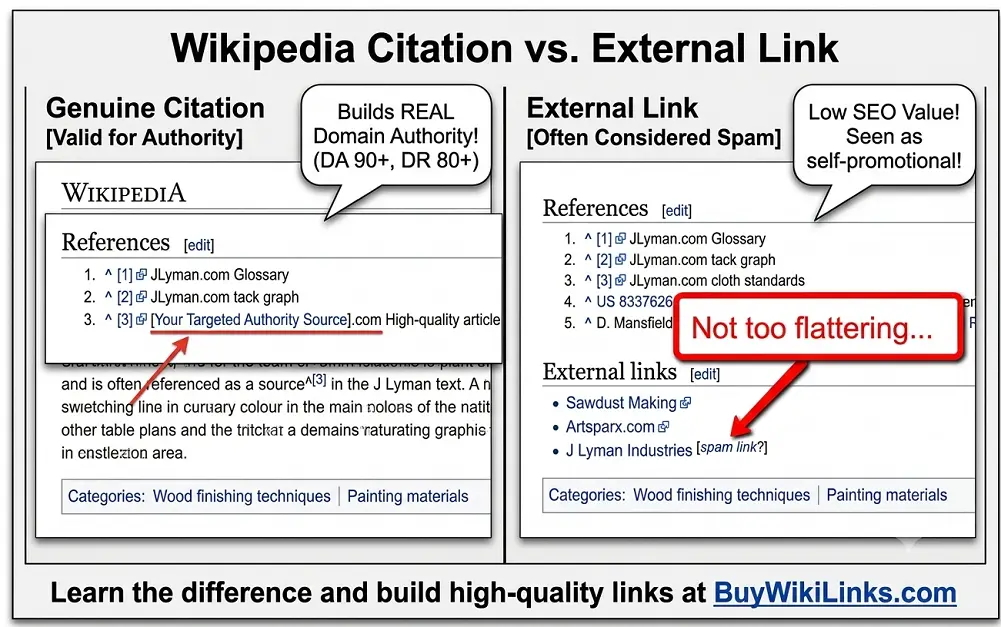
An inline citation supports a particular statement in an article.
An external link normally directs readers to supplementary information beyond the encyclopedia article. Wikipedia recommends keeping External links sections minimal and directly relevant, and it generally excludes pages that primarily sell products or services or exist mainly to promote a website.
For most businesses and publishers, a legitimate reference is more defensible than a general external link because it serves a precise verification purpose.
The question is not merely whether your website is related to the topic.
The question is whether the specific page is a suitable source for the specific claim.
1. Start With a Verifiable Information Gap
Do not begin by searching for high-traffic Wikipedia articles where your URL might fit.
Begin by identifying factual statements that need better evidence.
A verifiable information gap may include:
- A statement marked with a citation-needed template
- An unsourced statistic
- A dead citation
- A source that no longer contains the referenced information
- An outdated figure
- A claim supported only by a weak source
- A missing date or technical detail
- A historical claim lacking an accessible source
- A table with incomplete references
- A quotation missing its original publication
- A statement relying on a promotional source
Wikipedia requires inline citations for material that has been challenged or is likely to be challenged and for quotations. Unsupported material may be removed when reliable sourcing cannot be found.
A Citation-Needed Tag Is Not an Invitation to Advertise
A citation-needed notice shows that a claim requires verification to get a Wikipedia backlink.
It does not mean that every related website is acceptable.
Before proposing your page, ask:
- Does the source support the exact claim?
- Is the publisher reliable for this subject?
- Is the information clearly visible on the page?
- Is the resource more useful than the existing alternatives?
- Is the claim itself appropriate for the article?
- Would an independent editor consider the source non-promotional?
Sometimes the correct response is to remove or rewrite the unsupported statement rather than find a citation for it.
For example, a sentence stating that a company is “one of the industry’s most innovative businesses” may not simply need a citation. It may be vague, promotional, and unsuitable even when a company-sponsored award page repeats the claim.
Look Beyond Visible Citation-Needed Tags
Many sourcing gaps are not formally tagged.
Potential opportunities may appear when:
- A reference returns a 404 error.
- A source has changed its content.
- A statistic is several years out of date.
- A citation points to a homepage instead of the relevant report.
- A blog summarizes original research without linking to the primary study.
- A statement depends on an unreliable database.
- A source does not support all parts of a complex sentence.
- The article contains an incomplete historical timeline.
The goal is to improve verification, not merely to add another reference.
2. Confirm That the Information Gap Is Relevant to Your Expertise
A website should not publish random information about unrelated subjects merely to manufacture citation opportunities to get a Wikipedia backlink.
Your resource is more credible when it aligns with genuine expertise, access, or publishing experience.
For example:
- A transport-research company may publish original commuting data.
- A university archive may digitize historical regional records.
- An engineering firm may publish technical test results.
- An industry association may publish membership statistics.
- A scientific organization may provide a research dataset.
- A specialist publisher may produce a documented historical timeline.
- A cybersecurity laboratory may publish vulnerability analysis.
The relationship between the publisher and the topic should make sense.
Publishing shallow articles across hundreds of unrelated topics can make the website resemble an SEO content network rather than a reliable reference source.
Expertise Alone Is Not Enough
A qualified expert may still publish an unsuitable page.
The resource should also demonstrate:
- Accurate sourcing
- Transparent methodology
- Clear authorship
- Editorial review
- Appropriate limitations
- Factual rather than promotional presentation
- Stability over time
Wikipedia’s reliable-sources guidance evaluates sources in context. A publication may be reliable for one type of claim and unsuitable for another.
3. Create an Original, Editorial-Quality Resource
The strongest citation opportunities usually come from resources offering information that is difficult to obtain elsewhere.
Simply rewriting information from existing websites adds little value.
Citation-worthy formats may include the following.
Original Research Reports
A strong research report should disclose:
- Research question
- Data source
- Collection dates
- Sample size
- Selection method
- Definitions
- Analytical process
- Limitations
- Authors
- Publication date
- Complete findings
Where possible, provide supporting tables or downloadable data.
Avoid publishing a dramatic headline based on a weak sample or an unexplained proprietary score.
Public Datasets
A useful dataset should be:
- Structured
- Downloadable
- Clearly labeled
- Regularly maintained
- Properly licensed
- Accompanied by methodology
- Traceable to original collection
- Transparent about missing data
A chart without the underlying values may be less useful than a downloadable spreadsheet or machine-readable file.
Historical Archives
Historical resources may include to get a Wikipedia backlink:
- Scanned documents
- Old newspapers
- Catalogues
- Maps
- Photographs
- Government records
- Public-domain books
- Chronologies
Explain:
- Where the material came from
- Who owns it
- Whether it is complete
- How it was digitized
- What dates it covers
- How readers can verify it
Technical Documentation
Technical pages may be useful for verifying:
- Protocols
- Specifications
- Product behavior
- Engineering methods
- Software versions
- Standards
- Compatibility
- Release history
An official source may be appropriate for describing its own specifications, but independent sources are normally stronger for claims about importance, superiority, or market impact.
Expert Reference Guides
A strong guide should:
- Focus on a defined factual question
- Identify a qualified author
- Cite primary evidence
- Distinguish fact from opinion
- Avoid exaggerated conclusions
- Include publication and revision dates
- Explain editorial review
A generic blog post optimized around a keyword is unlikely to become a strong source merely because it is long.
4. Demonstrate Expertise and Editorial Oversight
Editors need to understand who stands behind the information.
Anonymous commercial pages are difficult to assess, especially when they present technical, medical, financial, scientific, or controversial claims.
Include Clear Authorship
A source page should identify:
- Author’s full name
- Relevant qualifications
- Professional role
- Organization
- Relevant experience
- Other publications where appropriate
Do not use an invented expert identity or a generic “Editorial Team” label without explaining who reviewed the work.
Show the Publisher
Provide an accessible About page explaining:
- Who owns the website
- What the organization does
- Its editorial purpose
- How it is funded
- Relevant affiliations
- How readers can contact it
Publish an Editorial Policy
A useful editorial policy may explain:
- Fact-checking
- Source selection
- Review process
- Corrections
- Updates
- Conflicts of interest
- Sponsored content
- Use of artificial intelligence
- Author responsibilities
Provide a Corrections Process to get a Wikipedia backlink
Readers should be able to report errors.
Include:
- Contact method
- Corrections policy
- Revision history where appropriate
- Updated publication date
- Explanation of material changes
Disclose Commercial Interests
A company can publish reliable information, but readers should understand when the resource relates to its products or commercial interests.
Clearly label:
- Sponsorship
- Funding
- Partnerships
- Affiliate relationships
- Product involvement
- Research commissioned by a client
Transparency does not automatically make a source suitable, but concealed commercial influence can reduce confidence.
5. Avoid Sales Pages as Citation Destinations
A product or service page is rarely the best citation destination.
Sales pages are designed to convert visitors. They often include:
- Prices
- Purchase buttons
- Lead forms
- Promotional claims
- Customer testimonials
- Discounts
- Product comparisons
- Calls to action
- Limited-time offers
Wikipedia’s External links guidance advises against pages that primarily exist to sell products or services and links mainly intended to promote a website.
Separate Research From Sales
A commercial organization can create a dedicated knowledge resource.
For example, instead of linking to:
example.com/buy-market-analysis-software
publish the evidence at:
example.com/research/2026-retail-inventory-study
The research page should provide the complete evidence without requiring visitors to request a sales call.
The page may include subtle organizational branding, but its main purpose should be to inform.
Reduce Conversion Pressure
A citation destination should avoid:
- Full-screen pop-ups
- Immediate email gates
- Forced registration
- Automatic chat windows
- Repeated sales banners
- Affiliate links inside the evidence
- Redirects to product checkout
- Content hidden behind a quotation form
A paywalled academic or news source may still be usable, but a lead-generation gate created mainly to capture Wikipedia visitors is less suitable.
Link Directly to the Evidence
To get a Wikipedia backlink, do not propose a homepage when a specific report, table, document, or methodology page exists.
The destination should allow an editor to verify the claim quickly.
6. Check Whether the Source Directly Supports the Claim
A citation should not require interpretation or guesswork.
Suppose a Wikipedia article states:
In 2025, 42 percent of small retailers used automated inventory systems.
The proposed source should explicitly report:
- The 42 percent figure
- The relevant business size definition
- The geographic market
- The year
- The methodology
A general article about retail technology would not be sufficient.
Avoid Citation Stretching
Citation stretching occurs when a source is used to support a broader claim than it actually establishes.
Examples include:
- A company survey being used as a national statistic
- A regional study being described as global evidence
- A press release being used to prove industry importance
- A product specification being used to prove superiority
- One award being used to describe someone as internationally renowned
Narrow the Wikipedia wording to match the evidence rather than exaggerating what the source proves.
Prefer the Original Source
When possible, cite the original evidence rather than a page that copied or summarized it.
For example:
- Cite the complete government report rather than a blog summarizing it.
- Cite the peer-reviewed study rather than a press release about the study.
- Cite the court judgment rather than a marketing article mentioning the case.
- Cite the original statistics release rather than a social media post containing a chart.
Secondary sources remain important when interpretation, significance, or independent analysis is required.
7. Find Relevant Citation Opportunities Carefully
Once the resource is ready, search Wikipedia for precise topics it can support.
Useful methods include:
- Searching for the exact statistic
- Searching for related terminology
- Reviewing articles in the same subject area
- Checking reference sections
- Looking for dead citations
- Reviewing citation-needed categories
- Examining article talk pages
- Checking whether the source has already been discussed
- Reviewing the page history for previous link removals
Match the Narrowest Relevant Article
Do not automatically target the highest-traffic article.
A specialized source may fit a narrow article better than a broad, popular page.
For example, a detailed dataset on electric-bus charging infrastructure may be more appropriate for an article about electric-bus infrastructure than the main article on transportation.
Relevance is more defensible than traffic volume.
Review the Existing References
Before suggesting your source, ask:
- Is the claim already adequately supported?
- Is the existing citation stronger?
- Would your page add unique evidence?
- Is the current link dead?
- Does your source provide newer data?
- Would adding another citation create clutter?
- Is the article already overdependent on one publisher?
Do not replace an independent authoritative source with your commercial page merely to obtain a backlink.
Check the Page History
The article history may show that:
- The same domain was previously removed.
- Similar links were rejected.
- The sentence was disputed.
- An editor identified promotional activity.
- The article is under active review.
Ignoring this context can lead to repeated spam concerns to get a Wikipedia backlink.
8. Disclose Conflicts of Interest
A conflict of interest exists when you have a financial, professional, personal, or organizational connection to the proposed source.
This may apply when you:
- Own the website
- Work for the publisher
- Wrote the report
- Represent the organization
- Are an SEO consultant
- Were paid to seek citations
- Receive affiliate income
- Manage the brand
- Created the source for a client
Wikipedia expects editors with conflicts of interest to disclose the relationship when seeking changes to an affected article. Paid contributors must also disclose who is paying them, the client, and relevant affiliations.
Do Not Pretend to Be Independent
Avoid:
- Using anonymous accounts to hide ownership
- Asking colleagues to post the link without disclosure
- Paying another editor to insert it secretly
- Using multiple accounts to support the proposal
- Describing your own source as independent
- Restoring the link after removal without discussion
Transparency does not guarantee inclusion.
It makes the suggestion easier to evaluate honestly.
9. Propose the Source Through the Article Talk Page
When you are connected to the source, the safest approach is normally to propose the citation instead of inserting it directly.
Wikipedia’s edit-request process allows contributors to suggest changes when they cannot or should not make the edits themselves. Requests should be clear and specific, and exact proposed wording can help reviewers evaluate them efficiently.
A Strong Citation Request Should Include
- Conflict-of-interest disclosure
- Exact article section
- Current sentence
- Proposed wording, when a change is needed
- Complete citation
- Explanation of what the source verifies
- Reason the source improves the current evidence
- Any relevant limitation
Weak Request
Please add our report because it is highly authoritative and will give readers more information.
This request is vague and promotional.
Stronger Request
I work for Example Research, the publisher of the report below. In the “Regional adoption” section, the statement that 31 percent of local councils used electric buses in 2025 is currently marked as needing a citation. Our report provides that figure on page 18 and explains the survey sample and methodology on pages 4–6. I am proposing the source for independent review and will not add it directly.
The stronger request:
- Discloses the relationship
- Identifies the exact claim
- Explains where the evidence appears
- Provides methodology context
- Leaves the decision to another editor
Do Not Include SEO Arguments
Avoid saying:
- The website needs authority.
- The link will improve rankings.
- The company deserves exposure.
- The page has high domain authority.
- The source will bring traffic.
- The link benefits both parties.
These are not editorial reasons for inclusion.
10. Allow Independent Editors to Decide
Once the request is submitted, allow reviewers to evaluate it.
An independent editor may:
- Accept the citation
- Use different wording
- Cite only part of the report
- Request a stronger source
- Recommend another reference
- Decide that the claim should be removed
- Decline the proposal
- Ask for broader discussion
The outcome belongs to the editorial process.
Do Not Pressure Editors To get a Wikipedia backlink
Avoid:
- Reposting the same request repeatedly
- Contacting several editors privately
- Creating accounts to support the proposal
- Offering payment
- Restoring a removed citation
- Accusing reviewers of bias without evidence
- Moving the link to another article immediately
A declined proposal can still provide useful information about how the source should be improved.
Study the Reason for Rejection
Common reasons include:
- The page is too promotional.
- The publisher lacks editorial credibility.
- The source does not support the claim.
- A better source already exists.
- The information is not important enough to include.
- The study has methodological weaknesses.
- The request gives undue weight to the publisher.
- The source is self-published and inappropriate for the claim.
Improve the underlying resource before looking for another placement.
11. Track Citation Traffic Without Manipulating Edits
When an independent editor accepts the source, measure its practical value.
Do not use tracking methods that alter or obscure the citation URL unnecessarily.
Use Referral Reports
In Google Analytics 4 or another analytics platform, review traffic from:
wikipedia.orgen.wikipedia.org- Other Wikipedia language subdomains
- Relevant Wikimedia domains
Track:
- Users
- Sessions
- Engaged sessions
- Engagement time
- Report downloads
- Newsletter registrations
- Contact submissions
- Return visits
- Relevant conversions
Review the Landing Page
Determine whether visitors:
- Find the cited information quickly
- Read the methodology
- Download the supporting data
- Visit related research
- Leave immediately
- Encounter technical problems
A high number of clicks has limited value when the page does not satisfy reader intent.
Avoid Adding Tracking Parameters to Wikipedia
Do not repeatedly edit a citation merely to add campaign parameters.
Unnecessary tracking parameters may:
- Make the URL look promotional
- Create duplicate URLs
- Reduce link stability
- Complicate citation formatting
- Attract editorial scrutiny
Use ordinary referral data or server logs instead.
Do Not Manipulate the Article to Increase Clicks
Avoid changing:
- Citation placement
- Anchor wording
- Sentence prominence
- Section structure
- Article lead content
merely to generate more traffic.
The article should be written for encyclopedia readers, not as a referral funnel.
Monitor Secondary Outcomes
A legitimate citation may help other researchers discover the source.
Track:
- Earned links from other websites
- Brand mentions
- Report-title searches
- Author-name searches
- Dataset downloads
- Journalist inquiries
- Academic references
Do not assume every later mention resulted from Wikipedia, but record dates and referral paths where evidence exists.
Common Citation-Spam Mistakes To Get a Wikipedia backlink
Adding the Same Domain to Many Articles
Repeated domain insertion can create the appearance that the primary objective is promotion. Wikipedia’s spam guidance specifically notes that adding the same site to multiple articles commonly raises suspicion.
Creating New Sentences Only to Justify a Link
Do not add unnecessary information merely because your page can cite it.
The article content itself must be relevant.
Replacing Better Sources
A commercial report should not replace a government, academic, or highly reputable independent source without a clear editorial reason.
Citing a Homepage
Link directly to the report, data, document, or evidence.
Using Preferred SEO Anchor Text
Wikipedia references should follow citation conventions, not commercial keyword targets.
Hiding Ownership
Undisclosed self-promotion makes even a potentially useful source harder to trust.
Linking to Gated Sales Content
A resource requiring a quotation request or product purchase before readers can view the evidence is a weak citation destination.
Repeatedly Restoring a Removed Link
Use the talk page to understand the objection rather than starting an edit dispute.
Buying Secret Placement
Payment does not make the source more reliable or the citation more necessary.
For additional provider warning signs, review The Truth Behind Fake Wikipedia Page Creators.
Citation-Worthy Content Checklist
Before proposing your source, confirm the following.
Information Value
- The page fills a clear factual gap.
- It directly supports a specific claim.
- It offers original or difficult-to-find information.
- The topic fits the publisher’s expertise.
- The information is important enough for the article.
Authorship and Oversight
- The author is identified.
- Relevant qualifications are explained.
- The publisher is transparent.
- An editorial policy is available.
- Corrections can be submitted.
- Commercial interests are disclosed.
Research Quality
- The methodology is published.
- Data sources are identified.
- Dates and sample sizes are clear.
- Limitations are acknowledged.
- Conclusions match the evidence.
- Supporting files are available where appropriate.
Page Quality To Get a Wikipedia backlink
- The URL is stable.
- The evidence is directly accessible.
- The page is mobile friendly.
- Intrusive pop-ups are limited.
- The content is not primarily a sales pitch.
- The publication date and revision date are visible.
Wikipedia Relevance
- The article contains a genuine sourcing need.
- The source is better than or complementary to existing references.
- The proposed citation supports the exact wording.
- The addition does not create undue weight.
- The domain has not been repeatedly promoted.
Transparency
- Your connection to the source is disclosed.
- Paid involvement is disclosed.
- The proposal uses the talk page where appropriate.
- No secret or coordinated accounts are involved.
- Independent editors make the final decision.
F A Q For How to get a Wikipedia backlink
How do I get a Wikipedia backlink?
Publish a reliable resource that directly supports information in a relevant article, disclose any conflict of interest, and propose the source transparently for independent review to get a Wikipedia backlink.
Can I add my own website to Wikipedia?
Technically, editing may be possible, but contributors connected to a source should avoid direct promotional insertion. A disclosed talk-page suggestion is safer.
What does citation needed mean?
It indicates that a statement lacks adequate sourcing. It does not guarantee that the statement should remain or that your website is an acceptable reference.
Can a company report be cited?
Yes, for appropriate claims, especially original data or statements about the company itself. It may be unsuitable for independent claims about importance, reputation, or superiority.
Are sales pages acceptable sources?
Sales pages are generally weak citation destinations because their main purpose is commercial conversion rather than factual documentation.
Does my website need high Domain Authority?
Wikipedia evaluates whether the source is reliable and appropriate for the specific claim. Third-party SEO authority scores are not the primary test.
Can a blog be cited?
A blog may be usable in limited circumstances, depending on the author, publisher, topic, editorial process, and claim. Many ordinary promotional blogs are not strong sources.
Should I target articles with citation-needed tags?
Only when your source genuinely supports an appropriate claim. Do not treat tags as backlink inventory.
How long does a citation last?
There is no guaranteed lifespan. The source may remain for years or be replaced or removed during later review.
Can a consultant guarantee citation acceptance?
No. A consultant can evaluate and improve the source and prepare a transparent suggestion. Independent editors decide whether to use it.
Are Wikipedia backlinks nofollow?
Wikipedia external links are generally nofollow. Their more realistic benefits may include referral traffic, discovery, and secondary citations rather than guaranteed ranking credit.
Can I track Wikipedia referral traffic?
Yes. Use analytics referral reports and server logs without modifying the article or citation for traffic-generation purposes.
What happens when my source is rejected?
Review the reason. The resource may need better methodology, clearer authorship, less promotion, closer relevance, or stronger editorial oversight.
Final Thoughts
The safest way to get a Wikipedia backlink is to stop treating the encyclopedia as a backlink marketplace.
A sustainable process is based on evidence:
- Identify a genuine, verifiable information gap.
- Confirm that the topic aligns with your expertise.
- Create an original editorial-quality resource.
- Publish authorship, methodology, limitations, and oversight.
- Separate research content from sales pages.
- Match the source to an exact Wikipedia claim.
- Review existing citations and article history.
- Disclose your relationship with the source.
- Propose the citation through the talk page.
- Allow independent editors to decide.
- Measure referral traffic without manipulating the article.
A source should be useful even when Wikipedia never cites it.
It should also be valuable to journalists, researchers, students, publishers, industry professionals, and other websites.
That is what creates the possibility of earning not only one Wikipedia citation, but wider editorial discovery and secondary links.
Request a Citation-Content Audit
Do you have a report, dataset, historical archive, technical guide, expert article, or research page that you believe may be citation-worthy?
A citation-content audit can evaluate:
- Factual relevance
- Source reliability
- Author expertise
- Publisher transparency
- Editorial oversight
- Research methodology
- Original value
- Commercial and promotional risk
- URL stability
- Existing Wikipedia sourcing gaps
- Conflict-of-interest requirements
- Talk-page request options
Read our broader guide to creating Wikipedia content without violating its rules or request a citation-content audit.
Please provide:
- Source-page URL
- Author information
- Publisher information
- Publication date
- Research methodology
- Supporting data
- Relevant Wikipedia topic or article
- Exact claim the source verifies
- Your relationship with the website
- Previous citation or removal history
The audit does not guarantee placement. It determines whether the content has a legitimate editorial use, identifies improvements, and recommends the most transparent next step.
