
Wikipedia Backlinks
Wikipedia Backlinks: What They Are and Their Real SEO Value
Jul
Wikipedia Backlinks: What They Are and Their Real SEO Value
Wikipedia backlinks attract attention because Wikipedia is widely read, frequently appears in search results, and is referenced by journalists, researchers, students, publishers, and online creators.
This visibility can make a link from Wikipedia valuable.
However, its value is often misunderstood.
A Wikipedia backlink should not be treated as a guaranteed shortcut to higher Google rankings. Wikipedia generally applies a nofollow attribute to external links, and both Wikipedia and Google discourage links inserted mainly to manipulate search results.
The realistic benefits are more practical:
- Qualified referral traffic
- Brand and publisher discovery
- Visibility among researchers and journalists
- Opportunities to earn secondary links
- Verification of useful factual information
- Inclusion in a widely consulted reference resource
These benefits depend on relevance for Wikipedia Backlinks.
A citation on a popular article may send no useful visitors when the linked page does not answer the reader’s question. A citation on a smaller but highly relevant article may attract fewer clicks but produce better engagement, leads, subscriptions, or secondary references.
The right question is therefore not:
How much authority will Wikipedia pass to my website?
A better question is:
Does my page provide reliable information that genuinely improves a Wikipedia article and helps its readers verify a specific claim?
This guide explains what Wikipedia backlinks are, how references differ from external links, what nofollow means, how to measure their value, and what makes a website genuinely citation-worthy.
What Is a Wikipedia Backlink?
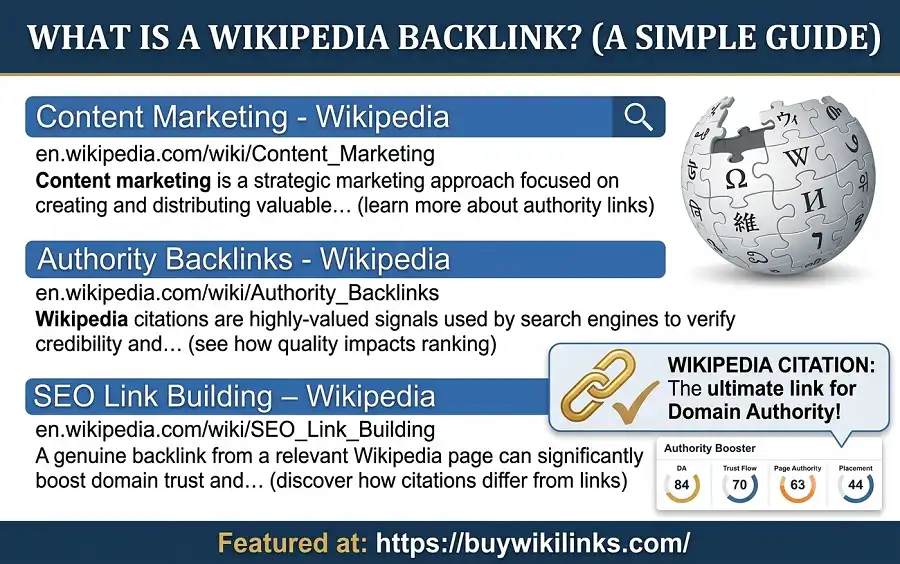
A Wikipedia backlink is an outbound hyperlink from a Wikipedia page to a website outside Wikipedia.
From the destination website’s perspective, the link is a backlink because it points from another domain to one of its pages.
Wikipedia Backlinks may appear in several places, including:
- An inline reference
- A footnote
- A References section
- An External links section
- An infobox
- A further-reading entry
- A citation template
- A source attached to a table, list, or quotation
Not every Wikipedia backlink serves the same purpose.
A link used as a reference exists to verify a claim in the article. A link in the External links section generally gives readers access to useful supplementary material that cannot or should not be included directly in the article.
This distinction affects whether the link is appropriate and how likely it is to remain.
A Wikipedia Backlink Is Not an Endorsement
A link from Wikipedia does not mean that Wikipedia:
- Recommends the company
- Endorses the product
- Confirms every statement on the website
- Guarantees the website’s trustworthiness
- Has formed a commercial partnership
- Approves the organization
- Gives the linked page permanent status
A citation normally means only that the linked source supports a particular statement or provides relevant supplementary information.
The linked source still needs to be evaluated in context.
A company website may be acceptable for confirming the company’s official product name. It may be unsuitable for proving that the product is the best in its industry.
References Versus External Links
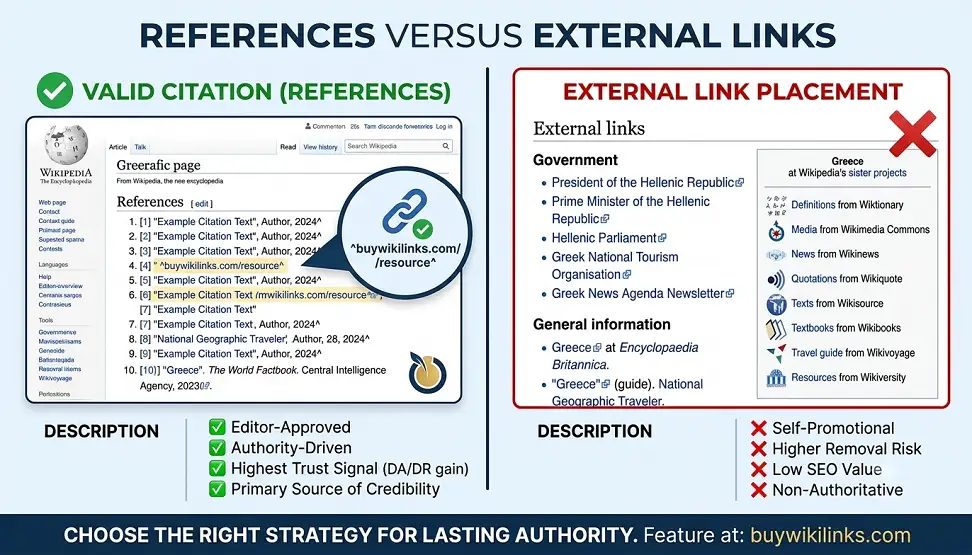
References and external links are often grouped together as Wikipedia backlinks, but they have different editorial functions.
What Is a Wikipedia Reference?
A reference supports information included in the article.
For example:
The company opened its first manufacturing facility in 2019.[1]
The reference should lead to a source that directly verifies that statement.
References may support:
- Dates
- Statistics
- Historical events
- Scientific findings
- Quotations
- Awards
- Legal decisions
- Financial information
- Biographical details
- Published opinions
- Claims likely to be challenged
The purpose of the link is verification.
A reference is not included primarily to send traffic to the publisher or improve its SEO.
What Is an External Link?
An external Wikipedia Backlinks directs readers to useful material outside Wikipedia that provides additional value beyond the article.
Potential examples include:
- The subject’s official website
- A legally available original document
- A detailed database relevant to the topic
- A complete interview transcript
- Extensive statistics that cannot fit in the article
- A specialized educational resource
- An online archive
Wikipedia’s external-links guideline says these links should be kept minimal, useful, meritable, and directly relevant.
An External links section should not become:
- A business directory
- A collection of related websites
- A list of suppliers
- A list of company partners
- A resource page created for SEO
- A collection of sales pages
- A list of social media accounts
Which Type of Link Is More Valuable?
Neither is automatically more valuable.
A reference may receive clicks from readers checking a particular fact. An official external link may receive clicks from readers seeking the subject’s primary website.
The practical value depends on:
- Article traffic
- Topic relevance
- Link location
- Reader intent
- Anchor or citation context
- Quality of the destination page
- Visibility of the reference
- Whether the article is actively read
- Whether the link continues to be editorially justified
For most publishers, earning a legitimate reference is more sustainable than inserting a general promotional link.
A reference has a clear reason to exist: it verifies information used in the article.
Are Wikipedia Backlinks Nofollow?
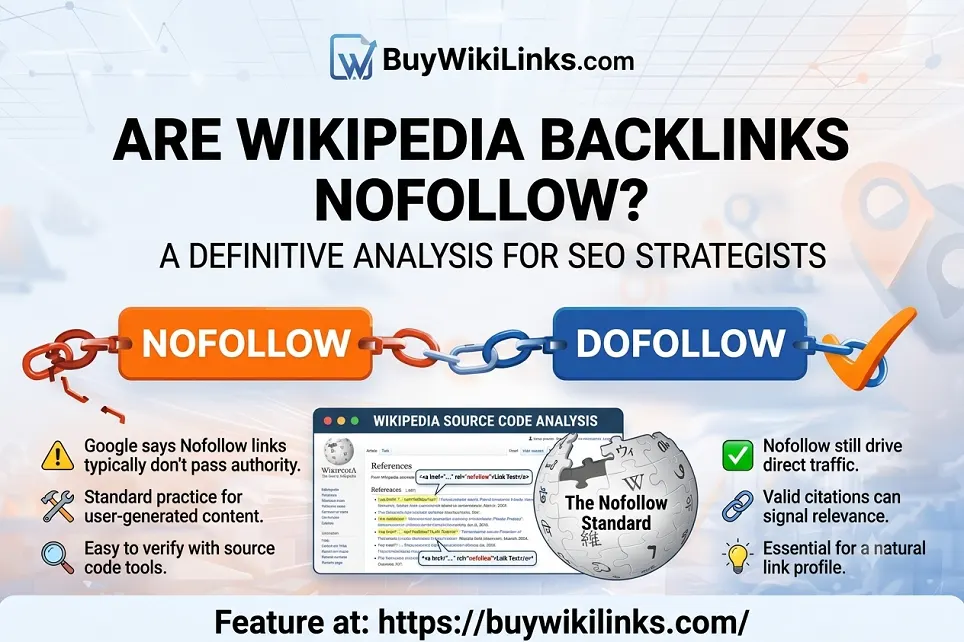
Wikipedia external links are generally marked with the HTML attribute:
rel="nofollow"
MediaWiki, the software used by Wikipedia, applies nofollow to external links by default as an anti-spam measure.
The attribute tells search engines that the link should not be treated like an ordinary editorial endorsement for ranking purposes.
Google currently treats attributes such as nofollow, ugc, and sponsored as signals or hints when evaluating links. However, Google also says links carrying these attributes generally will not be followed in the same way as ordinary unqualified links.
The practical conclusion is simple:
Do not purchase or pursue Wikipedia backlinks on the assumption that they will pass conventional PageRank or directly increase rankings.
Does Nofollow Mean the Link Has No Value?
No.
Nofollow limits the traditional ranking-credit expectation, but it does not prevent human users from clicking the link.
A relevant Wikipedia citation can still produce:
- Referral traffic
- Brand discovery
- Research visibility
- Journalist discovery
- Secondary citations
- Content validation
- Audience engagement
A nofollow link may also help search engines discover a URL, although the linked page can be discovered through many other methods, including sitemaps and links from other websites.
The important distinction is between:
- Direct ranking credit, which should not be promised
- Indirect business and visibility value, which may be measurable
Direct Ranking Value Versus Referral Value
SEO discussions often treat every backlink as a mechanism for transferring authority.
That is too narrow for Wikipedia Backlinks.
Direct Ranking Value
Direct ranking value refers to the possibility that a link will contribute to search-engine calculations that help the destination page rank.
Because Wikipedia external links are generally nofollow, no provider should promise:
- A specific ranking increase
- Higher Domain Authority
- A guaranteed trust score
- A fixed amount of link equity
- A particular keyword position
- Guaranteed indexing
- Protection from future algorithm updates
Third-party metrics such as Domain Authority, Domain Rating, Trust Flow, and Citation Flow are not official Google ranking scores.
A visible Wikipedia link does not guarantee that any of these metrics will increase.
Referral Value
Referral value comes from real users clicking the link.
A reader may click because they want to:
- Verify a statistic
- Read the complete research
- View original data
- Check a historical document
- Examine a technical report
- Read a full interview
- Find an official source
- Understand the topic in more depth
Referral traffic can be valuable even when the total number of visits is modest.
A niche citation that sends 100 highly relevant users may be more valuable than a general link that sends 5,000 visitors who immediately leave.
What Determines Referral Value?
The likely referral value depends on several factors.
Article traffic
A heavily visited article can create more opportunities for clicks.
However, popular pages also receive more editorial attention, making weak or unnecessary links more likely to be challenged.
Link relevance
The destination should answer the exact question raised by the citation.
A link about renewable-energy statistics should lead directly to the data, not to a general homepage or sales page.
Wikipedia Backlinks position
A reference supporting an important statement may receive more attention than a citation attached to a minor detail.
Reader intent
Readers checking a technical claim, historical fact, or original dataset may be highly motivated to visit the source.
Destination-page quality
A slow, cluttered, promotional, or difficult-to-read page may waste the opportunity.
The landing page should be:
- Fast
- Mobile friendly
- Clearly structured
- Free from intrusive pop-ups
- Focused on the cited information
- Transparent about authorship
- Easy to verify
- Stable over time
Brand Discovery
A Wikipedia citation may introduce a publication, research organization, company, or expert to readers who had not encountered it before.
This can matter when the source demonstrates genuine expertise.
For example, a reader may discover:
- A research institute through an original dataset
- A publisher through a historical archive
- A company through a technical specification
- A professional association through a standards document
- An expert through a specialist report
This discovery should result from the usefulness of the source—not from promotional anchor text or forced brand placement.
Wikipedia citations usually use neutral citation formatting rather than keyword-optimized commercial anchors.
Secondary-Link Opportunities
One of the most realistic indirect benefits of a Wikipedia citation is the possibility of earning links from other publishers.
Journalists, bloggers, students, researchers, and content creators often review Wikipedia references when researching a subject.
When they find a useful source, they may cite it in:
- News articles
- Research reports
- Blog posts
- Educational resources
- Industry guides
- Videos
- Newsletters
- Academic papers
- Reference pages
These secondary links may be ordinary followed links, depending on the publisher.
This opportunity is not guaranteed.
It depends on whether the source offers information worth citing independently of Wikipedia.
A weak sales page is unlikely to attract natural secondary references. A well-designed original study, public dataset, technical report, or historical archive has a much stronger chance.
Wikipedia as a Discovery Layer
Wikipedia should not be treated as the final purpose of a content strategy.
Instead, it can be viewed as one possible discovery layer within a larger research ecosystem.
The strongest source should be useful even if Wikipedia never links to it.
It should be capable of earning attention through:
- Search
- Journalism
- Academic research
- Industry newsletters
- Social sharing
- Professional communities
- Other websites
When a page exists only to obtain a Wikipedia backlink, its editorial value is usually weak.
Why Irrelevant Wikipedia Links Are Removed
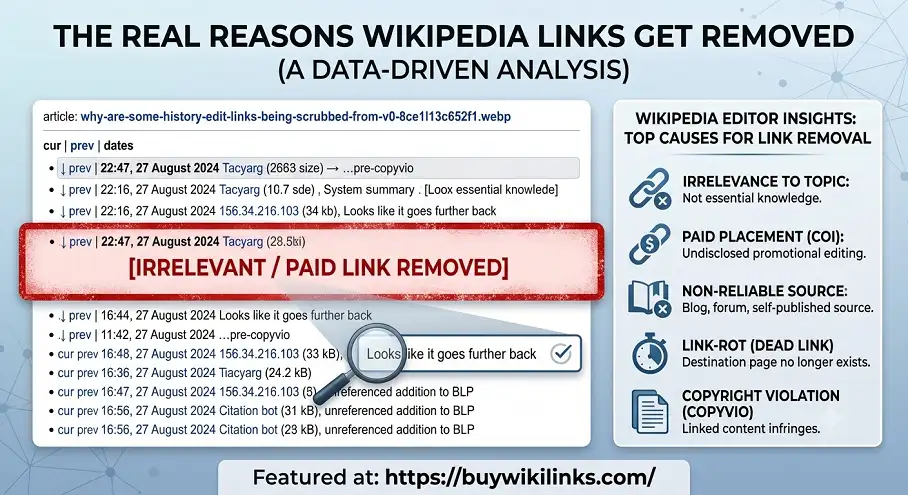
Wikipedia is continuously edited by volunteers.
A link may be removed within minutes, days, months, or years when an editor determines that it does not improve the article.
Common Wikipedia Backlinks removal reasons include:
- The link does not support the statement.
- The destination is promotional.
- The page primarily sells a product or service.
- A better source is available.
- The link is unrelated to the article.
- The source lacks editorial credibility.
- The same website is linked excessively.
- The URL contains affiliate or tracking parameters.
- The linked page has disappeared.
- The content has changed.
- The citation was inserted by someone with a conflict of interest.
- The link appears intended mainly for SEO.
- The source repeats information from another publisher.
- The page contains malware or copyright violations.
- The citation gives undue attention to a weak source.
A link does not become permanent because it has remained for several months.
Every citation remains open to future review.
Link Spam and Promotional Intent
Wikipedia distinguishes between adding useful sources and adding links primarily to promote a website.
Repeatedly inserting a domain across multiple articles may be interpreted as external-link spamming.
Warning signs include:
- Adding links only to one company’s website
- Replacing existing strong sources with commercial pages
- Using keyword-rich anchor text
- Adding unrelated links to high-traffic articles
- Creating new sentences mainly to justify a link
- Inserting the same resource across many pages
- Using multiple accounts to place or defend links
- Restoring removed links repeatedly
- Paying someone to insert links without disclosure
Google also identifies buying or selling links for ranking purposes as link spam.
Therefore, buying Wikipedia links specifically to manipulate search rankings can create risks under both Wikipedia’s editorial practices and Google’s spam policies.
What Makes a Source Citation-Worthy?
A citation-worthy source helps verify a specific claim and improves the reader’s understanding of the subject.
The following characteristics strengthen a source.
1. Direct Wikipedia Backlinks Relevance
The page should directly support the statement being cited.
If the Wikipedia statement concerns a 2025 market statistic, the source should clearly contain that statistic and explain its methodology.
Do not link to:
- A general homepage
- An unrelated blog category
- A service page
- A page that mentions the subject only briefly
- A page that requires the editor to infer the conclusion
2. Clear Authorship
The page should identify who created the content.
Helpful information includes:
- Author name
- Author qualifications
- Organization
- Editorial team
- Publication date
- Contact or corrections information
Anonymous content may be harder to evaluate, especially for technical or contentious claims.
3. Editorial Oversight
A credible publisher should demonstrate some process for reviewing and correcting information.
This may include:
- Named editors
- Fact-checking
- Corrections policy
- Methodology
- Peer review
- Source citations
- Publication standards
4. Original Value
The source should contribute something useful beyond rewriting information from other websites.
Examples include:
- Original research
- Public data
- Historical documents
- Expert analysis
- Technical specifications
- Survey results
- Complete transcripts
- Archival material
- Detailed statistics
- Investigative reporting
5. Transparent Methodology
For studies, surveys, rankings, or reports, explain:
- Data source
- Sample size
- Date range
- Collection method
- Definitions
- Limitations
- Calculation process
A number without a transparent method is harder to trust.
6. Wikipedia Backlinks Stability
The URL and content should remain available.
Avoid:
- Temporary campaign pages
- Expiring stories
- Session-based URLs
- Pages that change completely each month
- URLs dependent on tracking parameters
- Content accessible only after completing a sales form
When updating content, preserve old editions or provide archives so previous citations remain verifiable.
7. Accessible Evidence
Paywalled sources can be acceptable, but the publication details should be clear enough for verification.
For publicly accessible pages, reduce obstacles such as:
- Forced registration
- Aggressive pop-ups
- Automatic redirects
- Broken mobile layouts
- Geo-blocking
- Excessive advertising
8. Non-Promotional Purpose
A citation destination should exist primarily to inform, document, analyze, or preserve information.
Pages that primarily exist to sell a service are usually weak citation candidates.
Avoid using:
- Product pages
- Checkout pages
- Lead-generation landing pages
- Affiliate roundups
- Promotional guest posts
- Sponsored company profiles
- Keyword-stuffed SEO pages
9. Appropriate Source Type
Different claims require different sources for Wikipedia Backlinks.
An official company page may verify its own current executive title. It is not an independent source for claims of market leadership.
An original research report may be appropriate for its own data. An independent secondary publication may be stronger for explaining the significance of that research.
Review what counts as a reliable source on Wikipedia before proposing any citation.
How to Create Citation-Worthy Content
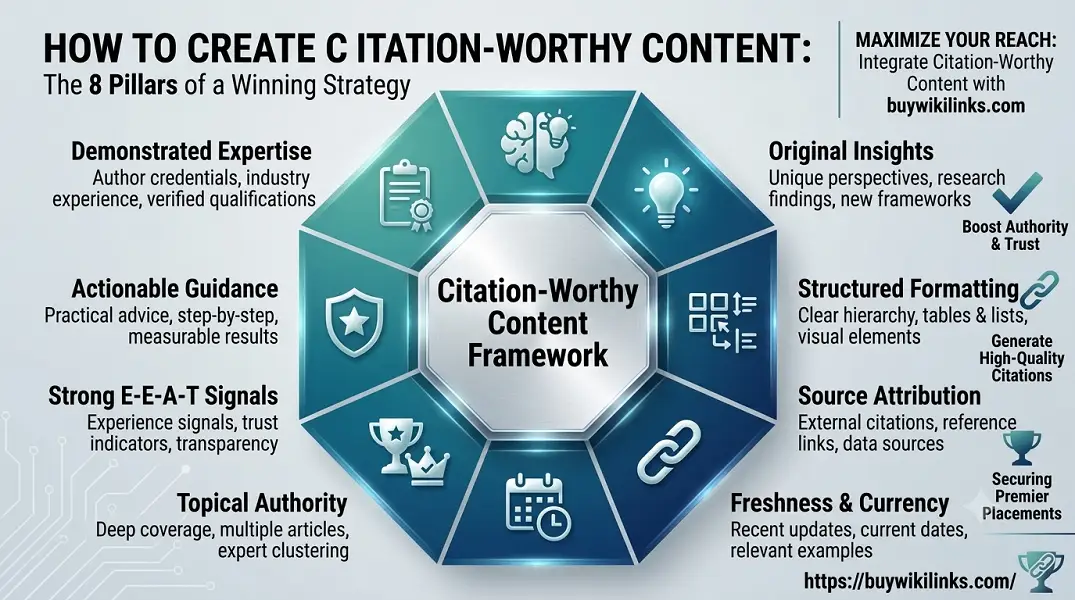
The goal should not be to create a page that looks as though it belongs in Wikipedia.
The goal should be to publish genuinely useful evidence.
Strong formats include:
Original research reports
Publish new findings with a clear methodology, sample, limitations, and downloadable data where appropriate.
Public datasets
Provide structured information that researchers can verify and reuse.
Industry statistics
Collect data that is difficult to find elsewhere and explain how the figures were calculated.
Historical archives
Digitize and organize documents, records, photographs, or timelines with accurate provenance.
Technical documentation
Publish specifications, standards, or detailed explanations written by qualified specialists.
Expert reference guides
Create comprehensive factual resources that answer a narrow question better than existing pages.
Transparent annual reports
Publish verifiable organizational data with defined metrics and historical comparisons.
Before pursuing a citation, use our guide on how to get backlinks from Wikipedia responsibly to understand the research and editorial process.
How to Measure Wikipedia Referral Traffic
A Wikipedia citation should be measured like a referral channel, not judged only by whether the link exists.
Google Analytics 4
In Google Analytics 4, review:
Reports → Acquisition → Traffic acquisition
Look for traffic sources containing:
wikipedia.orgen.wikipedia.org- Other language subdomains, such as
de.wikipedia.org - Wikimedia-related domains where relevant
Useful metrics include:
- Sessions
- Users
- Engaged sessions
- Engagement rate
- Average engagement time
- Key events or conversions
- Revenue
- Landing pages
- Geographic location
- Device type
Create a Referral Segment
Create a comparison or exploration segment for sessions where the referral source contains wikipedia.
This allows you to compare Wikipedia visitors with:
- Organic search visitors
- Social visitors
- Other referral traffic
- Paid traffic
- Direct traffic
Review Landing-Page Behavior
Check whether Wikipedia visitors:
- Read the cited page
- Visit related resources
- Download data
- Subscribe
- Contact the business
- Return later
- Leave immediately
A high bounce or low engagement rate may indicate that the destination does not match the citation context.
Track Meaningful Conversions
Choose conversions relevant to the content.
Examples include:
- Report downloads
- Newsletter subscriptions
- Demo requests
- Contact-form submissions
- Account registrations
- Dataset downloads
- Product purchases
- Citation requests
- Time spent on a research tool
Avoid judging the link only by session volume.
Use Server Logs
Server logs may help identify:
- Exact Wikipedia referrers
- Language editions
- Referral spikes
- Bot activity
- Frequently accessed files
- Visits not captured by analytics scripts
Monitor Secondary Links
Use backlink-monitoring tools or Search Console’s link report to identify whether other publishers begin linking to the cited resource.
Do not assume every new link was caused by Wikipedia. Look at publication dates, referral patterns, and surrounding context.
Monitor Brand Search
After earning legitimate editorial visibility, track whether there are changes in:
- Branded search impressions
- Branded clicks
- Searches for report titles
- Searches for named authors
- Direct traffic
- Mentions by other publishers
These changes may have many causes, so treat them as supporting indicators rather than proof of a direct Wikipedia effect.
A Practical Measurement Framework
Measure Wikipedia backlink performance in four categories.
| Category | Example Metrics |
|---|---|
| Visibility | Citation remains live, article views, reference position |
| Traffic | Sessions, users, engaged sessions, landing-page visits |
| Business value | Leads, registrations, downloads, sales |
| Secondary impact | New mentions, earned links, branded searches |
Review performance over several months rather than after only a few days.
Realistic Expectations for Wikipedia Backlinks
A responsible strategy should begin with realistic expectations.
Expect no guaranteed ranking improvement
Wikipedia’s nofollow links should not be sold as guaranteed ranking assets.
Expect editorial review
Any editor may examine, replace, or remove the source.
Expect the citation to serve readers
The source must help verify or explain article content.
Expect traffic to vary
Some links send regular traffic. Others receive very few clicks.
Expect relevance to matter more than domain authority
A relevant citation on a specialized page can outperform a poorly matched link on a high-traffic article.
Expect strong content to do most of the work
The source must remain useful after the backlink is removed.
Expect no permanence
Wikipedia articles, references, and external links change over time.
Expect no control over anchor text
Citation formatting is determined by editorial conventions, not keyword targets.
Expect no endorsement
The presence of a source does not mean Wikipedia recommends the publisher.
Expect indirect value to be difficult to isolate
Brand discovery, journalist attention, and secondary links may develop gradually and cannot always be attributed to one citation.
Wikipedia Backlink Myths
Myth: Every Wikipedia link improves rankings
There is no guaranteed direct ranking benefit.
Myth: A high-authority domain passes authority through every link
Link attributes, relevance, page context, and search-engine evaluation all matter.
Myth: Old Wikipedia links are permanent
Any source may be reviewed or replaced later.
Myth: An administrator can protect a commercial link
Administrator permissions do not create ownership or editorial immunity.
Myth: More Wikipedia links are always better
Repeated domain insertion can look promotional and increase removal risk.
Myth: Any original study deserves a citation
The study must be relevant, methodologically transparent, useful, and appropriate for the specific claim.
Myth: A Wikipedia citation guarantees other media coverage
It may help discovery, but secondary coverage is never guaranteed.
Frequently Asked Questions
What is a Wikipedia backlink?
It is an external hyperlink from a Wikipedia page to another website. It may appear as a reference, official link, or supplementary external resource.
Are Wikipedia backlinks nofollow?
Wikipedia external links are generally assigned the nofollow attribute through MediaWiki.
Do Wikipedia backlinks improve SEO?
They may produce referral traffic, brand discovery, and secondary-link opportunities. A direct ranking improvement should not be guaranteed.
Do nofollow links have any value?
Yes. People can still click them, discover the source, cite it elsewhere, subscribe, download resources, or become customers.
What is the difference between a reference and an external link?
A reference verifies a statement in the article. An external link provides useful supplementary material beyond the article.
Can a company website be cited on Wikipedia?
It may be used for limited official facts about the company. It is generally weak for independent claims about importance, reputation, or market leadership.
Can a product page receive a Wikipedia backlink?
A sales-focused product page is usually a poor candidate. A technical specification or official documentation page may be appropriate for a narrow factual claim.
Why was my Wikipedia link removed?
Possible reasons include irrelevance, promotional intent, weak sourcing, duplicate citations, link spam, a better available source, or failure to support the statement.
Can I add my own website as a source?
A person with a conflict of interest should act cautiously. A transparent talk-page suggestion allows independent editors to evaluate whether the source is appropriate.
Can I buy Wikipedia backlinks?
Buying links primarily to manipulate rankings conflicts with Google’s link-spam guidance and can result in removal or account scrutiny on Wikipedia. A safer service evaluates whether an existing resource genuinely merits citation.
Are image backlinks more permanent?
No Wikipedia link should be described as permanent. Images, file descriptions, attribution, licensing, and associated links may all be reviewed or changed.
How can I track Wikipedia traffic?
Use Google Analytics 4 referral reports, landing-page analysis, conversion tracking, and server logs.
How long does a Wikipedia backlink last?
There is no guaranteed lifespan. A legitimate citation may remain for years, while an unsuitable link may be removed quickly.
How many Wikipedia backlinks should a website have?
There is no target number. Each source should independently justify its inclusion in a relevant article.
Final Thoughts
Wikipedia backlinks have real value, but that value is often different from what traditional link-building sellers promise.
A Wikipedia link is generally nofollow. It should not be purchased or pursued as a guaranteed method of passing PageRank, increasing Domain Authority, or achieving a specific Google position.
Its more realistic value may come from:
- Relevant referral traffic
- Brand and publisher discovery
- Exposure to researchers and journalists
- Secondary editorial links
- Verification of useful original information
- Long-term visibility for high-quality resources
The strongest strategy is to create content worth citing before looking for a Wikipedia opportunity.
A citation-worthy resource should be:
- Directly relevant
- Transparent
- Well researched
- Methodologically clear
- Stable
- Non-promotional
- Properly authored
- Useful beyond Wikipedia
The citation should improve the encyclopedia and help readers verify a claim.
When the primary goal is to manipulate rankings or insert a commercial URL, the link is unlikely to be sustainable.
Request a Citation-Worthiness Assessment
Do you have a research report, dataset, technical guide, historical archive, expert resource, or original publication that may be useful as a Wikipedia source?
A citation-worthiness assessment can evaluate:
- Whether the page directly supports a verifiable claim
- Source reliability
- Author and publisher transparency
- Editorial oversight
- Methodology
- Original value
- Promotional risk
- Link stability
- Relevant Wikipedia coverage
- Existing citation gaps
- Conflict-of-interest concerns
- Whether a talk-page suggestion may be appropriate
Request a citation-worthiness assessment and provide:
- The destination URL
- Author and publisher information
- Publication date
- Research methodology
- The Wikipedia topic or article
- The exact claim the page supports
- Your relationship with the website
- Any previous edit or link-removal history
The assessment does not guarantee placement. It determines whether the resource has a legitimate editorial purpose and recommends the safest next step.
