
 Buy Wikipedia Backlinks Image Link Insert For SEO - Buy Wikipedia Backlinks (Permanent)
 Wikipedia Backlinks
Should You Buy Wikipedia Backlinks? Risks, Costs and Safer Alternatives
Jul
Should You Buy Wikipedia Backlinks? Risks, Costs and Safer Alternatives
Businesses searching for ways to improve authority, visibility, and referral traffic often consider whether they should buy Wikipedia backlinks.
The offer can sound attractive.
A seller may promise a link from an established Wikipedia article, quick delivery, permanent placement, increased domain authority, better Google rankings, and access to an old or trusted editing account.
The reality is much less predictable.
You can pay a consultant to evaluate your source, research relevant articles, identify citation gaps, improve the quality of your publication, and prepare a transparent suggestion for independent editors.
You cannot legitimately purchase permanent ownership of a Wikipedia citation or guarantee that a volunteer community will keep a commercial link.
A paid link may be removed immediately or reviewed months later. Repeated promotional insertion can lead to account blocks, domain blacklisting, public scrutiny, and wasted spending. Buying links primarily to manipulate search rankings may also conflict with Google’s link-spam policies.
The safer question is not:
Where can I buy a Wikipedia link?
It is:
Does my website publish information that independently deserves to be cited?
This guide explains why businesses seek paid Wikipedia links, how legitimate citations differ from purchased placements, which seller promises to avoid, what risks buyers face, and what an ethical citation consultant can actually provide.
Quick Answer: Should You Buy Wikipedia Backlinks?
You should not buy Wikipedia backlinks as guaranteed link placements intended mainly to manipulate rankings.
A Wikipedia citation must have an editorial reason to exist. It should verify a statement, provide reliable evidence, or direct readers to highly relevant supplementary information.
A legitimate service may help you:
- Evaluate whether a page is citation-worthy
- Improve source transparency
- Research relevant Wikipedia topics
- Identify claims that require better references
- Prepare a neutral citation suggestion
- Disclose conflicts of interest
- Submit a talk-page request for independent review
- Track referral traffic after an editor accepts a source
A legitimate service should not promise:
- Guaranteed placement
- Permanent links
- Guaranteed Google rankings
- Guaranteed Domain Authority growth
- Administrator protection
- Secret account insertion
- Control over anchor text
- Immunity from future removal
- Placement on any requested article
- Unlimited links from one domain
You should pay for research, source evaluation, content improvement, and consultation—not for an editorial outcome that no seller can permanently control.
Why Businesses Search for Paid Wikipedia Links
Wikipedia is widely used as a starting point for online research.
Its articles frequently appear in search results and are consulted by:
- Journalists
- Researchers
- Students
- Bloggers
- Publishers
- Industry professionals
- Customers
- Investors
- Content creators
A relevant citation may therefore produce benefits such as:
- Referral traffic
- Brand discovery
- Exposure to researchers
- Secondary editorial links
- Increased visibility for original research
- Recognition of a useful public resource
These potential benefits explain why businesses search for terms such as:
- Buy Wikipedia backlinks
- Buy Wikipedia link
- Wikipedia backlink service
- Wikipedia link insertion
- Get a Wikipedia citation
- Wikipedia backlinks for SEO
The problem begins when the business treats Wikipedia as an advertising inventory or paid link marketplace.
Wikipedia is not designed to provide links based on who pays the most. Links are expected to improve the encyclopedia and help readers verify information.
Why Paid Wikipedia Backlink Offers Seem Attractive
A seller may reduce a complicated editorial process to a simple commercial offer:
- Submit your URL.
- Choose a target article.
- Select anchor text.
- Pay a fixed fee.
- Receive a live link.
This process resembles ordinary guest-post or niche-edit link building. It does not reflect how Wikipedia citations are supposed to work.
The seller may not evaluate:
- Whether the source is reliable
- Whether the page directly supports the claim
- Whether the publisher is independent
- Whether the insertion gives the source undue weight
- Whether a stronger source already exists
- Whether the contributor has a conflict of interest
- Whether the addition changes the article merely to create a link
The link may become live temporarily, but temporary visibility is not the same as legitimate editorial acceptance.
A Valid Wikipedia Citation Versus Paid Link Placement
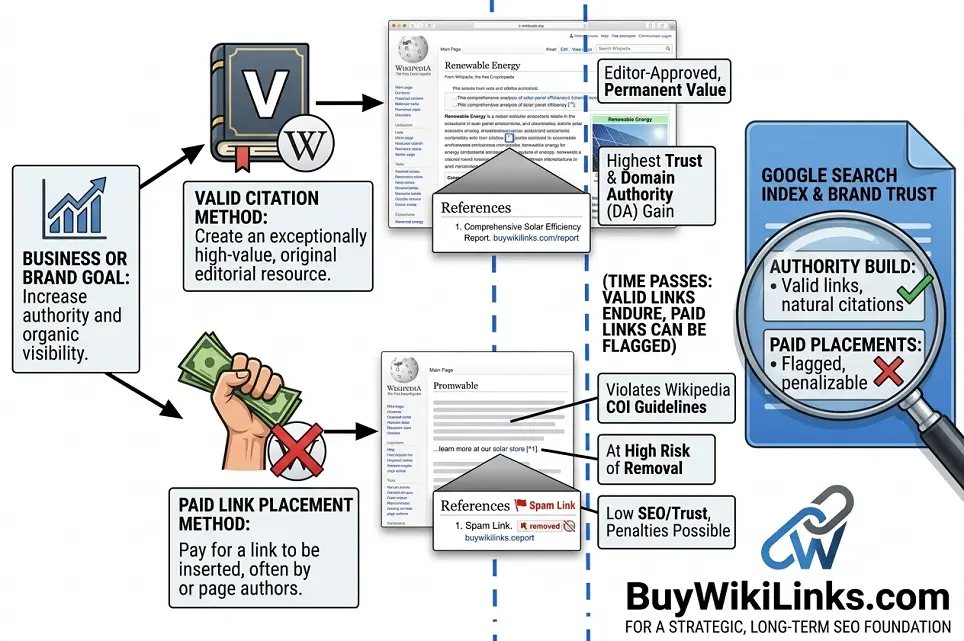
Understanding this difference is essential before purchasing any Wikipedia-related service.
What Is a Valid Citation?
A valid citation is added because it supports information in the article.
For example, a Wikipedia article may state:
The region generated 38 percent of its electricity from renewable sources in 2025.
A strong citation would lead to a reliable report containing that statistic, its date, its methodology, and the organization responsible for collecting the data.
The source has a reason to appear because it verifies the statement.
A valid citation should normally be:
- Directly relevant
- Accurate
- Reliable for the claim
- Properly attributed
- Stable
- Non-deceptive
- Useful to readers
- Proportionate to the source’s importance
What Is Paid Link Placement?
Paid placement begins with the commercial goal of obtaining a backlink.
The seller may:
- Find a loosely related sentence
- Add a new sentence mainly to justify the link
- Replace an existing reference
- Insert the link in an External links section
- Add the same domain to several articles
- Use a file or image page as a link location
- Choose a high-traffic page rather than the most relevant one
- Use a requested commercial anchor
In this process, the editorial purpose is secondary to the backlink sale.
That distinction affects sustainability.
A source chosen because it is the best evidence for a statement is easier to defend. A source inserted because someone paid for the URL is more vulnerable to removal.
Citation Assessment Is Not Placement
A citation consultant may determine that:
- The source is appropriate.
- The source needs improvement.
- The source is reliable only for a narrow fact.
- A different page on the website is stronger.
- The resource is too promotional.
- The Wikipedia article does not need the proposed citation.
- No ethical opportunity currently exists.
A link seller begins with a promise to place the link.
A legitimate consultant begins with an assessment of whether it belongs.
That willingness to say “no suitable opportunity exists” is one of the clearest differences between consultation and placement selling.
Wikipedia References Versus External Links
Paid sellers may offer a reference link, an external link, or an image link. These are not interchangeable.
Reference links
A reference verifies a claim in an article.
The linked source must directly support the relevant wording.
External links
An External links section provides a limited number of highly relevant resources offering meaningful information beyond the article.
It should not become a directory of related businesses, websites, or services.
Official website links
An article about an organization may include its official website in an infobox or External links section. This does not mean every related company, partner, consultant, or product page qualifies.
Image and file links
A link associated with an image, attribution, source page, or Wikimedia Commons file must have a legitimate licensing, attribution, or informational purpose.
Using file pages merely to create backlinks does not make the link permanent or editorially protected.
For a fuller explanation, read our guide to Wikipedia backlinks and their real SEO value.
Wikipedia Citation-Spam Rules
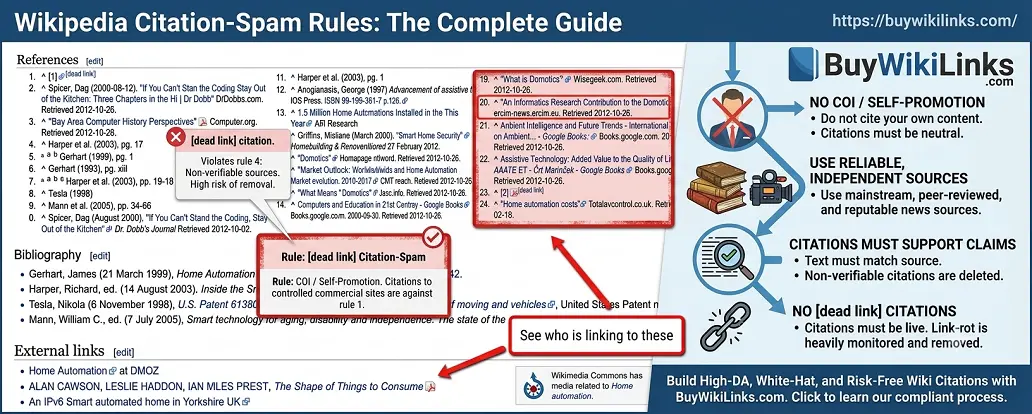
Wikipedia considers links added primarily to promote a website, product, organization, or individual to be spam.
A link can be considered promotional even when:
- The destination contains some useful information.
- The sentence is factually accurate.
- The page is related to the topic.
- The link uses neutral anchor text.
- The contributor has an old account.
- The source has previously appeared on Wikipedia.
The contributor’s pattern and purpose matter.
Common Citation-Spam Patterns
Warning signs include:
- Adding links mainly to one domain
- Inserting the same website across many articles
- Targeting high-traffic pages regardless of relevance
- Replacing stronger sources with a client’s page
- Restoring links after other editors remove them
- Adding new text primarily to create a citation opportunity
- Using several accounts to insert or defend links
- Hiding a paid relationship
- Linking to sales or lead-generation pages
- Using keyword-focused anchor text
- Creating citations that do not support the attached claim
Wikipedia may warn editors who add external links to many pages rapidly. Persistent domain promotion may lead to the domain being added to a spam blacklist, preventing the URL from being added across Wikimedia projects.
A Useful Link Can Still Be Spam
The fact that a website contains accurate information does not automatically justify adding it.
Editors may prefer another source because it is:
- More independent
- More authoritative
- More detailed
- More stable
- Less commercial
- Closer to the original evidence
- Better aligned with the article’s existing sourcing
A citation should not be added merely because it is possible to find a sentence that the page supports.
The source should materially improve verification or replace a weaker reference.
Conflict of Interest
A business owner, employee, agency, SEO consultant, or paid link provider has a conflict of interest when proposing the client’s website.
Directly inserting the link without disclosure may create additional concerns.
A safer process is to:
- Disclose the relationship.
- Identify the exact claim the source supports.
- Explain why the source improves the article.
- Propose the citation on the talk page.
- Allow an independent editor to decide.
Disclosure does not guarantee acceptance, but it makes the process transparent.
Google’s Paid-Link Policies
Google distinguishes ordinary editorial links from links created through payment or another exchange of value.
Its spam policies identify buying or selling links for ranking purposes as link spam.
Examples may include:
- Paying for links
- Exchanging products or services for links
- Paying someone to insert links into existing content
- Using advertorials or native advertising that pass ranking credit
- Participating in excessive link exchanges
- Creating links mainly to manipulate rankings
Google recommends qualifying paid outbound links with attributes such as rel="sponsored" or rel="nofollow".
Wikipedia external links are generally nofollow, which reduces the traditional expectation of direct PageRank transfer.
However, nofollow does not turn manipulative placement into a safe strategy.
A campaign may still:
- Violate Wikipedia’s anti-spam standards
- Waste money on temporary links
- Create an unnatural promotional pattern
- Expose the domain to editor scrutiny
- Encourage risky account behavior
- Mislead the buyer about SEO outcomes
Read Google’s official spam policies for web search before purchasing links for ranking purposes.
Nofollow Does Not Mean Risk-Free
Some sellers argue that buying a Wikipedia backlink is safe because the link is nofollow.
This misunderstands the issue.
The nofollow attribute primarily affects how search engines interpret the link. It does not decide whether the link belongs in Wikipedia.
An irrelevant or commercially motivated nofollow link may still be:
- Removed
- Reverted
- Reported
- Blacklisted
- Connected to a blocked account
- Publicly discussed as spam
The editorial risk remains even when direct ranking credit is limited.
No Guaranteed SEO Outcome
A seller should not guarantee that a Wikipedia backlink will:
- Increase rankings
- Raise Domain Authority
- Raise Domain Rating
- Increase Trust Flow
- Increase Citation Flow
- Produce a Knowledge Panel
- Improve indexing
- Protect a site from algorithm updates
- Generate a specific amount of traffic
Domain Authority and similar scores are third-party metrics, not official Google ranking scores.
A link may produce referral or discovery value, but its exact effect cannot be isolated or guaranteed.
Common Seller Promises to Avoid
Commercial backlink offers frequently use claims that sound reassuring but cannot be controlled.
“Permanent Wikipedia Backlink”
No Wikipedia link is permanent.
Any editor may later review:
- Source quality
- Relevance
- Link purpose
- Citation accuracy
- Contributor behavior
- The destination’s current content
The page may also be merged, redirected, rewritten, or deleted.
“Guaranteed Placement”
A seller can guarantee that they will attempt or temporarily complete an edit.
They cannot guarantee long-term community acceptance.
Ask whether “guaranteed” means:
- The edit will be submitted
- The link will remain for seven days
- The seller will replace a removed link
- The link will remain permanently
These are very different promises.
“Old Admin Account Placement”
Administrator status does not make a source reliable or a link editorially necessary.
Administrators do not own articles. Their actions can be reviewed and reversed by other contributors.
Purchased, shared, or compromised accounts create additional security and conduct risks.
“High-Authority Link Juice”
Wikipedia links are generally nofollow.
Claims of guaranteed PageRank, authority transfer, or measurable ranking growth should be treated cautiously.
“No Risk of Removal”
Every citation can be challenged.
A seller cannot control future editors, content changes, blacklists, article restructuring, or source replacement.
“Image Links Are Permanent”
Image and file pages are also subject to licensing checks, attribution requirements, deletion, replacement, and editorial review.
An image location is not a loophole providing permanent SEO ownership.
“We Can Use Your Preferred Anchor Text”
Wikipedia citations do not exist to target commercial keywords.
The visible citation format should follow article and source conventions, not the buyer’s SEO anchor plan.
“Unlimited Replacements”
Replacement guarantees may encourage the seller to keep inserting the same domain into different pages after removal.
This can make the promotional pattern more visible and increase blacklisting risk.
“100 Percent Google-Safe”
No independent seller can guarantee how Google will evaluate a link campaign.
Google’s policies and ranking systems are controlled by Google—not by a Wikipedia editing service.
Review our guide to warning signs associated with questionable Wikipedia service providers before purchasing any placement.
The Real Cost of Buying Wikipedia Backlinks
The visible seller fee is only one part of the cost.
Placement Fee
The buyer may pay a one-time price for:
- One reference link
- One External links placement
- One image or file link
- Several links
- A replacement guarantee
A low price does not reduce the editorial risk.
Replacement Costs
When a link is removed, the seller may charge for:
- A different article
- A revised destination page
- Another account
- A new citation sentence
- A new image placement
Repeated replacements can turn an inexpensive purchase into an ongoing expense.
Content Creation Costs
A seller may ask the buyer to publish:
- A new research article
- A statistics page
- A rewritten guide
- A press article
- A sponsored feature
Creating better content can be worthwhile. Creating superficial content solely to justify a paid link is less likely to produce sustainable value.
Reputation Costs
Public discovery of undisclosed paid placement may damage trust in:
- The website
- The company
- The agency
- The cited research
- Future edit requests
Opportunity Costs
Money spent chasing temporary links could instead fund:
- Original research
- A public dataset
- Digital PR
- Expert content
- Journalist outreach
- Technical documentation
- Industry reporting
- Earned media
These assets can attract links from Wikipedia and many other publishers without depending on one platform.
Measurement Costs
A link that remains live but sends no relevant traffic may provide little practical return.
Buyers should consider:
- Referral visits
- Engagement
- Leads
- Downloads
- Secondary links
- Brand searches
The presence of a link alone is not proof of business value.
Link-Removal Risks
A purchased link may be removed for several reasons.
The Source Does Not Support the Claim
The page may mention the topic without verifying the exact sentence.
A Better Source Exists
Editors may replace a commercial, primary, or low-quality source with a stronger publication.
The Destination Becomes Promotional
A useful research page may later be redesigned as a sales page, causing editors to reconsider it.
The Link Creates Undue Weight
The citation may give a small study, company, or viewpoint more prominence than reliable coverage justifies.
The Contributor Has a Promotional Pattern
Editors may review other additions made by the same account and remove related links.
The Domain Is Overused
Repeated citations to one website can appear promotional, even when individual links seem relevant.
The Article Changes
The sentence supported by the source may be removed, merged, rewritten, or moved.
The URL Breaks
Pages can disappear, redirect, require login, or lose the cited information.
No seller can eliminate these risks.
Account and Domain Risks
Paid insertion can create consequences beyond one removed link.
Account Warnings
An editor may receive warnings for external-link spamming or conflict-of-interest behavior.
Account Blocks
Persistent promotion, deceptive accounts, or repeated restoration of removed links may lead to blocks.
Domain Blacklisting
A repeatedly spammed domain may be added to a blacklist, preventing its links from being saved.
Wider Link Review
Editors may inspect and remove other citations from the same website.
A campaign intended to gain more links may therefore cause legitimate existing references to receive additional scrutiny.
Public Discussions
Link disputes, blacklist requests, and editor investigations may become part of Wikipedia’s public record.
What a Legitimate Citation Consultant Can Do
A professional citation consultant should not begin by guaranteeing placement.
The consultant can provide research and analysis in areas they control.
Citation-Worthiness Assessment
The consultant can determine whether the source is:
- Reliable for the claim
- Directly relevant
- Properly authored
- Editorially transparent
- Stable
- Non-promotional
- Better than existing references
- Appropriate for a talk-page suggestion
Destination-Page Audit
The consultant can review:
- Author information
- Publication date
- Methodology
- Citations
- Corrections policy
- Page stability
- Advertising
- Lead-generation elements
- Technical accessibility
- Mobile usability
Wikipedia Topic Research
The consultant can identify:
- Articles covering the subject
- Claims needing better evidence
- Existing weak citations
- Dead links
- Relevant discussions
- Previous link removals
- Conflict-of-interest concerns
Source Improvement Recommendations
The consultant may recommend:
- Adding a named author
- Publishing methodology
- Citing underlying evidence
- Removing exaggerated claims
- Preserving archived editions
- Separating research from sales content
- Providing downloadable data
- Adding correction and editorial policies
Transparent Citation Suggestions
When appropriate, the consultant can prepare a talk-page request that:
- Discloses the commercial relationship
- Identifies the exact statement
- Explains what the source verifies
- Provides neutral citation details
- Leaves the decision to independent editors
Measurement and Reporting
After independent acceptance, the consultant can help measure:
- Referral traffic
- Engagement
- Downloads
- Leads
- Secondary links
- Brand searches
A legitimate consultant sells analysis and professional preparation—not guaranteed link ownership.
Building Genuinely Citable Resources
The safest alternative to buying placements is publishing information that deserves independent citation.
Original Research
Publish a well-designed study with:
- A clear question
- Transparent methodology
- Sample details
- Data collection dates
- Limitations
- Full results
- Named authors
- Supporting files
Public Data
Create a dataset that is:
- Accurate
- Downloadable
- Regularly updated
- Clearly licensed
- Easy to verify
- Useful to researchers
Industry Reports
A strong report should provide more than opinions to buy Wikipedia backlinks.
Include:
- Original statistics
- Defined terms
- Comparison periods
- Source notes
- Charts
- Methodology
- Limitations
Historical Archives
Digitize material such as:
- Documents
- Records
- Photographs
- Catalogues
- Timelines
- Maps
- Public-domain publications
Explain the provenance and preservation process.
Technical Documentation
Publish stable documentation that helps verify:
- Specifications
- Standards
- Software behavior
- Engineering methods
- Protocols
- Product history
Expert Reference Guides
A reference guide should be factual, focused, and supported by authoritative evidence.
Avoid turning it into a sales article with a short factual section added only for citation purposes.
Separate Editorial and Commercial Content
A research report is more credible when it does not immediately push readers toward:
- Product checkout
- Aggressive contact forms
- Affiliate offers
- Sales calls
- Promotional pop-ups
Commercial organizations can publish valuable research, but the resource should stand on its own.
Read How to Get Backlinks from Wikipedia Responsibly for a source-first approach.
Safer Alternatives to Buying Wikipedia Links
Digital PR
To buy Wikipedia backlinks, pitch original research and expert analysis to journalists who may link editorially.
Data-Led Content
Create statistics, tools, maps, indexes, or reports that publishers can reference.
Expert Commentary
Provide useful, non-promotional expertise to reputable publications.
Broken-Link Replacement
Identify dead citations and recommend a genuine equivalent only when your source reproduces or improves the missing evidence.
Do not create a superficial replacement merely to capture the link.
Resource-Page Outreach
Contact relevant universities, associations, libraries, and publishers when your content genuinely complements their resource collections.
Academic and Industry Publishing
Publish through appropriate journals, conference proceedings, standards bodies, and respected trade outlets.
Improve Existing Earned Mentions
When independent articles mention your research without linking, politely ask whether the publisher would consider linking to the original source.
These methods may produce followed links, referral traffic, and broader visibility beyond Wikipedia.
Provider Due-Diligence Checklist to buy Wikipedia backlinks
Use this checklist before hiring a Wikipedia backlink or citation provider.
Service Definition
- Does the provider sell placement or consultation?
- Is the deliverable clearly described?
- Can the provider recommend no placement?
- Does it distinguish a citation from an External links entry?
Source Evaluation
- Will the provider review reliability?
- Will it check whether the source supports the claim?
- Will it evaluate promotional content?
- Will it compare the source with existing references?
- Will it identify stronger alternatives?
Transparency to buy Wikipedia backlinks
- Will the provider disclose the paid relationship?
- Will it use a talk-page request where appropriate?
- Will it provide the Wikipedia account name?
- Does it avoid purchased or shared accounts?
- Does it avoid multiple deceptive accounts?
Claims and Guarantees
- Does it avoid permanent-link promises?
- Does it avoid guaranteed ranking claims?
- Does it avoid guaranteed authority-score claims?
- Does it explain nofollow?
- Does it acknowledge removal risk?
Editorial Process
- Will you review the exact proposed wording?
- Will the citation be attached to a verifiable claim?
- Will the provider avoid preferred commercial anchor text?
- Will independent editors make the final decision?
- Is the process documented?
Replacement Policy
- What happens if the link is removed?
- Will the provider repeatedly insert the domain elsewhere?
- Does the replacement policy encourage spam?
- Will it explain why the first link was removed?
- Can you stop instead of escalating risky edits?
Reporting
- Will you receive a citation audit?
- Will you receive the proposed source and article?
- Will you receive disclosure wording?
- Will you receive traffic-measurement guidance?
- Are all fees explained before work begins?
Warning Signs
Avoid providers advertising:
- Permanent Wikipedia backlinks
- Guaranteed Wikipedia links
- Admin-protected links
- Secret placement
- Aged-account immunity
- Any anchor text you choose
- Instant Domain Authority increases
- Guaranteed Google rankings
- Zero removal risk
- Unlimited replacements
Frequently Asked Questions
Can you buy Wikipedia backlinks?
Sellers may offer paid link insertion, but purchasing a link does not create permanent editorial acceptance. To buy Wikipedia backlinks, the safer service is citation research and consultation without guaranteed placement.
Is buying a Wikipedia link against Google’s rules?
Buying links primarily to manipulate search rankings can fall under Google’s link-spam policies.
Are Wikipedia backlinks nofollow?
Wikipedia external links are generally nofollow. They may still generate referral traffic and discovery, but conventional PageRank transfer should not be guaranteed.
Can a paid Wikipedia link improve rankings?
No provider can guarantee a ranking improvement. The link may have referral or indirect discovery value, but the direct SEO effect is uncertain.
How much does a Wikipedia backlink cost?
To buy Wikipedia backlinks, seller fees vary by placement type, article, replacement policy, and claimed account access. The visible fee does not include removal, replacement, reputation, or opportunity costs.
Are permanent Wikipedia links possible?
A legitimate citation may remain for years, but no one can guarantee permanence. Every link remains subject to future editorial review.
Can an administrator guarantee a backlink?
No. Administrator status does not create article ownership or make a commercial source necessary.
Why are Wikipedia backlinks removed?
Common reasons include irrelevance, weak sourcing, failure to support the claim, promotional intent, conflict of interest, repetitive domain placement, or availability of a stronger source.
Can I suggest my own website as a citation?
Yes, but disclose your relationship and avoid direct insertion when you have a conflict of interest. A talk-page suggestion allows independent review.
What content is most likely to be citation-worthy?
Original research, transparent datasets, historical archives, technical documentation, reputable reporting, and stable expert references are stronger candidates than sales pages.
Can sponsored articles become Wikipedia sources?
Sponsored content is not independent and may be weak for many purposes. Its suitability depends on the claim, but it should not be misrepresented as independent editorial coverage.
What should I buy instead to buy Wikipedia backlinks?
Consider a source audit, citation-worthiness assessment, research-content improvement, Wikipedia topic analysis, and a transparent citation suggestion.
Can a consultant guarantee that an editor will accept the source?
No. Independent editors make the final decision.
Final Verdict
Should you buy Wikipedia backlinks?
Do not purchase them as guaranteed, permanent SEO placements.
That model creates several risks:
- The source may not be editorially appropriate.
- The link may be removed.
- The editing account may be warned or blocked.
- The domain may receive wider spam scrutiny.
- The placement may violate Google’s paid-link principles when intended to manipulate rankings.
- The link may produce no meaningful referral traffic.
- Replacement attempts may increase the risk rather than solve it.
A safer approach is to invest in:
- Original research
- Public data
- Technical resources
- Historical archives
- Independent reporting
- Source-quality improvements
- Transparent citation assessment
- Editorially appropriate talk-page suggestions
The objective should not be to force a backlink into Wikipedia.
It should be to create a source that researchers, journalists, publishers, and independent Wikipedia editors can reasonably choose to cite.
Request a Source and Citation Consultation
Do you have a report, dataset, guide, archive, technical document, or research page that may be useful as a Wikipedia source?
Our source and citation consultation can evaluate:
- Source reliability
- Direct relevance
- Author and publisher transparency
- Methodology
- Editorial quality
- Promotional risk
- Page stability
- Existing Wikipedia citations
- Relevant article opportunities
- Conflict-of-interest requirements
- Talk-page suggestion options
- Referral-traffic measurement
Request a source and citation consultation and provide:
- Your website URL
- The proposed source page
- Author and publisher details
- Publication date
- Research methodology
- Relevant Wikipedia topic
- The exact claim the source supports
- Your relationship with the website
- Any previous placement or removal history
The consultation does not guarantee placement to buy Wikipedia backlinks. It determines whether the source has a legitimate editorial use and recommends the safest next step.
