
Wikipedia Backlinks
What Makes a Website Reliable Enough to Be Cited on Wikipedia?

Jul
Website Reliable Enough to Be Cited on Wikipedia
Website owners often ask how to become a Wikipedia source after seeing newspapers, research institutes, academic publications, government websites, and specialist publishers cited throughout Wikipedia.
Some assume that a website needs high traffic, a strong domain authority score, an old domain, or a large social media following.
Those factors do not automatically make a website reliable.
Wikipedia evaluates sources according to the claim being supported and the processes behind the publication. Editors may consider the publisher’s reputation, editorial oversight, fact-checking, author expertise, independence, transparency, and history of accuracy.
A website may be reliable for one type of information and unsuitable for another.
For example:
- A company website may verify its official product name.
- It may not independently prove that the product is an industry leader.
- A scientist’s personal website may confirm their own published research interests.
- It may not be appropriate for contentious claims about another living person.
- A trade publication may be useful for industry developments.
- It may be unsuitable when an article was supplied or paid for by the company being discussed.
Becoming citation-worthy therefore requires more than publishing a long article.
A credible website should demonstrate that its information is researched, reviewed, attributable, correctable, transparent, and appropriate for the specific claim it is being used to support.
This guide explains the difference between popularity and reliability, the importance of editorial control and author credentials, why independence matters, which websites Wikipedia commonly rejects, and how to audit your own publisher credibility.
What Does “Reliable Source” Mean on Wikipedia?
A reliable source is a published source that can reasonably be trusted for the particular statement it supports.
Wikipedia’s reliable-sources guideline explains that reliability depends on the source, the context, and the claim. A source is not universally reliable for every possible use.
Editors may examine:
- The publisher
- The author
- The publication process
- Editorial review
- Fact-checking
- Subject expertise
- Independence
- Supporting evidence
- Corrections history
- Whether the content is news, opinion, advertising, or user-generated
- Whether the source directly supports the claim
Wikipedia’s verifiability policy also requires that article content be attributable to reliable, published sources. Quotations and claims that are challenged or likely to be challenged should have inline citations.
A source can be truthful but still unsuitable when readers cannot verify:
- Who wrote it
- How the information was obtained
- Whether it was reviewed
- Whether the author has expertise
- Whether the publisher has a conflict of interest
- Whether the page has been altered
- Whether the source directly supports the cited statement
Reliability Versus Popularity
Popularity and reliability are not the same.
A website may receive millions of visits and still publish:
- Unverified rumors
- User-generated content
- Sponsored articles
- Anonymous opinions
- Rewritten press releases
- Sensational headlines
- AI-generated summaries
- Affiliate content
- Poorly sourced claims
A smaller specialist journal may receive far less traffic but apply:
- Expert authorship
- Editorial review
- Fact-checking
- Transparent methodology
- Corrections
- Detailed sourcing
For a technical claim within that journal’s specialist field, the smaller publication may be the stronger source.
Metrics That Do Not Prove Reliability
The following may indicate visibility or marketing performance, but they do not independently establish Wikipedia reliability:
- Domain Authority
- Domain Rating
- Organic traffic
- Social media followers
- Search-engine rankings
- Number of indexed pages
- Domain age
- Newsletter subscribers
- Verification badges
- Advertising expenditure
- Backlink count
- Website design quality
Wikipedia editors are generally more interested in editorial reputation than SEO metrics.
A high-authority domain can host low-quality contributor posts. A modest website can publish an exceptional original dataset.
Each page and claim must be evaluated in context.
Reliability Is Claim-Specific
A source may be reliable for one statement and weak for another.
For example, an official university website may reliably verify:
- A professor’s job title
- The name of a department
- The date of an institutional announcement
- The university’s stated program requirements
It would be less independent for claims that the professor is:
- Internationally influential
- The leading scholar in the field
- Widely respected
- Historically important
Those judgments require independent sources.
Similarly, a company’s annual report may verify its reported revenue, but an independent financial publication may be preferable when discussing the significance or interpretation of those results.
1. Wikipedia Editorial Control and Fact-Checking
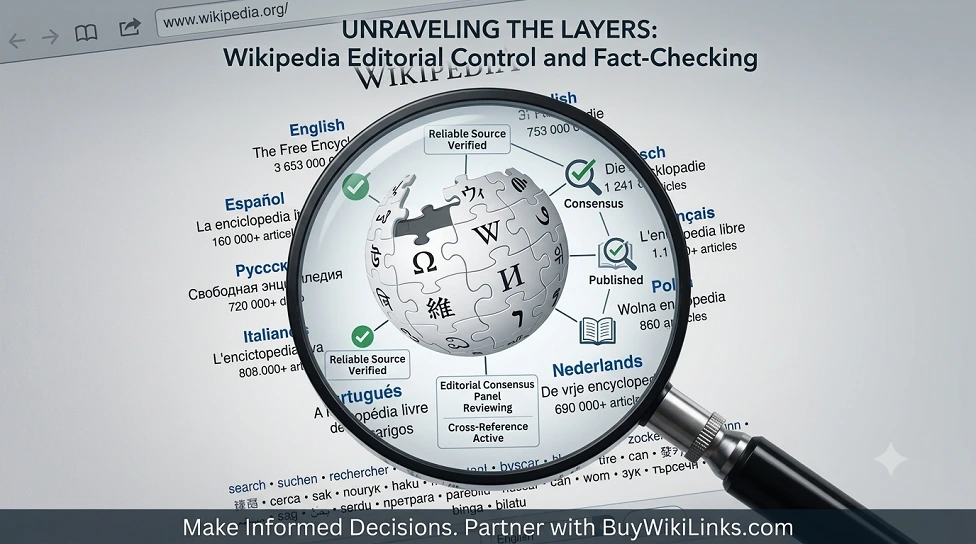
Wikipedia Editorial control is one of the strongest indicators of publisher credibility.
A reliable publication does not allow anyone to publish anything without review.
It normally has a process for:
- Selecting topics
- Assigning qualified writers
- Reviewing evidence
- Checking factual claims
- Editing language
- Identifying conflicts
- Correcting errors
- Distinguishing news from opinion
- Labeling sponsored material
What Editorial Oversight Looks Like
A website can demonstrate oversight by publishing:
- Names of editors
- Editorial leadership profiles
- Submission standards
- Fact-checking procedures
- Corrections policy
- Source-selection standards
- Review workflow
- Ethics policy
- Conflict-of-interest rules
- Advertising and sponsorship policy
The policy should describe actual practices rather than make a vague claim such as “We are committed to accuracy.”
Fact-Checking Standards
A fact-checking process may require writers and editors to verify:
- Names
- Dates
- Statistics
- Quotations
- Locations
- Job titles
- Research findings
- Legal claims
- Medical statements
- Financial figures
Higher-risk subjects require stronger checking.
Medical, scientific, financial, legal, political, and biographical claims should not be published from anonymous tips, unverified social media posts, or single unsupported statements.
Separate Editorial and Commercial Teams
A credible publication should clearly distinguish editorial decisions from advertising and sales.
The sales team should not be able to promise:
- Positive editorial coverage
- Guaranteed publication
- Specific conclusions
- Removal of legitimate criticism
- Articles written entirely from client material
Where sponsored content is accepted, label it prominently.
Readers and editors should not have to investigate whether an article was purchased.
2. Wikipedia Author Credentials and Bylines
Clear authorship helps editors assess whether the writer has appropriate knowledge and accountability.
A citation-worthy article should normally display:
- Author’s full name
- Publication date
- Relevant biography
- Professional background
- Subject expertise
- Contact or profile information
- Links to previous work
Why Bylines Matter
An article without a byline raises important questions:
- Who researched the information?
- Does the writer understand the topic?
- Is the content accountable to a real person?
- Was it written by the company being discussed?
- Was it generated automatically?
- Can errors be traced and corrected?
A generic label such as “Admin” or “Staff Writer” provides limited information unless the website explains its editorial team and review process.
Credentials Should Match the Claim
Relevant expertise depends on the subject.
For example:
- Medical analysis should involve qualified medical or scientific expertise.
- Legal interpretation should be written or reviewed by someone with appropriate legal knowledge.
- Engineering claims should be handled by relevant technical specialists.
- Historical research should identify archives and source methods.
- Financial analysis should explain the author’s experience and evidence.
A respected expert in one field is not automatically authoritative in another.
Contributor Platforms Require Care
Large publications sometimes host content from:
- Staff journalists
- Guest contributors
- Brand partners
- Council members
- Freelancers
- Advertisers
- Community members
These content types may receive different levels of editorial oversight.
The publication’s name alone does not make every page equally reliable. Editors may inspect the byline, content label, editorial category, and publication process. Wikipedia’s community-maintained source discussions frequently distinguish staff reporting from contributor or sponsored material.
3. Wikipedia Original Reporting and Research
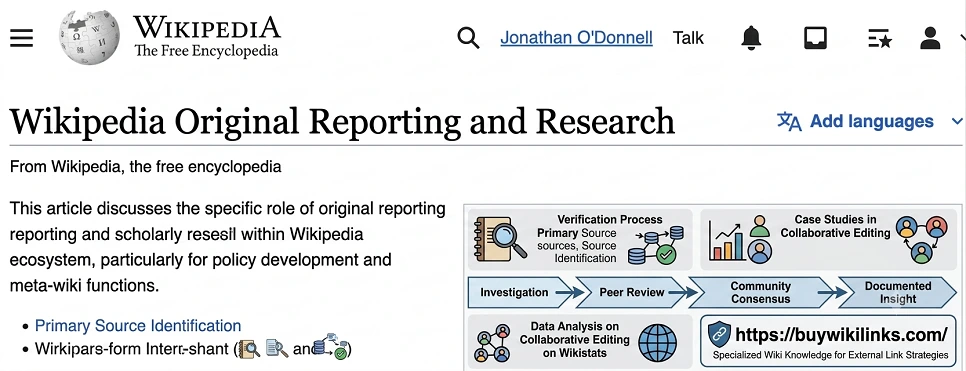
Websites become more citation-worthy when they contribute original, verifiable information.
Original value may include:
- Investigative reporting
- First-hand interviews
- Public-record research
- Data analysis
- Surveys
- Experiments
- Historical archives
- Technical testing
- Academic research
- Government information
- Court reporting
- Expert analysis
Original Reporting
A strong news or investigative article should explain where its information came from.
It may include:
- Named sources
- Direct quotations
- Documents
- Public records
- Multiple viewpoints
- Responses from affected parties
- Relevant background
- Limitations or unresolved questions
Anonymous sources may sometimes be necessary, but a credible publisher should have standards governing when and how they are used.
Original Research Reports
A research report should disclose:
- Research question
- Authors
- Funding
- Data sources
- Sample size
- Collection dates
- Definitions
- Methodology
- Limitations
- Conflicts of interest
- Complete results
A report that publishes only a headline statistic without its methodology is difficult to evaluate.
Avoid Rewriting Other Websites
Content that merely summarizes or rewrites existing publications may add little sourcing value.
Warning signs include:
- No original evidence
- No links to underlying sources
- Repeated wording from press releases
- Identical statistics appearing across many websites
- Generic AI-style summaries
- No named author
- No analysis
- No corrections process
When a page summarizes an original study, Wikipedia editors may prefer citing the study itself.
Avoid Circular Sourcing
A website should not use Wikipedia as its source and then be cited back by Wikipedia for the same information.
This creates a circular reference.
Publishers should identify and cite the original evidence rather than copying facts from:
- Wikipedia
- Wikipedia mirrors
- Search snippets
- AI summaries based on Wikipedia
- Websites that republish Wikipedia content
4. Independence From the Subject
Independence is especially important when a source is used to establish:
- Notability
- Reputation
- Importance
- Influence
- Market leadership
- Critical reception
- Public impact
A source is not independent when the subject controls, pays for, commissions, or substantially supplies the content.
Connected Sources Include
- Official websites
- Company blogs
- Personal websites
- Press releases
- Employee profiles
- Investor-relations pages
- Marketing brochures
- Client case studies
- Sponsored interviews
- Paid guest articles
- Brand-partner content
- Agency-written profiles
These sources may still be used for limited statements about the subject itself.
For example, an official website may verify:
- The company’s stated product name
- A person’s official position
- The organization’s published mission
- The release date announced by the company
It cannot independently prove that the subject is notable, respected, successful, or influential.
Editorial Independence
A publication should explain how it protects editorial decisions from:
- Advertisers
- Sponsors
- Clients
- Owners
- Political interests
- Business partners
- Subjects of coverage
A sponsored article should not be formatted to look identical to independent reporting without a clear label.
Interviews Are Partly Primary
An interview can be useful, but the subject’s statements remain claims made by the subject.
The journalist’s independent reporting, fact-checking, contextual analysis, and selection may provide secondary value. A transcript that simply republishes the subject’s answers provides less independent analysis.
For biography or company notability, several independent profiles are generally stronger than multiple promotional interviews.
5. Corrections and Transparency Policies
Reliable publishers acknowledge that errors can occur.
What matters is whether there is a visible process for correcting them.
Corrections Policy to Become a Wikipedia source
A clear corrections policy should explain:
- How readers can report an error
- Who reviews correction requests
- How corrections are displayed
- Whether material changes are dated
- Whether removed content is explained
- How quickly serious errors are addressed
Avoid silently changing significant facts without a correction note.
Publication and Update Dates
Each resource should display:
- Original publication date
- Last updated date
- Revision history when appropriate
This is especially important for:
- Statistics
- Product specifications
- Laws
- Medical guidance
- Technology
- Company information
- Government policy
Ownership Transparency
The website should clearly identify:
- Legal or trading name
- Ownership
- Funding model
- Contact information
- Editorial leadership
- Relevant business relationships
Hidden ownership can make it difficult to assess conflicts.
Sponsorship Disclosure
Disclose when content was:
- Paid for
- Commissioned
- Sponsored
- Produced in partnership
- Supplied by a client
- Funded by an interested organization
- Written using affiliate arrangements
Labeling sponsored content does not make it independent. It does help readers understand what they are viewing.
AI-Generated Content
A publisher using artificial intelligence should maintain human accountability.
Useful safeguards include:
- Human review
- Source verification
- Named editors
- Corrections
- Prohibition on fabricated citations
- Disclosure where appropriate
- Expert review for sensitive topics
Mass-producing unsupervised AI content without reliable authorship or checking is unlikely to strengthen source credibility.
6. Commercial Pages Versus Editorial Resources
A commercial organization can publish a reliable resource.
The problem is not simply that the website belongs to a business.
The relevant questions are:
- What is the page’s primary purpose?
- Does it provide verifiable evidence?
- Is the claim within the publisher’s competence?
- Is the commercial interest disclosed?
- Is the information directly accessible?
- Does the page attempt to sell more than inform?
Commercial Pages That Are Usually Weak
The following are generally poor citation destinations:
- Product checkout pages
- Service landing pages
- Lead-generation pages
- Affiliate comparisons
- Sales brochures
- Promotional case studies
- Customer testimonials
- Discount pages
- Category pages
- Pages built mainly around commercial keywords
Wikipedia’s external-links guideline specifically restricts e-commerce and commercial-sales links in External links sections, although a commercial page may occasionally be used as a footnoted citation when it is genuinely necessary for a limited factual claim.
Editorial Resources Published by Companies
A business may produce a stronger source when it publishes a separate resource such as:
- Original research
- Public data
- Technical documentation
- Historical archive
- Transparent annual report
- Standards documentation
- Detailed methodology
- Public-interest analysis
The page should stand on its own without requiring a visitor to:
- Request a quotation
- Book a sales call
- Create an account
- Purchase a product
- Provide an email address
- Navigate through aggressive pop-ups
Separate Research From Sales
A cleaner structure would be:
example.com/research/annual-industry-report
rather than:
example.com/buy-our-service
The research page may identify the company, but its main purpose should be providing evidence.
7. Sources Wikipedia Commonly Rejects or Restricts
No source type is judged entirely by its label, but some categories regularly create concerns.
Self-Published Blogs
Personal and group blogs generally lack independent editorial oversight.
They may sometimes be usable when written by an established subject-matter expert for claims within that person’s field. They should not be used as third-party sources for contentious claims about living people.
Social Media Posts
Social posts may verify limited statements about the account owner when:
- The account is authentic
- The claim is not exceptional
- The content is not unduly self-serving
- There is no reasonable doubt about authorship
They are usually poor sources for claims about other people.
Press Releases
A press release confirms what an organization announced.
It does not independently prove:
- Significance
- Success
- Market leadership
- Public recognition
- Notability
Sponsored and Advertorial Content
Paid coverage is not independent of the subject.
Even when it appears on a recognized media website, its usefulness may be limited by:
- Payment
- Client control
- Minimal fact-checking
- Promotional purpose
- Supplied quotations
- Lack of critical analysis
Content Farms
Websites publishing large quantities of low-cost, generic, or automatically generated articles may lack topic expertise and editorial accountability.
Open Wikis
User-editable wikis are normally unsuitable because their content may change and may not have identifiable authorship or editorial review.
Wikipedia itself generally should not be cited as a reliable source within Wikipedia articles.
Forums and User Reviews
Forums, comments, review platforms, and community posts usually contain unverified user-generated claims.
Business Directories
Directories may confirm that a listing exists but generally do not establish independent significance or detailed factual claims.
Republished Press Releases
Dozens of websites publishing the same announcement still represent one connected source—not dozens of independent reports.
Anonymous Articles
An unnamed article may still come from a credible editorial organization, but missing authorship can reduce accountability, especially on an unfamiliar website.
Preprints
Research preprints may not have completed peer review. Their reliability depends on the claim, author expertise, field, and context, and they should be used cautiously.
8. How to Improve Your Website’s Citation Credibility
Publish Real Author Profiles
Include:
- Full names
- Qualifications
- Professional experience
- Areas of expertise
- Previous publications
- Contact or professional profiles
Build an Editorial Team Page
Identify:
- Editor-in-chief
- Section editors
- Fact-checkers
- Reviewers
- Advisory specialists
Publish Editorial Standards
Explain:
- Source requirements
- Review procedures
- Corrections
- Conflicts of interest
- Sponsorship
- AI use
- Anonymous sources
- Author accountability
Cite Primary Evidence
Link to:
- Studies
- Public records
- Government data
- Court documents
- Interviews
- Historical materials
- Technical documentation
Do not hide your evidence.
Publish Methodology to Become a Wikipedia source
For reports and rankings, explain:
- Definitions
- Sample selection
- Calculations
- Exclusions
- Time period
- Limitations
Maintain Stable URLs
Avoid deleting or completely replacing cited pages.
When updating research:
- Preserve prior editions
- Create dated reports
- Archive supporting files
- Maintain redirects
- Record material revisions
Remove Unnecessary Promotional Language
A research page should not describe the publisher as:
- Leading
- Best
- Most trusted
- Revolutionary
- World-class
- Number one
Let the evidence demonstrate expertise.
Earn Independent Recognition
Publisher credibility grows when independent organizations:
- Cite the research
- Interview the authors
- Review the findings
- Discuss the methodology
- Link to the original data
- Use the publication in academic or professional work
Do not manufacture recognition through sponsored profiles.
Review our guide to creating Wikipedia content without violating its rules for a broader explanation of sourcing, neutrality, and conflict-of-interest issues.
Website Credibility Checklist
Use this checklist before proposing your website as a Wikipedia source.
Publisher Identity
- The organization’s name is clear.
- Ownership is disclosed.
- A physical or verifiable business identity is available.
- Editorial leadership is named.
- Contact information is functional.
Authorship
- Articles have named authors.
- Authors have relevant expertise.
- Author biographies are accessible.
- Guest contributors are clearly identified.
- Staff and sponsored authors are distinguished.
Editorial Standards
- An editorial policy is published.
- Articles are reviewed before publication.
- Fact-checking is documented.
- Opinion is labeled.
- Sponsored content is labeled.
- Conflicts of interest are disclosed.
Evidence
- Important claims cite original sources.
- Data and methods are available.
- Quotations are attributable.
- Conclusions do not exceed the evidence.
- Articles do not rely on circular Wikipedia sourcing.
Corrections and Updates
- A corrections policy exists.
- Readers can report errors.
- Publication dates are visible.
- Update dates are visible.
- Significant corrections are documented.
Independence to Become a Wikipedia source
- The publisher’s relationship with article subjects is disclosed.
- Paid coverage is clearly labeled.
- Press releases are not presented as independent reporting.
- Advertisers do not control conclusions.
- Client-supplied content is identified.
Page Quality to Become a Wikipedia source
- The URL is stable.
- The cited information is easy to locate.
- The page is accessible on mobile devices.
- Intrusive advertising is limited.
- The page is not primarily a sales funnel.
- The content remains available without mandatory lead forms.
Wikipedia Suitability
- The source directly supports a specific claim.
- The source is reliable for that subject.
- A stronger source is not already available.
- The citation would not give the publisher undue weight.
- Any conflict of interest will be disclosed.
- Independent editors will make the final decision.
A website does not need to satisfy every item for every limited use. The more significant, controversial, or sensitive the claim, the stronger the source should be.
Frequently Asked Questions
How do I become a Wikipedia source?
Publish accurate, attributable information supported by strong editorial processes. Provide named authors, relevant expertise, fact-checking, evidence, corrections, transparency, and independence appropriate to the claim.
Does my website need high Domain Authority?
No. Domain Authority is a third-party SEO metric. Wikipedia focuses more on reliability, reputation, editorial control, and suitability for the specific claim.
Can a new website be cited?
Possibly, but a new publisher may have little established reputation. Original evidence, expert authorship, transparent methodology, and strong editorial controls can help.
Can a company blog be a Wikipedia source?
It may verify limited facts about the company itself. It is not independent evidence of the company’s importance, reputation, or notability.
Can a commercial website be reliable?
Yes, for appropriate claims. Commercial ownership does not automatically disqualify a source, but sales purpose, conflicts, editorial independence, and claim relevance must be considered.
Can sponsored articles be cited?
Sponsored content is not independent. It may be unsuitable for most claims about the sponsor’s importance or reputation and should never be presented as independent editorial coverage.
Are expert blogs acceptable?
An established subject-matter expert’s self-published work may sometimes be used for claims within that expert’s field. Restrictions are much stronger for claims about living people.
Is an author byline enough?
No. A byline helps, but editors may also evaluate the author’s expertise, the publisher, editorial review, evidence, and accuracy history.
Does publishing original research guarantee a citation?
No. The research must be relevant, methodologically sound, directly supportive of an article claim, and appropriate within Wikipedia’s sourcing rules.
Can Wikipedia cite a sales page?
A sales page may occasionally verify a narrow official fact, but it is usually a weak citation and is generally inappropriate as an External links entry.
Can I add my website as a citation myself?
When you own, work for, or represent the website, disclose the relationship and consider proposing the source through the article’s talk page for independent review.
What if Wikipedia editors disagree about my website?
Editors may discuss the source at the Reliable Sources Noticeboard or on the article talk page. Reliability decisions are contextual and may change with new evidence or community consensus.
Can a publisher credibility audit guarantee citation acceptance?
No. An audit can identify strengths, weaknesses, and appropriate uses. Independent Wikipedia editors decide whether a source should be cited.
Final Thoughts to become a Wikipedia source
Learning how to become a Wikipedia source is not about increasing domain metrics or making a website appear more authoritative than it is.
It requires building real publishing credibility.
A citation-worthy website should demonstrate:
- Clear ownership
- Named and qualified authors
- Editorial review
- Fact-checking
- Original reporting or research
- Evidence and transparent methodology
- Independence from article subjects
- Corrections and update policies
- Clear sponsorship disclosure
- Stable, accessible, non-promotional resources
Reliability remains contextual to become a Wikipedia source.
An official source may be appropriate for one narrow fact but unsuitable for independent claims. A respected publication may have different standards for staff reporting, opinion columns, contributor posts, and sponsored material.
The goal should not be to make every page on your website acceptable to Wikipedia.
Build specific resources that reliably document specific information.
Those resources should also be useful to journalists, researchers, students, industry professionals, and other publishers—even when Wikipedia never cites them.
Request a Publisher Credibility Audit
Does your website publish research, statistics, technical information, historical material, industry reporting, or expert analysis?
A publisher credibility audit can evaluate:
- Publisher identity and ownership
- Author credentials
- Editorial oversight
- Fact-checking
- Source use
- Research methodology
- Independence
- Sponsorship disclosure
- Corrections policy
- Content stability
- Commercial and promotional risks
- Potential uses as a Wikipedia source
Read our guide to warning signs associated with unreliable Wikipedia service providers or request a publisher credibility audit.
Please provide:
- Website URL
- Proposed source pages
- Author profiles
- Editorial policy
- Corrections policy
- Ownership information
- Research methodology
- Relevant Wikipedia topics
- Your relationship with the publisher
- Any previous citation or removal history
The audit does not guarantee that Wikipedia editors will accept a citation. It identifies credibility gaps, clarifies which claims the website may appropriately support, and recommends improvements that can strengthen the publication for Wikipedia and other editorial uses.
