
Wikipedia Account
How to Become a Wikipedia Admin: A Complete Guide to Earning Community Trust
Jul
Becoming a Wikipedia admin is not about buying access, using shortcuts, or controlling pages. So, you have the chance to become a Wikipedia Admin on the right path.
It is about trust.
Wikipedia administrators, also called admins or sysops, are experienced volunteer editors who receive extra technical tools to help maintain the encyclopedia. These tools can include deleting pages, protecting pages, blocking disruptive users, editing fully protected pages, and handling important maintenance tasks.
However, admins are not owners of Wikipedia content. They are not above other editors. They are not hired brand managers. They are trusted community members with extra responsibilities.
If you are searching for how to become a Wikipedia admin, the first thing to understand is simple:
You cannot become an admin overnight.
You cannot buy real community trust.
You cannot use adminship to control a business page.
You cannot use admin rights as a private SEO shortcut.
You cannot become an admin only because you want more power over Wikipedia content.
To become a Wikipedia admin, you must build a strong editing history, understand Wikipedia policies, show good judgment, earn community trust, and pass a public community review process.
This guide explains how the process works, what the Wikipedia community usually expects, and how to prepare the right way.
Before trying to edit, create, or manage Wikipedia content for a person, brand, or company, it is also useful to understand how to create a Wikipedia page without violating rules. That guide explains the importance of notability, reliable sources, neutral writing, and policy-safe page creation.
What Is a Wikipedia Admin?
A Wikipedia admin is a volunteer editor with access to special maintenance tools.
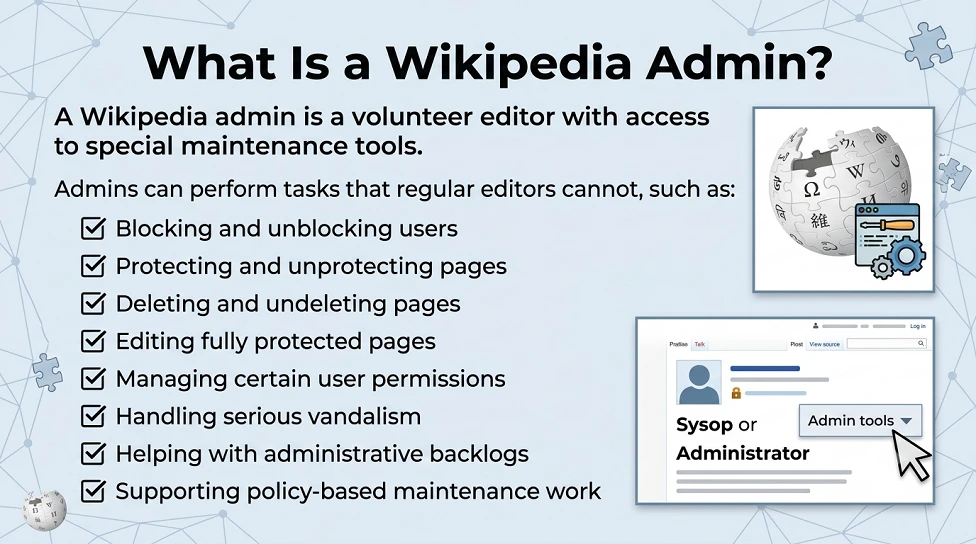
Admins can perform tasks that regular editors cannot, such as:
- Blocking and unblocking users
- Protecting and unprotecting pages
- Deleting and undeleting pages
- Editing fully protected pages
- Managing certain user permissions
- Handling serious vandalism
- Helping with administrative backlogs
- Supporting policy-based maintenance work
These tools are powerful because they can affect users, pages, and discussions. That is why Wikipedia gives admin rights only to editors who have earned a high level of trust from the community.
You can learn more from Wikipedia’s official page about Wikipedia administrators.
But adminship is not a trophy.
It is not a status symbol.
It is not a badge of authority.
It is not a way to win content disputes.
It is not a way to control articles.
It is not a tool for business promotion.
Wikipedia adminship is often described as “being given the mop.” This means admins help clean up and maintain the project. They are trusted helpers, not bosses.
Why Do People Want to Become Wikipedia Admins?
People may want adminship for different reasons. So, become a Wikipedia Admin steadily.
Some want to fight vandalism more effectively.
Some want to help delete spam pages.
Some want to protect pages from disruption.
Some want to support article maintenance.
Some want to help with backlogs.
Some want to serve the community.
These are good reasons.
But some people want adminship for the wrong reasons.
They may want to:
- Control a company page
- Remove negative content
- Add promotional links
- Publish client articles faster
- Protect paid edits
- Influence content disputes
- Sell access or services
- Use Wikipedia for SEO manipulation
These are not good reasons.
Wikipedia adminship is based on community service, not private benefit. If the community believes a candidate wants admin tools for control, promotion, or business advantage, the candidate is unlikely to succeed.
For businesses, the better approach is not to chase admin power. To become a Wikipedia Admin, a safer path is to focus on notability, reliable sources, neutral content, and ethical Wikipedia strategy.
Can You Buy a Wikipedia Admin Account?
No. You should not treat Wikipedia admin access as something to buy or sell.
Admin rights are granted by the Wikipedia community through a public trust-based process. They are not a normal digital asset. They are not like buying a domain name, social media profile, or marketplace account.
Some people research aged accounts or admin-related services because they believe older accounts may have more edit history or more trust. For example, this article discusses the market around a Wikipedia account for sale.
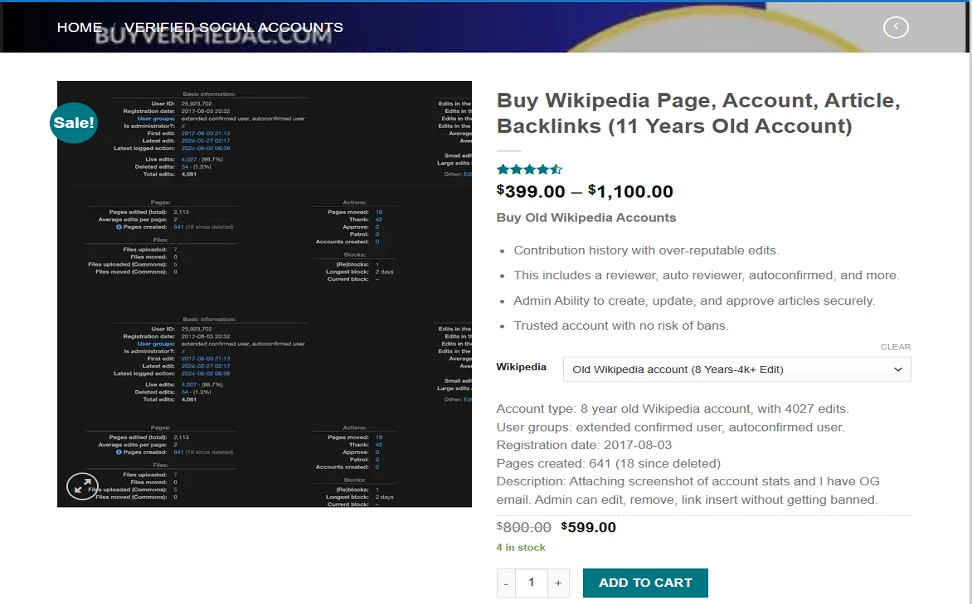
However, businesses should be careful.
An aged account does not remove the need to follow Wikipedia rules.
An aged account does not make a weak article acceptable.
An aged account does not guarantee page approval.
An aged account does not allow spammy backlinks.
An aged account does not give a business control over Wikipedia.
An aged account does not replace community trust.
If your real goal is visibility, brand authority, or SEO, the safer strategy is to build credibility first. A proper notability review, source audit, and neutral content plan are much more valuable than trying to force results through account-based shortcuts.
The Main Path: Request for Adminship
The traditional way to become an English Wikipedia admin is through Request for Adminship, often called RfA.
RfA is a public community process where editors discuss whether a candidate should receive administrator tools. A candidate can nominate themselves, or another editor can nominate them with the candidate’s acceptance.
During the process, the community reviews the candidate’s editing history, policy knowledge, judgment, behavior, communication style, and overall trustworthiness.
In simple words:
You do not become an admin because you ask.
You become an admin because the community trusts you.
The Formal Minimum Requirement
The formal minimum requirement for English Wikipedia adminship is having an extended confirmed account.
This usually means to become a Wikipedia Admin:
- At least 500 edits
- At least 30 days of account age
However, this is only the minimum requirement.
It does not mean that an editor with 500 edits and 30 days of experience is likely to pass.
In reality, the community usually expects much more. Serious candidates often have years of editing experience, thousands of useful edits, strong content work, good communication, and clear evidence of policy understanding.
So if you want to become a Wikipedia admin, do not aim for the minimum.
Aim for trust.
What the Wikipedia Community Looks For
There is no simple checklist that guarantees success. However, successful admin candidates usually show strength in several important areas.
1. Trust
Trust is the most important factor to become a Wikipedia Admin.
The community wants to know that you will use admin tools carefully, fairly, and only for proper purposes.
A trusted candidate usually has:
- A clean or well-explained editing history
- Civil communication
- Good judgment
- Neutral behavior
- Respect for policies
- A history of helping others
- No pattern of edit warring
- No pattern of promotional editing
- No misuse of multiple accounts
- No hidden conflict-of-interest behavior
Trust is built slowly. Every edit, every discussion, and every response contributes to your public reputation.
2. Experience
Experience matters because admin tools can affect other editors and important pages.
Successful candidates often have experience in areas where admin tools would be useful, such as:
- Anti-vandalism work
- Deletion discussions
- New page review
- Page protection requests
- Copyright cleanup
- Spam cleanup
- Noticeboard discussions
- Dispute resolution
- Article maintenance
The goal is not only to have a high edit count.
The goal is to show that you understand how Wikipedia works.
3. Content Creation
Admins should understand how difficult it is to build good encyclopedia content.
That is why content creation matters to become a Wikipedia Admin.
A candidate who has written, improved, or expanded well-sourced articles shows that they understand the real work of Wikipedia.
Useful content work may include:
- Creating well-sourced articles
- Expanding short articles
- Improving citations
- Fixing neutrality problems
- Removing promotional language
- Improving article structure
- Helping articles reach Good Article quality
- Cleaning up weak or poorly written pages
Wikipedia is an encyclopedia first. Maintenance matters, but content building is still central to the project.
4. Policy Knowledge
Admins must understand key Wikipedia policies and guidelines.
Important areas include:
- Neutral point of view
- Verifiability
- Reliable sources
- Notability
- No original research
- Conflict of interest
- Paid editing disclosure
- Deletion policy
- Blocking policy
- Protection policy
- Civility
- Consensus
You do not need to memorize every policy page, but you need to show good judgment and policy-based thinking.
For example, neutrality does not mean giving every opinion equal weight. It means representing significant views fairly based on reliable sources.
Verifiability does not mean “I know this is true.” It means readers can check the information in a reliable published source.
Consensus does not mean a simple vote. It means a reasoned agreement based on policy and discussion.
These details matter.
5. Good Temperament
Adminship is not only about knowledge.
It is also about attitude.
Admins often deal with conflict, disruption, heated discussions, frustrated users, and difficult decisions. The community looks for people who can stay calm, fair, and respectful.
If an editor often argues aggressively, takes disputes personally, or escalates conflict, they may struggle at RfA.
A good admin candidate shows patience.
They explain decisions clearly.
They admit mistakes.
They avoid personal attacks.
They focus on policy.
They do not use tools to win arguments.
Step-by-Step Guide: How to Become a Wikipedia Admin
Step 1: Become a Strong Regular Editor First
Before thinking about adminship, focus on becoming a good editor.
Improve articles.
Fix references.
Remove spam.
Add reliable sources.
Correct grammar.
Help new editors.
Join discussions.
Study policies.
Watch how experienced editors work.
Do this because you care about improving Wikipedia, not because you want admin rights.
The community can usually tell the difference.
Step 2: Build a Clean Editing History
Your edit history is your public record.
During RfA, editors may review your past contributions, discussions, mistakes, disputes, warnings, and behavior. This does not mean you must be perfect. Many good editors have made mistakes.
But you should show growth.
Avoid:
- Edit warring
- Personal attacks
- Promotional editing
- Undisclosed paid editing
- Copyright violations
- Source manipulation
- Aggressive talk page behavior
- Adding weak or spammy links
- Using multiple accounts improperly
A clean, honest editing history builds confidence.
Step 3: Learn Wikipedia Policies Deeply
Policy knowledge is essential.
You should understand not only the words of policies, but also their purpose.
Read policy pages.
Review real discussions.
Study deletion debates.
Watch experienced editors.
Learn how consensus works.
Understand why promotional editing causes problems.
This is especially important if you work in SEO, digital PR, page creation, or online reputation management.
For example, many businesses care about Wikipedia Link Building With Affordable Pricing, but Wikipedia links should never be treated like ordinary paid backlinks. They should support useful, verifiable, encyclopedic content.
If a link does not help readers, it may be removed.
Step 4: Contribute in Administrative Areas
Admin candidates often show experience in areas related to admin work.
Useful areas may include:
- Articles for deletion discussions
- New page review
- Recent changes patrol
- Anti-vandalism work
- Requested moves
- Page protection requests
- Copyright cleanup
- Spam cleanup
- Noticeboard discussions
- User warning and dispute handling
Do not rush into these areas without learning first.
Watch how experienced editors handle them. Read past discussions. Understand the standards before participating heavily.
Step 5: Create and Improve Real Content
Wikipedia needs editors who build useful, neutral, well-sourced content.
If you want to become an admin someday, show that you understand article creation.
You can:
- Create well-sourced articles
- Expand stubs
- Improve article structure
- Add reliable references
- Fix citation problems
- Improve neutrality
- Remove promotional language
- Help bring articles to higher quality standards
- Clean up poorly written pages
If your main interest is business or brand-related Wikipedia work, start by understanding notability and source quality. A professional Wikipedia notability and source review can help businesses understand whether they are ready for page creation before taking action.
Step 6: Build Community Trust
Trust is built through repeated good behavior.
Be helpful.
Be calm.
Be honest.
Be transparent.
Admit mistakes.
Avoid drama.
Explain your reasoning.
Respect consensus.
Help others without expecting reward.
If you disagree with someone, focus on sources and policy, not personal criticism.
Community trust grows slowly, but it is the foundation of adminship.
Step 7: Ask for Feedback Before Applying
Before applying for adminship, ask experienced editors for honest feedback.
Ask:
- Am I ready for RfA?
- What weaknesses do you see in my editing history?
- Do I have enough content work?
- Do I have enough policy experience?
- Are there concerns I should address first?
- Would you support my nomination?
- Should I wait and build more experience?
Listen carefully.
If several experienced editors say “not yet,” take that seriously.
A failed RfA is not the end of the world, but it can be stressful and public. It is better to prepare well before running.
Step 8: Decide Whether You Really Need Admin Tools
Adminship should solve a real need.
If you can already do most of your work without admin tools, there may be no reason to apply yet.
Ask yourself:
- What admin tasks do I want to help with?
- Have I already worked in those areas?
- Do experienced editors trust my judgment there?
- Would admin tools help me serve the project better?
- Am I ready for public criticism?
- Can I use the tools without personal bias?
If your honest answer is unclear, wait.
Adminship is not a prize. It is a responsibility.
What Happens During RfA?
During a Request for Adminship, the community publicly reviews the candidate.
Editors may support, oppose, or remain neutral. They may ask questions about the candidate’s editing history, judgment, policy knowledge, conflict handling, and plans for using the tools.
The discussion can be intense.
Your past actions may be examined.
Your old edits may be discussed.
Your mistakes may be raised.
Your temperament may be tested.
Your answers may influence the final result.
This is why preparation matters.
A successful RfA usually shows that the candidate has broad community confidence.
A failed RfA is not the end of the world. Many candidates learn from feedback and return later when they are stronger.
Common Reasons RfA Candidates Fail
Candidates may fail for many reasons, including:
- Too little experience
- Weak content creation history
- Poor communication style
- Recent blocks or warnings
- Edit warring
- Lack of policy knowledge
- Weak judgment in deletion discussions
- Too much drama or conflict
- Promotional editing concerns
- Conflict-of-interest concerns
- Unclear need for admin tools
- Rushing before being ready
The best way to avoid failure is to build a strong record before applying.
How Long Does It Take to Become a Wikipedia Admin?
There is no fixed timeline.
Technically, an editor must meet the extended confirmed level to participate in the process. But in practice, most serious candidates need much more experience.
It can take years to become a strong candidate.
That is because adminship is not only about account age or edit count. It is about trust, judgment, policy knowledge, communication, and service to the project.
The better question is not:
“How fast can I become an admin?”
The better question is:
“How can I become the kind of editor the community would trust with admin tools?”
That mindset is much more likely to lead to success.
Can Businesses Become Wikipedia Admins?
No. Businesses cannot become Wikipedia admins.
Only individual volunteer accounts can receive administrator rights.
A company, agency, brand, or client cannot own admin rights. A business should not try to control Wikipedia through admin access.
If a business needs Wikipedia help, the ethical route is to work with transparent, policy-aware consultants who understand notability, reliable sources, neutrality, and conflict-of-interest rules.
This is where ethical Wikipedia consulting can be helpful. The purpose should be to reduce risk, improve source quality, and follow the rules, not to control Wikipedia.
Can a Paid Wikipedia Editor Become an Admin?
A paid editor may face serious trust concerns if their editing history is mainly commercial or promotional.
Wikipedia adminship requires community trust. If the community believes a candidate may use admin tools for paid clients, private advantage, or promotional purposes, that can strongly hurt the candidate’s chances.
Transparency is essential.
Anyone involved in paid editing should follow disclosure rules and avoid using Wikipedia for hidden marketing.
Paid work and adminship are a sensitive combination. If your long-term goal is adminship, your editing history should clearly show that you serve the encyclopedia, not only private clients.
Why Adminship Should Not Be Treated as an SEO Shortcut
Many people in SEO are interested in Wikipedia because of its authority.
That is understandable.
Wikipedia pages often rank well. Wikipedia content can support public trust. Wikipedia citations and links can influence how people discover information.
But Wikipedia is not a link-building marketplace.
Adminship should never be used to:
- Add paid backlinks
- Protect promotional links
- Force client pages live
- Remove criticism without policy basis
- Control article narratives
- Hide conflicts of interest
- Bypass normal editorial review
A safer SEO strategy is to build real authority first.
That means:
- Earn independent media coverage
- Publish useful research
- Build reference-worthy content
- Improve brand transparency
- Create strong source pages
- Fix weak online signals
- Avoid spammy link tactics
- Follow Wikipedia rules carefully
This approach takes more time, but it protects your brand.
Better Business Strategy: Wikipedia Readiness Before Wikipedia Control
If you are a business owner, SEO agency, founder, author, public figure, or brand manager, you may not need adminship.
You may need a Wikipedia readiness strategy.
A readiness strategy may include:
- Notability audit
- Source review
- Draft review
- Neutrality check
- Conflict-of-interest guidance
- Backlink risk review
- Reputation risk assessment
- Page creation planning
- Content improvement suggestions
- Long-term authority-building plan
This is safer than trying to buy control or force edits.
Before trying to publish or manage a page, learn how to create a Wikipedia page without violating rules. This helps reduce mistakes and gives your page a better chance of surviving community review.
What to Avoid
If you want to become a Wikipedia admin or build a safe Wikipedia strategy, avoid these mistakes:
- Do not buy access to control pages
- Do not add spammy backlinks
- Do not hide paid editing
- Do not write promotional articles
- Do not create pages before notability is clear
- Do not use multiple accounts to mislead others
- Do not remove criticism just because it is negative
- Do not treat Wikipedia like a private marketing tool
- Do not rush into RfA before you are ready
- Do not ignore community feedback
Shortcuts can create long-term problems.
Trust is hard to earn and easy to lose.
Best Practices for Future Admin Candidates
If you want to become a Wikipedia admin someday, follow these best practices:
- Edit because you want to improve Wikipedia
- Focus on neutral, reliable content
- Learn policies before enforcing them
- Be civil even when others are difficult
- Avoid promotional editing
- Avoid unnecessary conflict
- Participate in maintenance areas carefully
- Ask for feedback from experienced editors
- Review successful and unsuccessful RfAs
- Build a long, consistent record of good judgment
- Do not rush the process
- Never treat adminship as a business tool
Adminship is not about power.
It is about responsibility.
Final Thoughts: How to Become a Wikipedia Admin the Right Way
So, how do you become a Wikipedia admin?
You earn it.
You become a strong editor.
You learn the rules.
You build useful content.
You help with maintenance.
You show good judgment.
You stay civil in conflict.
You build community trust over time.
You apply only when you are truly ready.
You accept that the community makes the final decision.
Wikipedia adminship is not something to buy, sell, or shortcut.
It is a responsibility given to trusted volunteers who have shown that they can help protect and maintain the encyclopedia.
If your goal is to support Wikipedia in the right way, start with the basics.
Edit well.
Use reliable sources.
Respect neutrality.
Help other editors.
Learn from mistakes.
Build trust.
That is the real path to becoming a Wikipedia admin.
FAQs
What is a Wikipedia admin?
A Wikipedia admin is a trusted volunteer editor with extra technical tools for maintenance tasks such as blocking disruptive users, protecting pages, and deleting pages when policy allows.
Can I buy a Wikipedia admin account?
No. Wikipedia adminship is based on community trust. Buying or selling admin access is risky and should not be treated as a legitimate path to adminship.
How many edits do I need to become a Wikipedia admin?
The formal minimum for English Wikipedia adminship is extended confirmed status, which usually means 500 edits and 30 days. However, successful candidates usually have much more experience.
How long does it take to become a Wikipedia admin?
There is no fixed time. Many serious candidates spend years building a strong editing history, policy knowledge, content experience, and community trust.
Can a company become a Wikipedia admin?
No. Only individual volunteer accounts can receive admin rights. A company, agency, or brand cannot own adminship.
Can adminship help with SEO?
Adminship should not be used for SEO manipulation. Wikipedia links and pages should serve readers and follow encyclopedia rules, not private ranking goals.
What is the safest way to work with Wikipedia for business?
The safest way is to start with a notability audit, source review, neutral draft, conflict-of-interest guidance, and policy-safe editing strategy.
