
Wikipedia Page
How to Create a Wikipedia Biography for a Person
Jul
How to Create a Wikipedia Biography for a Person
Creating a Wikipedia biography involves much more than writing a professional profile and publishing it online.
Wikipedia is not a personal branding platform, resume directory, social network, or public relations website. A person generally needs substantial coverage in reliable sources that are independent of them before a standalone biography is appropriate.
The article must then summarize those sources neutrally.
It should not be based mainly on information supplied by the subject, their family, employer, agent, publicist, or marketing team. It must also handle privacy, criticism, legal allegations, relationships, health information, and other sensitive claims with exceptional care.
The process becomes even stricter when the subject is alive.
Wikipedia’s rules for biographies of living people require conservative writing and high-quality sourcing because incorrect information can harm a person’s privacy, safety, career, and reputation.
A responsible Wikipedia biography creation process therefore begins with eligibility research—not writing.
The main steps are for Wikipedia biography creation:
- Check whether the person qualifies for a standalone biography.
- Review any profession-specific notability guidance.
- Find substantial independent coverage.
- separate strong sources from interviews, personal websites, and promotional profiles.
- Plan an article around what those sources actually cover.
- Write achievements and criticism neutrally.
- Exclude unsupported private or sensitive claims.
- Disclose paid, personal, or professional connections.
- Submit the draft for independent review.
- Monitor the article after publication without attempting to control it.
This guide explains each stage and helps determine whether a proposed Wikipedia page for a person has a credible foundation.
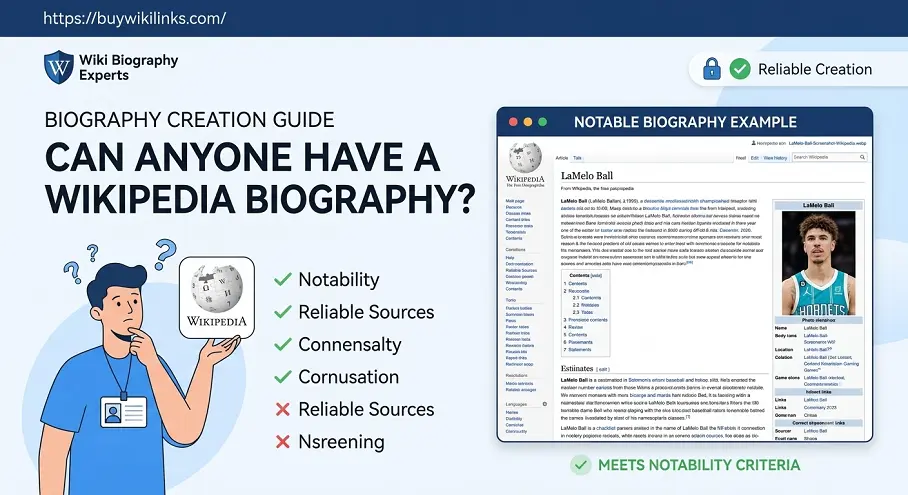
Can Anyone Have a Wikipedia Biography?
No.
A Wikipedia biography is not automatically available to everyone who is successful, qualified, popular, wealthy, influential, verified, or publicly visible.
The key question is not:
Is this person accomplished?
The better question is:
Have reliable, independent publications covered this person in enough depth to support a balanced encyclopedia article?
A person may have:
- A senior job title
- Professional qualifications
- Published books
- Business ownership
- Awards
- Large social media audiences
- Television appearances
- Speaking engagements
- Media interviews
- Successful products
These achievements may be relevant, but they do not automatically establish Wikipedia eligibility.
The person generally needs significant coverage from sources that did not merely repeat a biography, press release, interview pitch, or promotional profile supplied by the subject’s representatives.
Who Qualifies for a Wikipedia Biography?
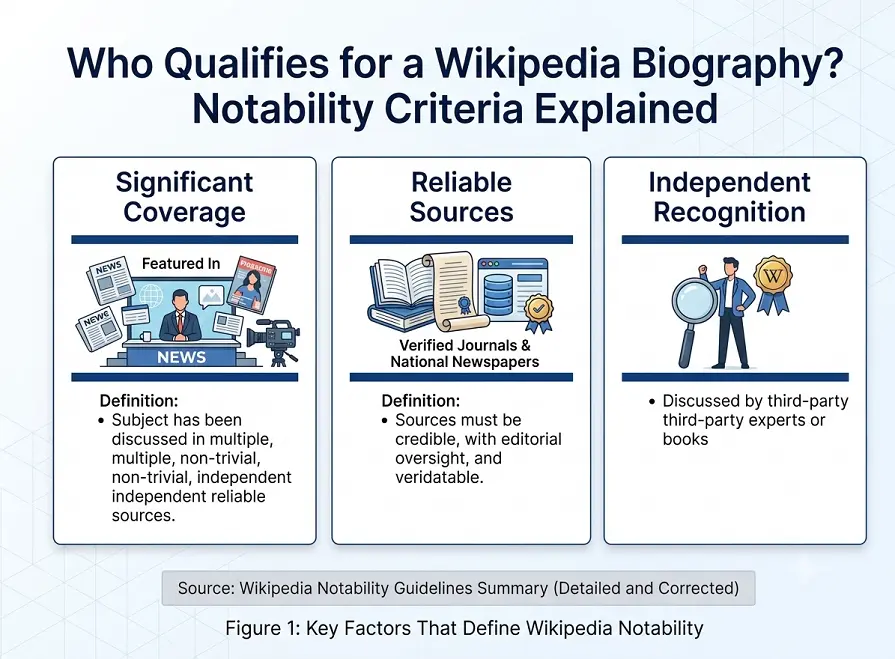
A person is generally presumed suitable for a standalone article when multiple reliable and independent published sources discuss that individual in significant detail.
The sources should normally provide enough material to write more than a short introduction or list of achievements.
Potentially useful coverage may include:
- Detailed newspaper profiles
- Independent magazine features
- Biographical books
- Substantial book chapters
- Academic analysis
- Major critical reviews
- Independent documentary coverage
- Detailed career reporting
- Investigations
- Sustained reporting about significant public work
Brief mentions usually provide less value.
Examples include:
- A person quoted in one sentence
- A conference speaker listing
- A company biography
- A social media profile
- An award announcement
- A routine appointment notice
- A name in a list
- A short event report
- A press release
- A database entry
These sources may verify limited facts, but they generally do not demonstrate substantial biographical coverage.
Notability Is Not a Measure of Human Importance
Wikipedia’s use of the term “notability” can sound like a judgment about a person’s value.
It is not.
A person can be respected, accomplished, influential within a community, or excellent at their profession without having sufficient published coverage for a Wikipedia biography.
Likewise, a controversial or widely criticized person may qualify because independent sources have covered them extensively.
Wikipedia notability is an editorial test based primarily on published evidence.
It is not a moral endorsement, award, professional certification, or guarantee of a positive profile.
Notability Standards by Profession
Wikipedia has additional guidance for some professional fields for Wikipedia biography creation. These guidelines help editors evaluate typical evidence within a profession, but they do not create automatic entitlement to an article.
A person may satisfy a profession-specific indicator and still need reliable sources to support the biography’s content.
Entrepreneurs and Business Executives
Being a founder, owner, chief executive, director, or investor does not automatically establish personal notability.
A company may be notable while its chief executive is not independently notable. The reverse may also be true.
Useful coverage should focus substantially on the person rather than merely identify them in reporting about the company.
Stronger evidence may include:
- Multiple independent career profiles
- Detailed reporting on the individual’s influence
- Substantial coverage of major decisions
- Independent analysis of their work
- Books discussing their career
- Significant public controversies or achievements
Weaker evidence includes:
- Company leadership pages
- LinkedIn profiles
- Press releases announcing appointments
- Founder interviews arranged by a publicist
- Business directory biographies
- Articles focused almost entirely on the company
Academics and Researchers
Academic notability is not determined only by having a doctorate, teaching at a university, publishing papers, or receiving citations.
Editors may consider evidence such as:
- Major scholarly impact
- Highly influential research
- Prestigious academic awards
- Election to significant scholarly societies
- Leadership of major academic institutions
- Widely recognized contributions to a field
- Independent coverage beyond routine university announcements
University biographies and research profiles can verify employment and qualifications, but they are connected sources.
A biography still needs enough reliable material to explain the academic’s career without depending mainly on a curriculum vitae.
Authors and Journalists
Publishing one or more books does not automatically create eligibility.
Relevant evidence may include:
- Significant independent reviews
- Major literary awards
- Substantial profiles
- Scholarly discussion of the person’s work
- Wide coverage of an influential publication
- Sustained recognition within the field
An author’s website, publisher biography, book listing, and retailer profile are generally weak evidence for personal notability.
For journalists, routine bylines establish that the person writes for a publication, but not necessarily that the journalist deserves a biography. Independent coverage focused on the journalist is more useful.
Artists, Musicians and Entertainers
Performing, releasing music, appearing in films, exhibiting art, or building an online audience does not automatically qualify someone for a page.
Potential evidence may include for Wikipedia biography creation:
- Significant critical reviews
- Major recognized awards
- Independent career profiles
- Coverage of influential work
- Scholarly or cultural analysis
- Sustained reporting in reputable arts publications
- Important roles in notable productions
Self-published music pages, event listings, agency profiles, fan sites, and promotional interviews generally carry less weight.
Athletes
Athlete eligibility depends on the sport, competition level, career record, and available coverage.
Possible indicators include:
- Participation at a major professional or international level
- Significant competitive achievements
- Major awards
- Sustained coverage from reputable sports publications
- Recognized records
- Independent career profiles
A team roster, statistics database, or official league profile may verify participation and results. It may not provide enough independent biographical depth on its own.
Politicians and Public Officials
Holding a significant elected or appointed public office may provide a strong notability indicator.
However, a biography still requires accurate sourcing.
Public officials’ pages may need coverage of:
- Political career
- Elections
- Public positions
- Legislative activity
- Significant criticism
- Controversies
- Relevant professional history
Campaign websites and official government biographies are connected or primary sources. Independent political reporting is important for balance.
Medical and Legal Professionals
Being licensed, experienced, or successful does not automatically make a doctor, lawyer, surgeon, or other professional notable.
Useful evidence may include:
- Widely recognized research
- Major contributions to the profession
- Significant legal cases
- Leadership of important institutions
- Major professional awards
- Substantial independent profiles
Clinic websites, law-firm biographies, patient testimonials, conference listings, and professional directories generally do not establish notability.
Medical claims require particularly strong, appropriate sourcing.
Influencers and Online Creators
Follower counts, views, subscriber totals, verification badges, and viral posts may demonstrate popularity. They do not replace reliable independent coverage.
A creator has a stronger case when established publications provide meaningful analysis of:
- Their career
- Cultural impact
- Major projects
- Public influence
- Controversies
- Business activities
Articles that merely repeat follower statistics or promotional biographies may offer limited support.
Sources Required for a Living Person
Biographies of living people receive special protection because inaccurate content can cause real harm.
Wikipedia’s official biographies of living persons policy requires material to be written carefully, neutrally, and with close attention to privacy.
Contentious claims about a living person should be supported by strong, reliable sources.
This applies to negative, positive, neutral, or questionable claims.
Examples include:
- Criminal allegations
- Lawsuits
- Political beliefs
- Religious affiliation
- Medical conditions
- Relationships
- Sexual orientation
- Financial disputes
- Professional misconduct
- Academic dishonesty
- Dismissal from employment
- Family conflict
- Personal habits
- Controversial statements
Poorly sourced contentious material should not be included merely because it appears on social media, a gossip website, an anonymous blog, or an unreliable database.
Stronger Sources for Living-Person Claims
As Wikipedia biography creation depends on the subject and claim, stronger sources may include:
- Established newspapers
- Reputable magazines
- Published books
- Reliable broadcast journalism
- Peer-reviewed journals
- Official court judgments
- Appropriate government records
- Independent investigative reporting
Even reliable sources should be represented accurately and proportionately.
An accusation should not be presented as a proven fact when the source describes it only as an allegation.
Weak Sources for Sensitive Claims
Avoid relying on:
- Anonymous blogs
- Gossip sites
- Unverified social posts
- Forums
- User-edited databases
- Self-published accusations
- Leaked private documents
- Tabloid speculation
- Unconfirmed screenshots
- Competitor websites
- Partisan attack pages
A citation does not make a claim acceptable when the cited source is unreliable or does not directly support the wording.
Privacy and Sensitive Personal Information
A Wikipedia biography should not include every fact that can be found online.
Privacy remains important, particularly for people who are not widely public figures.
Potentially sensitive information includes:
- Home addresses
- Personal telephone numbers
- Private email addresses
- Exact locations
- Names of non-public family members
- Children’s schools
- Private medical information
- Unpublished relationship details
- Financial account information
- Government identification numbers
The fact that information appears somewhere online does not automatically make it appropriate for an encyclopedia.
Editors should consider:
- Is the information widely published?
- Is it relevant to the biography?
- Is the source reputable?
- Is there a legitimate public-interest reason to include it?
- Could publication create unnecessary harm?
- Is the detail proportionate to its importance?
Children and Family Members
A subject’s children, spouse, parents, or other relatives should not be included merely to make the biography more complete.
Family information may be appropriate when reliable sources discuss it and it is relevant to the person’s public biography.
Non-public family members deserve additional privacy consideration.
Recommended Wikipedia Biography Structure
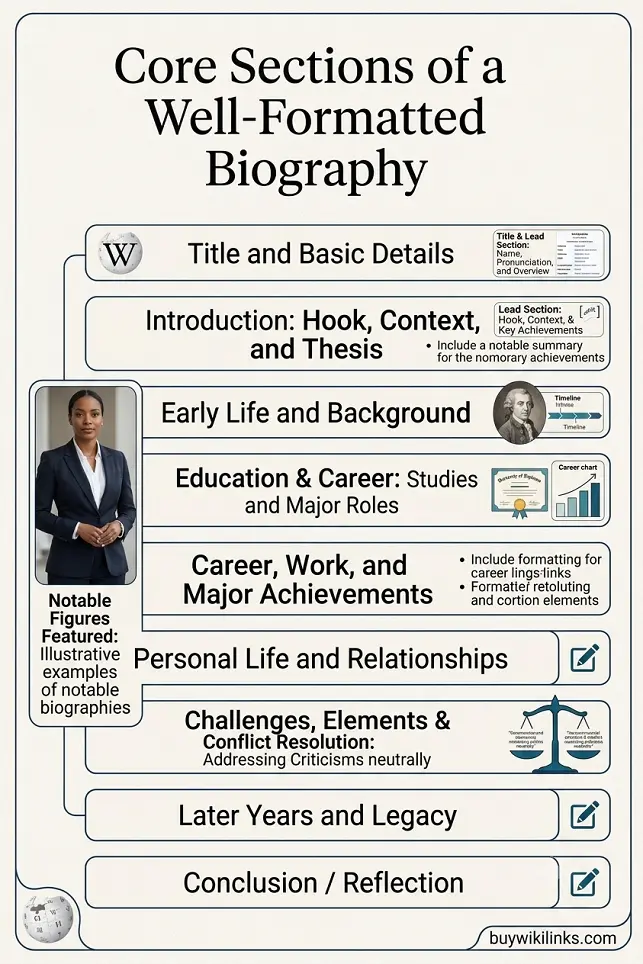
A biography should be structured around the available independent coverage.
A common structure includes:
- Lead section
- Early life and education
- Career
- Major works or activities
- Recognition and awards
- Personal life, when relevant
- Controversies or legal matters, when significant
- References
Not every biography requires every section.
Lead Section
The lead should identify the person and summarize why they are known as a Wikipedia biography creation.
It may include:
- Nationality
- Profession
- Major role
- Most significant work
- Important recognition
- Broad career summary
Avoid promotional wording such as:
- Renowned expert
- Visionary leader
- Celebrated entrepreneur
- Globally respected professional
- Inspirational public figure
Use specific, sourced facts instead.
Early Life and Education
Include early-life information only when reliable sources provide it.
Do not rely entirely on resumes, university profiles, family submissions, or personal websites.
Avoid unnecessary details that do not help readers understand the person’s later work.
Career
The career section should summarize significant stages rather than reproduce a full resume.
Focus on:
- Major positions
- Important projects
- Career changes
- Recognized works
- Significant public impact
- Events independently covered by sources
Do not list every job, presentation, partnership, or client.
Personal Life
A personal-life section is not mandatory.
Include information only when it is:
- Reliably sourced
- Relevant
- Proportionate
- Respectful of privacy
Avoid turning the biography into entertainment gossip.
Neutral Presentation of Achievements
A biography should report achievements without becoming promotional.
Promotional version:
Khan became one of the world’s most respected and innovative business leaders.
Neutral version:
In 2021, Khan received the National Enterprise Award for the company’s export program.
The neutral version identifies a specific event that can be verified.
Avoid Resume Language
Common resume-style problems include:
- Long lists of speaking engagements
- Every professional membership
- Minor awards
- Routine certifications
- Client lists
- Promotional quotations
- Unverified revenue claims
- Self-described expertise
- Repeated praise
The article should reflect what independent sources consider significant.
Awards and Recognition That Need Sourcing
An award should be supported by a reliable source confirming:
- The award’s correct name
- The awarding organization
- The year
- The category
- The recipient
- The award’s relevance
The award organizer’s website may verify the result. Independent coverage may be needed to show why the award is significant.
Avoid vague claims such as:
- Multiple prestigious awards
- Internationally recognized
- Widely honored
- Award-winning leader
Name the actual award and cite it.
Claims of “First,” “Largest,” or “Most Influential”
Superlative claims require strong evidence.
Examples include:
- First person to achieve something
- Youngest professional in a role
- Largest-selling author
- Most influential entrepreneur
- Leading expert
- Highest-paid performer
These claims should not be based only on personal websites, press releases, or promotional profiles.
Conflict-of-Interest Issues
A conflict of interest exists when the writer has a close relationship with the person.
This includes for Wikipedia biography creation:
- The subject
- Family members
- Friends
- Employees
- Employers
- Agents
- Managers
- Public relations firms
- Marketing agencies
- Lawyers
- Paid consultants
A connected contributor may unintentionally emphasize positive information, exclude criticism, or rely too heavily on sources supplied by the subject.
Can You Create Your Own Wikipedia Biography?
You may provide corrections or propose content, but directly writing and controlling your own biography is strongly discouraged.
A safer process is:
- Disclose your relationship.
- Collect reliable independent sources.
- Prepare neutral proposed wording.
- Use draft review or a talk-page request.
- Allow independent editors to decide.
Paying someone does not remove the conflict of interest. The paid editor should also disclose the client and affiliation.
Before commissioning a complete biography, review the wider Wikipedia page creation process.
Biography Draft Submission
A new biography may be prepared in:
- A user sandbox
- Wikipedia Draft space
- The Article Wizard
- Articles for Creation
Articles for Creation allows an independent volunteer to review the proposed biography.
The reviewer may examine:
- Personal notability
- Source quality
- Coverage depth
- Neutrality
- Privacy
- Citation accuracy
- Copyright
- Conflict-of-interest disclosure
The reviewer may accept, decline, or reject the draft.
A decline may be fixable when the problem involves tone, formatting, or missing citations. A lack of substantial independent coverage cannot usually be fixed through rewriting alone.
Common Reasons Biography Drafts Are Declined or Deleted
Common problems include:
- The person lacks independent coverage.
- Sources are mainly interviews or personal profiles.
- The draft reads like a resume.
- Claims are promotional.
- Content was copied from an official biography.
- Awards are unsupported or minor.
- Contentious claims lack high-quality sources.
- Private information is unnecessary.
- Paid involvement was not disclosed.
- The person is known only through a company.
- The article duplicates another topic.
- The biography depends on original research.
Maintaining a Published Biography
Publication is not the end of the process.
Other editors may:
- Correct facts
- Add new sources
- Remove weak claims
- Add important criticism
- Reorganize the article
- Challenge notability
- Nominate the page for deletion
Neither the subject nor the original writer owns the article.
Correcting Errors
A subject or representative can propose corrections by using the article’s talk page.
A strong request should include:
- The exact incorrect wording
- Proposed replacement wording
- A reliable supporting source
- A concise explanation
- Conflict-of-interest disclosure
For simple, obvious errors, editors may act quickly. Complex or disputed changes may require discussion.
Monitoring Without Controlling
Monitoring may help identify:
- Vandalism
- Unsupported claims
- Outdated positions
- Broken references
- New privacy concerns
- Major talk-page discussions
- Deletion nominations
Monitoring should not become an attempt to restore every preferred version or remove all unfavorable information.
Biography Eligibility Checklist
Before writing, answer these questions:
- Are multiple independent sources focused substantially on the person?
- Are the publications reliable?
- Is the coverage more than interviews and passing mentions?
- Is enough material available for a balanced biography?
- Does the individual qualify independently from their company or employer?
- Can major claims be supported?
- Can sensitive material be handled safely?
- Has any previous deletion history been reviewed?
- Is the writer prepared to disclose relevant connections?
- Is independent draft review acceptable?
When most answers are no, the biography may be premature.
Our Wikipedia page creation options should begin with this evidence review rather than a publication guarantee.
Frequently Asked Questions
How does someone qualify for a Wikipedia biography?
A person generally needs substantial coverage in reliable, independent sources or evidence that they satisfy relevant profession-specific guidance for Wikipedia biography creation.
How many sources are needed?
There is no fixed number. Multiple detailed independent sources are generally stronger than many brief, sponsored, or connected mentions.
Do interviews establish notability?
Interviews can provide useful material, but the subject’s answers are primary information. Independent reporting focused on the person is usually stronger.
Can social media followers qualify someone?
No. Followers and verification badges may demonstrate popularity but do not replace independent published coverage.
Can a company founder have a biography?
Yes, when sources focus substantially on the founder. Coverage focused only on the company may not establish the person’s independent notability.
Can a person write their own page?
Direct autobiographical editing is strongly discouraged. Disclosure and independent review are safer.
Can negative information appear?
Yes, when it is relevant, proportionate, neutrally written, and supported by strong reliable sources.
Can private information be removed?
Unnecessary, poorly sourced, or policy-violating private information can be challenged. Use the article talk page and provide a precise explanation.
Does hiring a writer guarantee approval?
No. A writer can research and prepare the draft, but independent Wikipedia editors control publication and future changes.
Is a published biography permanent?
No. It may be edited, merged, redirected, returned to draft, or deleted when community review supports that outcome.
Final Thoughts
Responsible Wikipedia biography creation begins with evidence rather than personal ambition.
A strong process requires for Wikipedia biography creation:
- Personal notability research
- Profession-specific review
- Independent source evaluation
- Strict living-person sourcing
- Careful privacy decisions
- Neutral biographical writing
- Accurate award verification
- Conflict-of-interest disclosure
- Independent draft review
- Responsible maintenance
The strongest biography is not the most flattering one.
It is the article that accurately summarizes what reliable independent sources have published, gives each subject appropriate weight, respects privacy, and remains useful to readers.
Request a Biography Eligibility Review
Are you considering a Wikipedia page for an entrepreneur, executive, author, artist, academic, athlete, professional, public official, or online creator?
A biography eligibility review can help determine:
- Whether the person has significant independent coverage
- Which professional notability guidance may apply
- Which sources are strong or weak
- Whether interviews and profiles are independent
- Whether enough material exists for a balanced biography
- Whether living-person sourcing creates additional risk
- Whether a previous draft or deletion affects the project
- Whether full biography writing is currently justified
Request a biography eligibility review and provide:
- The person’s full name
- Profession
- Country
- Official website
- Independent media coverage
- Books, journals, or critical reviews
- Major awards
- Previous Wikipedia drafts
- Previous deletion discussions
- Preferred Wikipedia language edition
We will review the available evidence and recommend whether to proceed, conduct deeper research, improve an existing article, or wait for stronger independent coverage for Wikipedia biography creation.
