
Wikipedia Page
How Does Wikipedia Work? From First Draft to Published Article
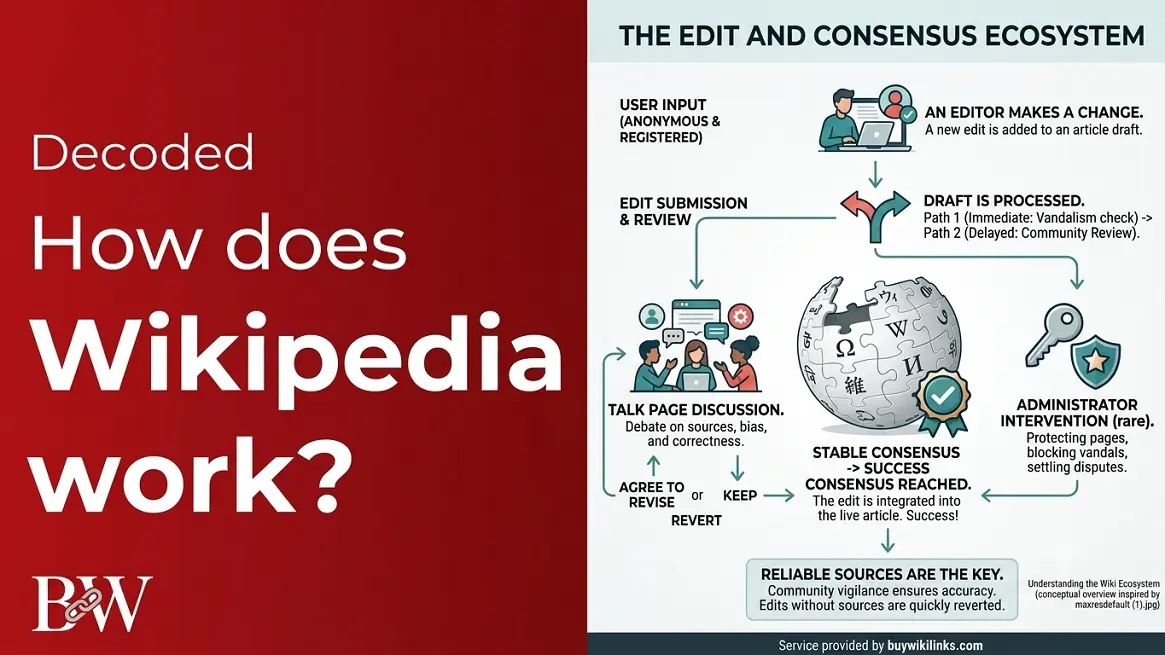
Jul
How Does Wikipedia Work? From First Draft to Published Article
Wikipedia may look like an ordinary website filled with articles, but its publishing process is very different from that of a traditional news outlet, company blog, or online magazine. Let’s detail about How does Wikipedia works.
There is no single editorial team deciding what gets published. Instead, Wikipedia is built and maintained by a worldwide community of volunteer contributors. These contributors research subjects, write drafts, add references, review new pages, correct mistakes, discuss disagreements, and sometimes remove articles that do not meet the encyclopedia’s standards.
So, how does Wikipedia work when someone wants to create a new article?
A Wikipedia article usually begins with an idea, but an idea alone is not enough. The subject must have meaningful coverage in reliable, independent sources. The draft must summarize those sources in a neutral tone, follow Wikipedia’s formatting rules, and survive review by other editors.
Even after an article is published, it does not belong to its creator. Other contributors can edit, improve, challenge, merge, redirect, or nominate it for deletion.
This guide explains the complete Wikipedia article process, from the first idea to a published and continuously edited encyclopedia entry.
How Does Wikipedia Work? A Quick Explanation
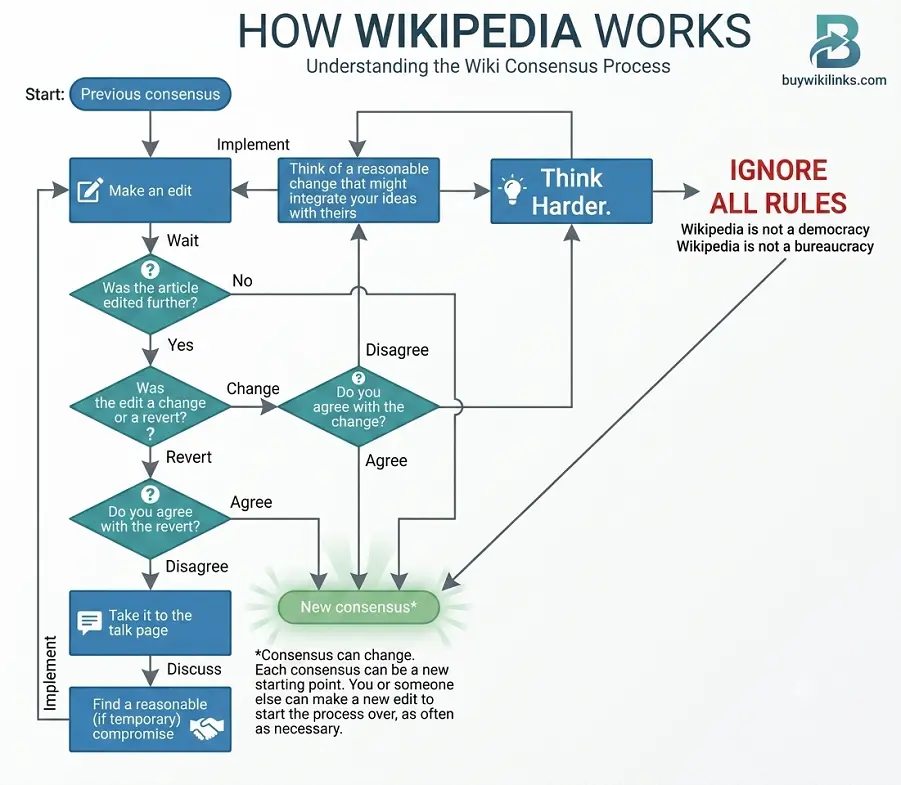
Wikipedia works through open, collaborative editing.
Most of its content is written by volunteers rather than employees of the Wikimedia Foundation. Contributors use published sources to write and improve articles, while other editors review those changes and apply community-created policies.
The basic process looks like this:
- Someone identifies a possible article topic.
- The existing encyclopedia is searched for duplicate pages.
- The subject’s notability is evaluated.
- Reliable and independent sources are collected.
- A neutral draft is written.
- The article is developed in a sandbox or draft space.
- The draft may be submitted through Articles for Creation.
- An experienced editor reviews it.
- If accepted, the draft becomes a published article.
- The wider community continues editing and monitoring it.
Publication is not the end of the process. A Wikipedia article can change hundreds or even thousands of times after it first appears.
1. How a Wikipedia Article Idea Begins
Every Wikipedia article starts with a topic someone believes should be included in the encyclopedia.
The idea could be about How does Wikipedia works:
- A person
- A company
- A historical event
- A book or film
- A scientific concept
- An organization
- A geographical location
- A product with significant historical or cultural coverage
- A social, political, or economic subject
However, Wikipedia is not a directory where every person, company, website, or product automatically receives a page.
Before writing anything, the contributor should search Wikipedia carefully. The topic may already have an article under a different name, spelling, abbreviation, or language variation. There may also be an unpublished draft being developed by another editor.
Creating a duplicate article wastes time and may result in the new page being redirected, merged, or deleted.
A good article idea begins with two questions:
- Does Wikipedia already cover this subject?
- Has the subject received enough independent coverage to justify a separate article?
The second question leads to one of the most important parts of the Wikipedia process: notability.
2. Checking Whether the Subject Is Notable
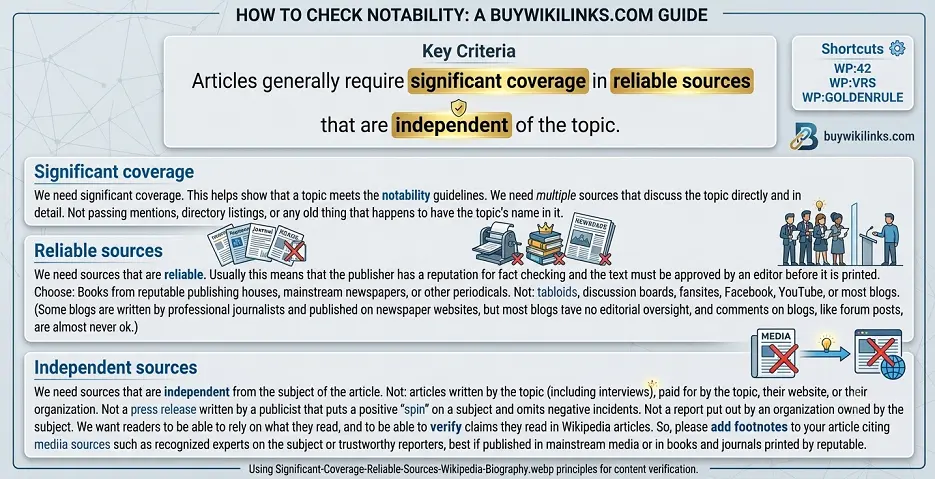
On Wikipedia, “notable” does not simply mean popular, successful, important, wealthy, famous, or respected.
Notability is an editorial standard used to decide whether a subject deserves its own standalone article.
In general, a subject is more likely to qualify when it has received significant coverage in reliable, independent, secondary sources.
Let us break that down.
Significant coverage as How does Wikipedia works
The source must discuss the subject in meaningful detail.
A passing mention, a name in a list, a short event announcement, or a one-sentence quotation is usually not enough. The coverage should provide substantial information that could be used to write an encyclopedia article.
Reliable sources
Reliable sources normally have editorial oversight, fact-checking procedures, professional writers, or recognized subject expertise.
Depending on the topic, suitable sources may include:
- Established newspapers
- Respected magazines
- Books from reputable publishers
- Academic journals
- Industry publications with editorial control
- Documentary programs
- Recognized broadcast media
- Independent investigative reports
Independent sources
The source should not be controlled by the article’s subject.
For example, the following sources may help verify basic facts but usually do not establish notability on their own:
- Official websites
- Press releases
- Company blogs
- Employee biographies
- Social media profiles
- Marketing materials
- Self-published interviews
- Sponsored articles
- Partner websites
A company cannot establish its Wikipedia eligibility simply by publishing information about itself. A person also cannot become notable by creating personal websites, issuing press releases, or collecting social media followers.
Secondary sources
Secondary sources analyze, discuss, or report on a subject rather than merely presenting information directly from it.
For example, an independent newspaper feature about a company’s history may contribute to notability. A company press release announcing the same history would be a primary source and would not independently establish notability.
There is no universal rule saying that a subject needs exactly three, five, or ten sources. Quality, independence, depth, and relevance matter more than the raw number.
Before paying for writing or submission assistance, it is sensible to complete a professional eligibility review. Our Wikipedia page creation service begins by examining whether sufficient source material exists before a complete article is prepared.
3. Finding Independent and Reliable Sources
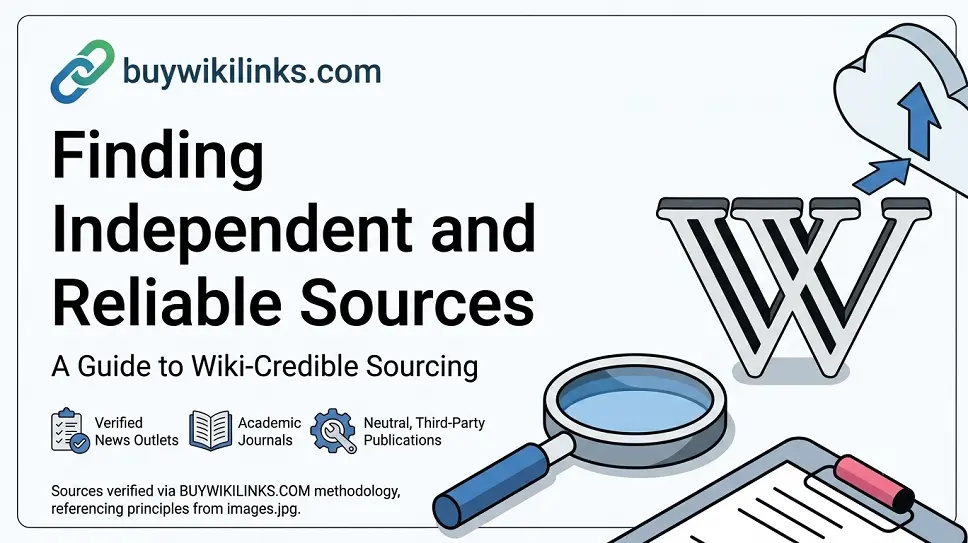
Research is the foundation of every sustainable Wikipedia article.
An article should not begin with what the subject wants to say. It should begin with what trustworthy, published sources have already said.
That distinction is important because Wikipedia does not publish original research. Contributors summarize existing knowledge rather than introducing unpublished claims, personal opinions, private documents, or original conclusions.
Where editors look for sources
Editors may search:
- Google News archives
- Newspaper databases
- Google Books
- Library catalogues
- Academic databases
- Industry journals
- Government publications
- Established magazines
- Reputable broadcast archives
- Books and biographies
- Conference proceedings, when appropriate
The strongest sources usually provide detailed and independent discussion of the subject.
Sources that are often weak
Some materials may be useful for confirming straightforward details, but they are rarely enough to support a full article:
- The subject’s official website
- LinkedIn profiles
- Facebook or Instagram pages
- IMDb-style user-edited databases
- Press releases
- Business directories
- Retail listings
- Affiliate websites
- Guest posts
- Sponsored content
- Personal blogs
- User-generated forums
These sources may contain accurate information, but Wikipedia also considers who published the information, how it was reviewed, and whether the publisher is independent.
Every important statement needs support
A Wikipedia article should not make unsupported claims such as:
- “The company is an industry leader.”
- “She is one of the most influential entrepreneurs.”
- “The product revolutionized the market.”
- “He is internationally recognized.”
- “The organization is trusted worldwide.”
These are promotional or subjective statements unless high-quality independent sources clearly support them.
Instead, an article should present specific, verifiable facts and cite the publications that reported them.
4. Writing in an Encyclopedic Style
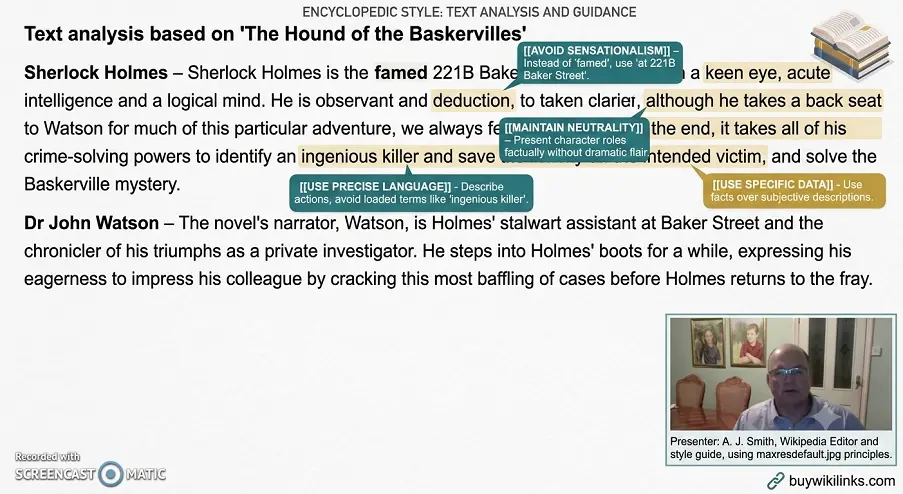
Wikipedia writing is different from advertising, public relations, blogging, and storytelling.
An encyclopedic article should explain a subject clearly without trying to persuade the reader to buy, support, admire, contact, or follow it.
Use a neutral point of view
Neutral writing does not mean that every source must be positive. It means the article should fairly represent significant viewpoints found in reliable sources.
When reputable coverage includes criticism, controversy, legal issues, professional setbacks, or public disputes, those subjects may need to be included in proportion to their importance.
Editors should not remove well-sourced criticism merely because it is uncomfortable. They should also avoid giving minor criticism more attention than the sources justify.
Avoid promotional language
Promotional wording includes expressions such as:
- World-class
- Leading provider
- Revolutionary
- Highly successful
- Renowned expert
- Prestigious company
- Best-in-class
- Innovative solution
- Trusted brand
- Award-winning leader
A neutral version would replace these descriptions with specific facts.
Promotional:
“ABC Company is a leading and innovative global technology provider.”
Neutral:
“ABC Company is a software company founded in 2012. It develops accounting applications for small businesses.”
The second version states what the company is without telling readers how they should feel about it.
Do not write from memory
Even when a contributor is an expert on the subject, Wikipedia requires published references.
Personal knowledge cannot normally be verified by readers. An article should therefore summarize what credible sources have published rather than what the writer personally knows.
Follow a logical article structure
The exact structure depends on the subject, but a company article might contain:
- Introduction
- History
- Operations
- Products or services
- Major events
- Acquisitions
- Reception or criticism
- References
A biography might include:
- Introduction
- Early life and education
- Career
- Major works
- Awards
- Personal life, when relevant and well sourced
- References
Sections should reflect the available independent coverage. They should not be used as spaces for inserting marketing messages.
5. Draft and Sandbox Stages
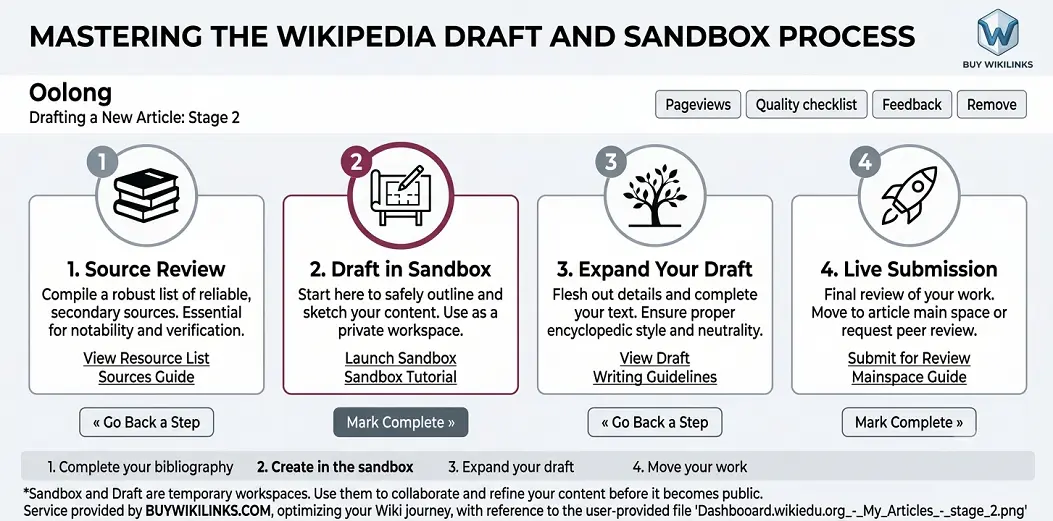
New contributors are generally encouraged to prepare an article before publishing it directly into Wikipedia’s main encyclopedia.
There are two common places to develop unfinished content.
User sandbox
A sandbox is a personal workspace connected to a registered Wikipedia account.
It allows an editor to practice formatting, test references, organize sections, and improve the article before it becomes publicly presented as an encyclopedia entry.
A sandbox page is still visible to other users. It should not be treated as a private or confidential document.
Draft space
Wikipedia also has a dedicated Draft namespace for articles under development.
A draft may be created through Wikipedia’s Article Wizard or moved into draft space while it is being improved. Drafts can be edited repeatedly before being submitted for review.
During the drafting stage, the writer should check:
- Whether the introduction clearly identifies the subject
- Whether the article demonstrates notability
- Whether major claims have inline citations
- Whether sources are independent
- Whether the tone is neutral
- Whether sections are properly organized
- Whether the wording has been copied from another website
- Whether any conflicts of interest have been disclosed
- Whether the article contains unnecessary external links
Wikipedia’s official first-article guide explains the recommended research, drafting, sourcing, and submission process for new contributors.
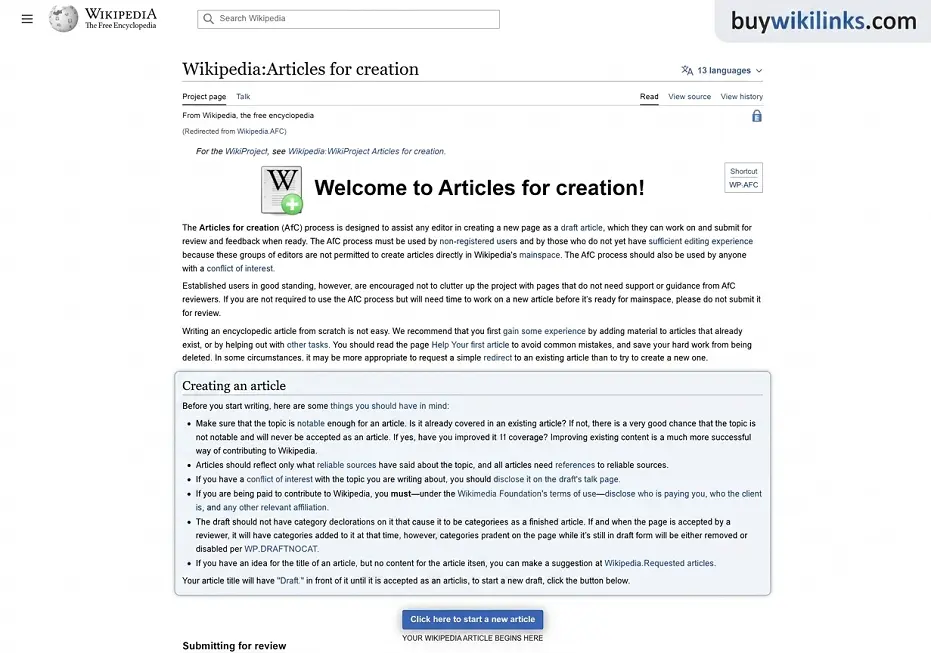
6. Articles for Creation Review
Articles for Creation, commonly shortened to AfC, is a Wikipedia review process for new article drafts.
A contributor submits a draft, and an experienced volunteer reviews whether it is suitable for publication.
AfC is especially important when:
- The contributor is new to Wikipedia
- The account is not yet confirmed
- The writer has a connection to the subject
- The article was prepared for a client or employer
- The writer wants independent feedback before publication
- The subject may have complicated notability issues
What happens during the review?
The reviewer examines the draft’s overall suitability.
The reviewer may consider:
- Whether the subject appears notable
- Whether the sources are reliable
- Whether the sources are independent
- Whether coverage is significant
- Whether the article is neutral
- Whether important statements are cited
- Whether the draft duplicates an existing article
- Whether the article contains promotional content
- Whether there are copyright concerns
The reviewer may then accept, decline, reject, or comment on the submission.
Accepted draft
When a draft is accepted, it is moved into Wikipedia’s main article space.
That means it becomes an ordinary encyclopedia article. It can appear in Wikipedia search results, receive internal links, and be edited by the wider community.
Acceptance does not guarantee that the article will remain unchanged or permanently published.
Declined draft
A declined draft is not necessarily permanently refused.
The reviewer usually explains what must be improved. The contributor can revise the draft, strengthen its sources, remove promotional content, and submit it again.
Submitting the same draft repeatedly without addressing the reviewer’s concerns is unlikely to help.
Rejected draft
Rejection is more serious than a decline.
A draft may be rejected when the subject is clearly unsuitable, when repeated submissions have not solved fundamental problems, or when the draft is unlikely to become acceptable through ordinary editing.
Before hiring a provider, examine whether its claims sound realistic. Our guide to fake Wikipedia page creators explains why guaranteed approval promises and shortcuts should be treated carefully.
7. What Happens After Publication?
A newly published Wikipedia article immediately becomes part of a collaborative encyclopedia.
The original writer no longer controls the content.
Other editors may:
- Correct spelling or grammar
- Rewrite unclear passages
- Add better sources
- Remove unreliable citations
- Shorten promotional sections
- Add missing context
- Challenge unsupported claims
- Reorganize sections
- Add maintenance notices
- Add categories and internal links
- Discuss concerns on the talk page
- Nominate the article for deletion
Some changes may happen within minutes. Others may occur months or years later.
New-page review
New articles may be examined by experienced contributors involved in new-page reviewing or patrolling.
They look for serious problems such as:
- Lack of notability
- Copyright violations
- Promotional writing
- Poor sourcing
- Duplicate content
- Inappropriate subjects
- Unsupported claims about living people
A page becoming publicly visible does not mean it has passed every possible review. It may still be examined, tagged, discussed, improved, redirected, merged, or deleted.
Article history
Every Wikipedia article has a public revision history.
The history normally shows:
- When each edit was made
- Which account or IP address made it
- What changed
- Edit summaries
- Reverted edits
This transparency allows contributors to compare versions and restore previous content when necessary.
Talk pages
Articles also have associated talk pages.
Editors use talk pages to discuss:
- Disputed wording
- Source quality
- Proposed additions
- Potential conflicts of interest
- Article structure
- Neutrality concerns
- Requested corrections
When someone is closely connected to a subject, suggesting changes on the talk page is often safer than directly rewriting the article.
8. Page Deletion, Merging, and Redirection
Not every published article remains a standalone page.
Wikipedia has several ways to deal with content that does not meet its standards or does not require a separate article.
Speedy deletion
Speedy deletion is used for pages that clearly meet specific deletion criteria.
Possible examples include:
- Obvious advertising
- Meaningless content
- Certain copyright violations
- Recreated pages previously deleted through discussion
- Pages with no credible indication of importance in applicable circumstances
- Attack pages
Speedy deletion does not normally require a lengthy community discussion.
Proposed deletion
Proposed deletion may be used when an editor believes an article should be removed but the issue does not require immediate deletion.
A notice is placed on the page. If another editor objects, the proposal can be challenged, and the article may be improved or sent to a broader discussion.
Articles for Deletion
Articles for Deletion, often abbreviated as AfD, is a community discussion.
Editors review the article, its sourcing, its notability, and relevant policies. Participants may recommend:
- Keep
- Delete
- Merge
- Redirect
- Draftify
- Another suitable outcome
The discussion is eventually closed by an experienced contributor who evaluates the arguments according to Wikipedia’s policies and community consensus.
It is not decided simply by counting votes.
Merging
An article may be merged when the subject is verifiable but does not need a separate page.
For example, a minor product may be covered within the article about its parent company. A small event may be included in a broader historical article.
After merging, useful information is retained while unnecessary duplication is removed.
Redirection
A redirect automatically sends readers from one page title to another.
Redirects are commonly used for:
- Alternative spellings
- Former names
- Abbreviations
- Common misspellings
- Merged subjects
- Closely related search terms
A redirect is not necessarily a punishment. It often helps readers find the correct article more easily.
9. Why No One Owns a Wikipedia Article
One of the most misunderstood parts of how Wikipedia works is article ownership.
A person, company, agency, writer, or editor cannot own a Wikipedia article.
Even when someone writes the first draft, other contributors are allowed to edit it. The subject of an article also cannot control which properly sourced information is included.
This means a business cannot treat its Wikipedia article like:
- An official company profile
- A social media account
- A press release
- A marketing landing page
- A personal website
- A controlled brand asset
The article exists to serve readers and the encyclopedia, not the subject’s promotional goals.
Disagreements are resolved through consensus
When editors disagree, they are expected to discuss the issue, examine reliable sources, and work toward consensus.
Repeatedly restoring preferred wording without discussion may be treated as edit warring.
The strongest argument is normally not:
“I created this page.”
It is:
“This wording accurately summarizes the best available reliable sources and follows Wikipedia’s policies.”
Paid assistance does not create ownership
A client may pay someone to research sources, assess eligibility, prepare a neutral draft, or suggest properly disclosed edits.
That payment does not purchase the article itself, guarantee publication, or give the client permanent editorial control.
Wikipedia’s volunteer community still decides whether the article is suitable and how it develops over time.
How Long Does It Take to Publish a Wikipedia Article?
There is no fixed publication time as per How does Wikipedia works.
The timeline depends on:
- The strength of the available sources
- The complexity of the subject
- The quality of the first draft
- The contributor’s experience
- Whether a conflict of interest exists
- Whether AfC review is required
- The number of drafts awaiting review
- Whether reviewers request revisions
- Whether the subject raises policy concerns
A strong article can still take time to review. A weak article does not become acceptable simply because it has been waiting for a long period.
The best way to improve the process is to complete the research and eligibility assessment before writing the full draft.
Common Mistakes During the Wikipedia Article Process
Many unsuccessful submissions share the same problems.
Writing before checking notability
A polished article cannot compensate for a subject that lacks sufficient independent coverage.
Using press releases as the main sources
Press releases come from the subject or its representatives. They usually do not establish independent notability.
Copying from an official website
Company and biography pages are protected by copyright unless clearly released under a compatible license. Copying them may result in deletion.
Treating the article as advertising
Wikipedia articles should inform readers rather than generate leads, sales, followers, or reputation.
Hiding a conflict of interest
Paid contributors and people closely connected to the subject should follow the relevant disclosure requirements.
Believing publication is permanent
Every article remains open to review and community editing after publication.
Adding every achievement
Only information supported by suitable sources and relevant to an encyclopedic summary should be included.
Frequently Asked Questions of How does Wikipedia works
Can anyone create a Wikipedia article?
Most people can contribute to Wikipedia, but creating a new article is more difficult than making a small edit. The subject must be suitable for an encyclopedia, and the draft must meet sourcing, neutrality, notability, and copyright standards.
Does Wikipedia approve every submitted article?
No. Drafts may be accepted, declined, or rejected. Reviewers assess the subject, sources, tone, structure, and compliance with Wikipedia’s standards.
Can a company create its own Wikipedia page?
A company employee or representative may have a conflict of interest. Directly creating or controlling the article is discouraged. Connections and paid relationships should be properly disclosed, and independent review through Articles for Creation is generally appropriate.
How many sources does a Wikipedia article need?
There is no universal number that guarantees acceptance. Several substantial, independent, reliable sources are normally more valuable than a large collection of press releases, directories, short mentions, or self-published pages.
Is a published Wikipedia page permanent?
No. A published article can be edited, merged, redirected, moved back to draft space, or deleted when the community identifies policy or sourcing problems.
Who has the final control over a Wikipedia article?
No individual contributor has permanent final control. Content develops through reliable sourcing, editorial policies, discussion, and community consensus.
Can the subject remove negative information?
Not simply because it is negative. Properly sourced, relevant, neutrally written information may remain. Unsupported, excessive, misleading, or policy-violating material can be challenged through the article’s talk page and normal editorial processes.
Does paying for a Wikipedia service guarantee publication?
No legitimate provider can control Wikipedia’s independent reviewers or guarantee permanent publication. A professional service can assess eligibility, research sources, prepare a neutral draft, disclose paid involvement, and respond to editorial feedback.
Final Thoughts
Understanding How does Wikipedia works begins with recognizing that it is not a promotional publishing platform.
A Wikipedia article is built from independent published sources, written from a neutral point of view, reviewed by volunteer contributors, and continuously open to community improvement.
The strongest process is:
- Search for an existing article.
- Evaluate the subject’s notability.
- Collect independent and reliable sources.
- Prepare a neutral, properly cited draft.
- Disclose any paid or personal connection.
- Use a sandbox or draft page.
- Submit the draft for review when required.
- Respond carefully to reviewer feedback.
- Accept that the community controls the published article.
How does Wikipedia work? Starting with eligibility saves time, reduces unnecessary writing costs, and identifies sourcing weaknesses before a draft is submitted.
Request an eligibility assessment to determine whether your person, company, organization, or brand currently has enough independent source coverage for a credible Wikipedia article.
