
Why Wikipedia Pages Get Rejected or Deleted: 15 Common Reasons
Jul
Why Wikipedia Pages Get Rejected or Deleted: 15 Common Reasons
“Why was my Wikipedia page rejected?” is one of the most common questions asked by companies, public figures, entrepreneurs, authors, and organizations after submitting a new article.
The answer is rarely as simple as poor formatting.
A draft may be declined because it lacks strong sources, reads like advertising, or does not yet demonstrate that the subject deserves a standalone article. A published page may later be deleted after editors find notability, copyright, sourcing, promotional, or account-related problems.
It is also important to distinguish among three different outcomes.
Declined, Rejected, and Deleted Are Not the Same
A declined draft usually means the reviewer believes the submission is not ready for publication but may be improved. The reviewer may request better sources, a more neutral tone, additional citations, or a clearer demonstration of notability. Wikipedia page rejected for a different reason.
A rejected draft is more serious. It generally indicates that the draft is unlikely to become acceptable through ordinary editing or that repeated submissions have failed to resolve a fundamental problem.
A deleted article was removed from public article space. Deletion can happen quickly under specific criteria or after a wider community discussion.
Before trying to repair the page, identify which outcome occurred and read the exact notice left by the reviewer or deleting editor.
The following are the 15 most common reasons Wikipedia pages get declined, rejected, or deleted. So, be details of Wikipedia page is rejected.
1. The Subject Lacks Wikipedia Notability
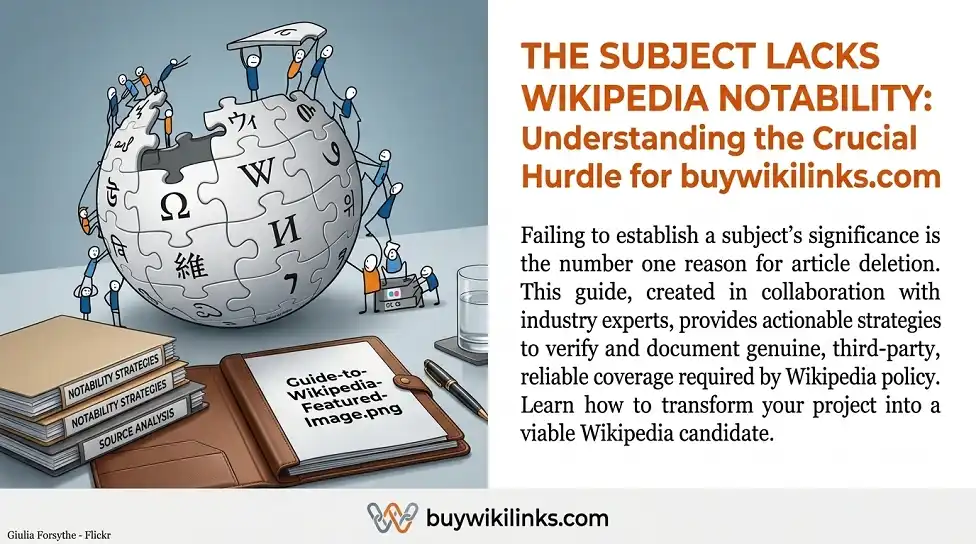
The most common reason for rejection is insufficient notability. Let’s go with a Wikipedia page rejected.
Wikipedia does not automatically provide a standalone page to every person, business, organization, product, or website. The subject generally needs significant coverage in reliable sources that are independent of it.
Notability is not established merely by having:
- A successful business
- High revenue
- Many employees
- A professional qualification
- A large social media audience
- A verified profile
- Several awards
- A registered trademark
- A popular website
- A long career
- Famous customers
- A published book
- Press releases
These facts may be impressive, but Wikipedia asks whether independent publishers have examined the subject in meaningful detail.
A polished draft cannot fix a subject that lacks qualifying coverage. Notability is based on evidence outside Wikipedia, not on the quality or length of the submitted article.
Can it be fixed?
A rejected Wikipedia page can be fixed. Only when suitable independent coverage already exists but was overlooked, or when meaningful new coverage has appeared since the previous review.
Rewriting the same facts without stronger sources will not solve the problem.
2. The Sources Are Not Independent
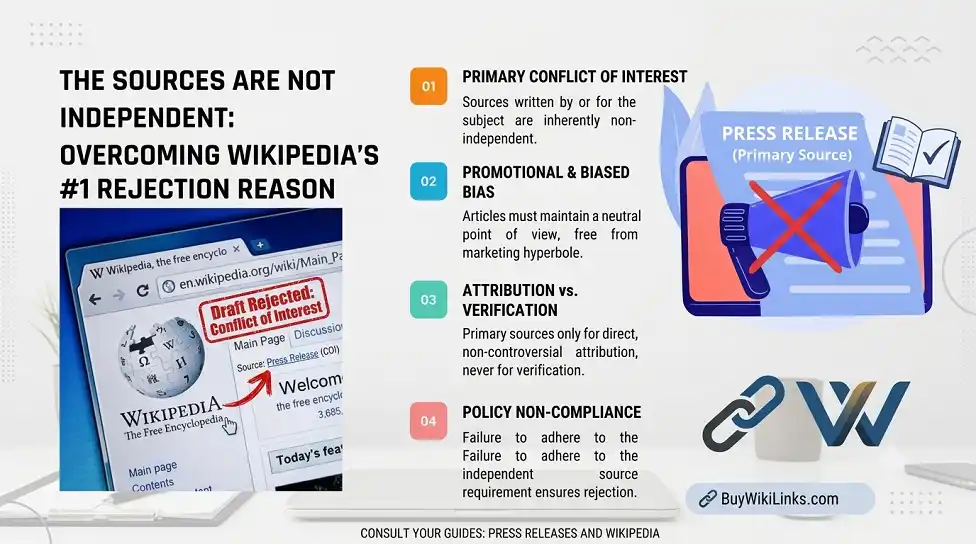
A source may contain accurate information but still be unsuitable for establishing notability because it is connected to the subject.
Connected sources include as per Wikipedia page rejected:
- Official websites
- Company blogs
- Personal websites
- Press releases
- Social media profiles
- Employee biographies
- Investor-relations pages
- Marketing brochures
- Sponsored profiles
- Partner websites
- Articles commissioned by a public relations agency
These sources may sometimes verify simple facts, such as an official company name or product launch date. They cannot independently prove that the subject is important enough for a standalone encyclopedia article.
Wikipedia page rejected draft often contains many references, but nearly all of them lead back to information controlled by the subject.
Can it be fixed?
Replace connected sources with substantial reporting from reputable publications that independently selected, researched, and wrote about the subject.
3. The Sources Contain Only Passing Mentions
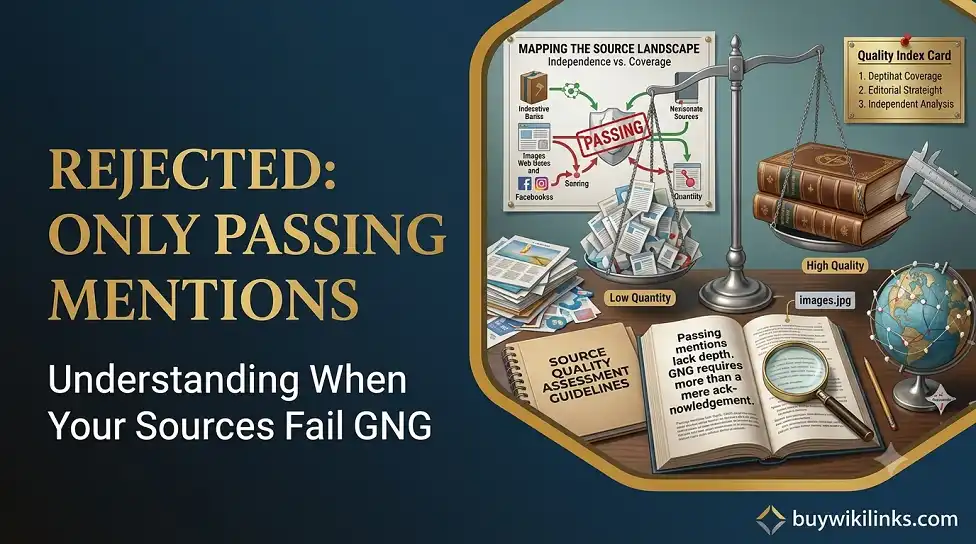
A source can be reliable and independent but still provide too little coverage.
A passing mention occurs when the subject is:
- Named in one sentence
- Included in a list
- Quoted briefly
- Identified as an event sponsor
- Listed as a conference speaker
- Mentioned in a funding announcement
- Named as one of several competitors
- Included in a photograph caption
- Listed in a directory
A one-sentence mention in a respected newspaper remains a one-sentence mention. The reputation of the publication does not transform brief coverage into a substantial profile.
Wikipedia reviewers look for sources that discuss the subject directly and in enough depth to support meaningful article content.
Can a rejected Wikipedia page be fixed?
Find sources that provide detailed profiles, analysis, history, criticism, reviews, or sustained reporting. Do not increase the reference count by adding more brief mentions.
4. The Writing Is Promotional on Wikipedia
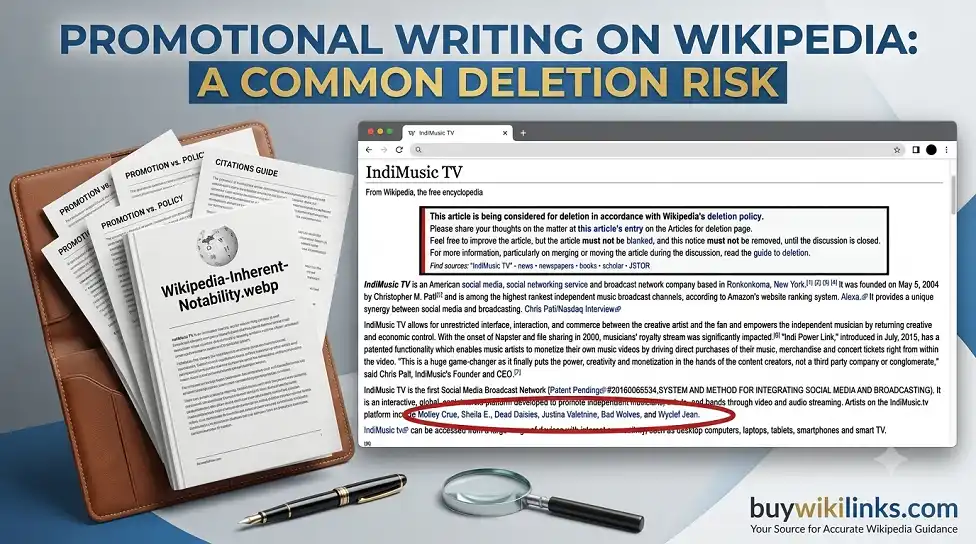
Wikipedia is an encyclopedia, not a marketing platform.
Drafts are frequently declined because they describe the subject using public relations or sales language.
Common promotional phrases include:
- Leading provider
- Globally renowned
- Visionary entrepreneur
- Trusted brand
- Innovative platform
- Award-winning expert
- Fast-growing company
- Best-in-class service
- Prestigious organization
- Industry-leading solution
These phrases tell readers how they should view the subject rather than presenting verifiable facts neutrally.
Promotional example
Brightwave is a globally trusted and highly innovative technology company delivering world-class solutions.
Neutral example
Brightwave is a software company founded in 2015. It develops payment-processing applications for retail businesses.
The neutral version identifies the company without advertising it.
Can a rejected Wikipedia page be fixed?
Remove unsupported praise, slogans, customer-focused language, calls to action, and subjective claims. Rewrite the article around what independent sources report.
5. The Draft Contains Original Research
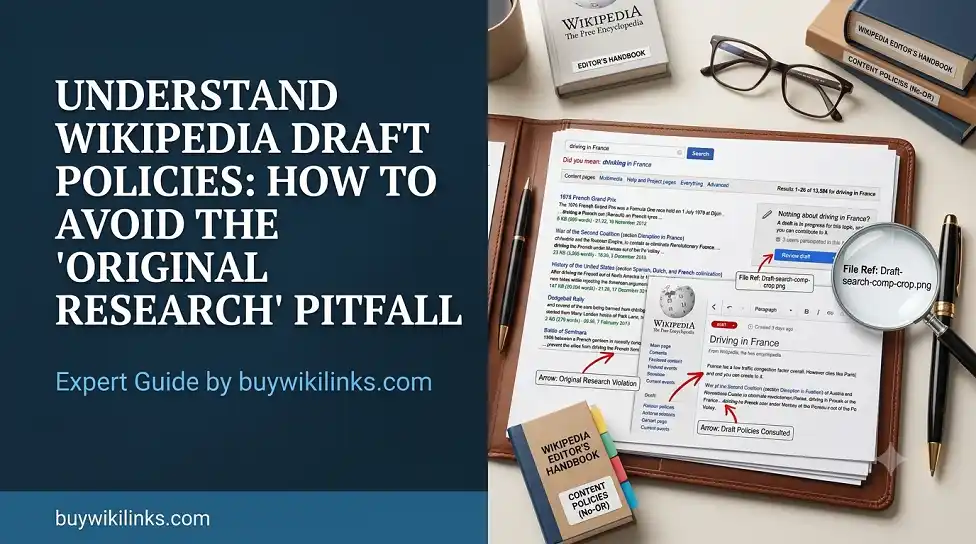
Wikipedia summarizes published knowledge. It does not publish new conclusions, private information, personal experience, or unpublished analysis.
Original research may include:
- Facts known only to the subject
- Internal company information
- Unpublished revenue figures
- Private correspondence
- Personal recollections
- Calculations created by the writer
- Conclusions combined from unrelated sources
- Interpretations that no source explicitly makes
- Claims based on interviews conducted solely for the draft
For example, an editor should not combine a company’s sales figures with an industry report and independently conclude that the company is the market leader unless a reliable source has made that conclusion.
Can it be fixed?
Remove unpublished claims and replace them with statements directly supported by published reliable sources.
6. Important Claims Are Missing Citations
A draft may contain several references but still leave its most important claims unsupported.
Citations are particularly important for:
- Dates
- Awards
- Statistics
- Revenue
- Job titles
- Educational qualifications
- Legal disputes
- Medical information
- Political positions
- Controversial statements
- Claims of influence
- Claims about living people
The source must directly support the statement.
A citation about a company’s product launch does not automatically support a claim that the company became an international market leader.
Can a rejected Wikipedia page be fixed?
Audit the draft sentence by sentence. Remove unsupported claims or attach a suitable source that verifies the exact wording.
7. The Article Infringes Copyright
Copying text from another website is a serious problem.
Common sources of copied material include:
- Company About pages
- Official biographies
- Press releases
- News articles
- Books
- Agency profiles
- Product descriptions
- Previous published drafts
Content appearing on a company’s own website is still normally protected by copyright. The company owning that content does not automatically make it acceptable to paste into Wikipedia.
Changing a few words while preserving the original sentence structure may still be too close to the source.
Copyright problems can lead to immediate removal of the affected content or deletion of the page.
Can it be fixed?
Write the article in the original language by accurately summarizing the facts from the sources. Do not copy distinctive wording or closely paraphrase entire paragraphs.
8. Paid Editing Was Not Disclosed
Paying someone to research or prepare a Wikipedia draft does not automatically make the work unacceptable.
The problem arises when the financial relationship is hidden.
Paid contributors are required to disclose their:
- Employer
- Client
- Relevant affiliation
Disclosure may be made on the editor’s user page, the draft or article talk page, or in an appropriate edit summary.
An undisclosed agency, public relations representative, employee, or consultant may create the appearance of independent editing while actually representing the subject.
This can cause account scrutiny and reduce trust in the draft.
Can it be fixed?
Disclose the relationship accurately and use an appropriate independent review process. Avoid presenting a paid contributor as an uninvolved volunteer.
9. The Article Duplicates an Existing Subject
A new Wikipedia page rejected because Wikipedia already covers the topic.
The company, person, product, or organization may already appear:
- Under another spelling
- Under a former name
- Under its legal name
- As a redirect
- In a parent-company article
- In a founder’s biography
- Within a broader event page
- In another draft
Wikipedia may prefer merging related content rather than creating several overlapping pages.
A product may belong within the manufacturer’s article. A minor subsidiary may be better covered within the parent company’s page. A person known mainly for one event may be discussed in the article about that event.
Can it be fixed?
Search Wikipedia and draft space carefully before resubmitting. Determine whether the content should be merged, redirected, or proposed as an update to an existing page.
10. The Draft Resembles an Advertisement
Promotional language is one problem, but some drafts are advertisements in their entire structure and purpose.
Warning signs include:
- Long service descriptions
- Product lists
- Prices
- Customer testimonials
- Client names
- Office-by-office details
- Contact information
- Calls to action
- Sales links
- Repeated company slogans
- Excessive external links
- Statements aimed at improving reputation
A Wikipedia article should summarize the subject’s encyclopedic significance. It should not help readers choose products, request quotations, contact sales teams, or view every service offered.
Pages created mainly for promotion may be removed quickly.
Can it be fixed?
Delete catalogue-style and sales-focused sections. Rebuild the article around independent coverage of history, work, public impact, reception, and significant events.
11. Claims About a Living Person Are Unsupported
Wikipedia applies especially strict sourcing standards to biographies of living people.
Poorly sourced contentious claims should not be included, regardless of whether the claim is positive or negative.
Sensitive subjects include:
- Criminal allegations
- Lawsuits
- Health conditions
- Political affiliation
- Religious beliefs
- Relationships
- Sexual orientation
- Financial disputes
- Misconduct
- Employment dismissal
- Academic dishonesty
- Family conflict
Social posts, gossip sites, anonymous blogs, forums, unverified screenshots, and competitor websites are generally poor sources for such material.
A biography Wikipedia page rejected when it reads like a resume created by the subject while omitting significant independent criticism.
Can it be fixed?
Remove poorly sourced contentious claims immediately. Use high-quality sources, represent allegations accurately, and exclude unnecessary private details.
12. The Wrong Submission Method Was Used
A potentially acceptable article may encounter problems because it was published through an unsuitable route.
Examples include:
- A new editor publishing directly in article space
- A paid writer bypassing independent review
- Copying a declined draft into article space
- Recreating a deleted article under a slightly different title
- Directly editing a client’s protected page
- Creating both a draft and a duplicate live article
For a writer with a personal or financial conflict of interest, the safer process is generally to disclose the connection and submit the draft through Articles for Creation.
If an article already exists, a specific talk-page edit request may be more appropriate than creating a new draft.
Can it be fixed?
Return to the correct process. Keep one working draft, disclose relevant connections, and follow the reviewer’s instructions rather than trying to bypass the review.
13. Sockpuppet or Account Concerns Were Identified
Wikipedia permits some legitimate uses of multiple accounts, but it prohibits using additional accounts deceptively.
Problematic behavior may include:
- Creating accounts to support the same draft
- Making a discussion appear to have independent agreement
- Evading a block
- Recreating deleted content through another account
- Hiding a paid editing relationship
- Using purchased or shared credentials
- Operating coordinated accounts for promotion
- Pretending to be an unrelated reviewer
Account concerns can cause the draft to receive greater scrutiny. Connected accounts may be blocked, and edits may be reverted.
An old or highly edited account does not make unsuitable content acceptable.
Can Wikipedia page rejected be fixed?
Stop using undisclosed coordinated accounts. Work transparently through one appropriate account, disclose paid or organizational connections, and follow the review process.
14. The Page Was Created Too Early
Wikipedia is generally a record of established public attention, not a tool for creating that attention.
A person, startup, new brand, product, event, or organization may be too new to have received sufficient independent coverage.
Early drafts often rely on:
- Launch announcements
- Funding news
- Press releases
- Founder interviews
- Event listings
- Product pages
- Brief trend articles
- Sponsored profiles
A short burst of publicity does not always demonstrate sustained encyclopedic significance.
Creating a page too early may lead to rejection even when the subject could become eligible later.
Can it be fixed?
Wait until substantial independent coverage exists. Monitor newspapers, books, journals, and reputable trade publications. Reassess eligibility when the source base has materially changed.
15. Previous Rejection or Deletion Problems Were Not Resolved
A draft should not be resubmitted simply because time has passed.
Reviewers expect the contributor to address the stated problems.
Common failed approaches include:
- Resubmitting without changing anything
- Adding more press releases
- Changing only the title
- Creating a new account
- Copying the draft into article space
- Recreating the page under another spelling
- Removing the reviewer’s notice
- Adding many irrelevant citations
- Paying another provider to repeat the same method
When an article was deleted after a community discussion, recreating it may require substantial new evidence or a successful review of the previous decision.
Can it be fixed?
Compare the current draft with the reviewer’s comments or deletion discussion. Identify what has genuinely changed: sources, notability evidence, structure, tone, disclosure, or article scope.
What to Do After a Wikipedia Draft Is Declined
A Wikipedia page rejected may be recoverable.
Follow these steps after a Wikipedia page is rejected.
1. Read the Complete Reviewer Comment
Do not focus only on the word “declined.”
Identify whether the concern involves:
- Notability
- Sources
- Tone
- Citations
- Copyright
- Duplication
- Conflict of interest
- Article structure
2. Separate Fixable and Fundamental Problems
Fixable problems may include:
- Promotional wording
- Citation formatting
- Unsupported minor claims
- Poor structure
- Excessive detail
Fundamental problems may include:
- No qualifying independent sources
- No standalone notability
- A duplicate subject
- A topic created only for advertising
3. Audit Every Source
Classify each source as:
- Strong and independent
- Useful only for a limited fact
- Passing mention
- Connected primary source
- Sponsored content
- Press release
- Duplicate
- Unsuitable
Do not measure source strength by quantity alone.
4. Rewrite Rather Than Patch
When the draft is deeply promotional, editing a few phrases may not be enough.
Create a new outline based on the strongest sources and rewrite the content neutrally.
5. Resubmit Only After Meaningful Improvement
Repeated submissions without resolving the reviewer’s concerns can lead to rejection rather than another decline.
What to Do After a Wikipedia Draft Is Rejected
Wikipedia page rejected draft usually requires a more cautious decision.
Ask:
- Are substantial independent sources actually available?
- Have several reviewers identified the same problem?
- Is the subject too new?
- Is the draft fundamentally promotional?
- Does the topic belong within another article?
- Has new evidence appeared since the rejection?
When no material new evidence exists, the correct choice may be to stop rather than submit again.
A different writer cannot manufacture notability that does not exist.
What to Do After a Wikipedia Page Is Deleted
First, determine how the Wikipedia page rejected.
Wikipedia uses several deletion routes, including speedy deletion, proposed deletion, and community discussion. The official Wikipedia deletion policy explains the main processes.
Then:
- Read the deletion log or discussion.
- Identify the exact policy-based reason.
- Contact the deleting administrator politely when clarification is needed.
- Request access to the deleted text when appropriate.
- Do not recreate the same content immediately.
- Gather genuinely stronger independent sources.
- Consider whether the topic belongs in another article.
- Use deletion review only when there is a policy-based reason to challenge the outcome.
Disliking the decision is not enough. A successful response requires evidence that the original issue was misunderstood or has materially changed.
When a Rejected Draft Audit Is Useful
A professional audit can help when:
- The reviewer’s comments are unclear
- Several submissions have failed
- You do not know which sources are independent
- The draft was written by an agency
- The page was previously deleted
- The article concerns a living person
- Paid editing was not disclosed
- The draft may contain copied wording
- The subject’s notability is uncertain
- You need an honest proceed-or-stop recommendation
A rejected-draft audit should examine:
- Review history
- Deletion history
- Subject eligibility
- Source quality
- Coverage depth
- Independence
- Promotional wording
- Citation accuracy
- Copyright risk
- Living-person concerns
- Conflict-of-interest disclosure
- Account and submission issues
- Appropriate next steps
It should not guarantee that the draft will be approved.
Rejected Wikipedia Draft Recovery Checklist
Before resubmitting, confirm that:
- The subject has qualifying independent coverage.
- Strong sources discuss the subject in depth.
- Press releases are not being used to prove notability.
- Passing mentions are not presented as full coverage.
- Promotional wording has been removed.
- No original research remains.
- Important claims have direct citations.
- The text is written originally.
- Paid involvement is disclosed.
- No duplicate article exists.
- Product and service lists have been removed.
- Living-person claims use strong sources.
- The correct submission route is being used.
- No deceptive multiple accounts are involved.
- Every reviewer concern has been addressed.
Frequently Asked Questions
Why was my Wikipedia page rejected even though it had many references?
The references may have been press releases, sponsored articles, official websites, passing mentions, or duplicate reports. Source quality matters more than quantity.
Can I submit a rejected draft again?
You may be able to resubmit after resolving the reviewer’s concerns. Repeated submission without meaningful improvement is unlikely to help.
Is a declined draft the same as a rejected draft?
No. A declined draft may be improvable. A Wikipedia page rejected draft is generally considered unlikely to become acceptable through ordinary revisions.
Why was my published page deleted?
Common reasons include lack of notability, advertising, copyright infringement, weak sourcing, duplication, unsupported living-person claims, or recreation of previously deleted material.
Can a company website prove notability?
No. It may verify limited official facts, but it is not independent evidence.
Can paid editing cause deletion?
Payment alone does not automatically require deletion. Undisclosed paid editing, promotional content, deceptive accounts, and weak sourcing can create serious problems.
Can an old Wikipedia account guarantee approval?
No. Account age and edit count cannot replace notability, reliable sources, neutrality, and disclosure.
Can I recreate a deleted page under another title?
Changing the title does not resolve the original deletion reason and may result in another removal.
How long should I wait before resubmitting?
There is no fixed waiting period. Resubmit only after the underlying problems have been solved or substantial new evidence has appeared.
Can an agency guarantee recovery?
No provider can guarantee a community-controlled decision. A responsible service can audit the case, improve fixable issues, and explain when recovery is unrealistic.
Final Thoughts of Wikipedia page rejected
Wikipedia pages usually fail because the draft does not yet meet the encyclopedia’s evidence, neutrality, copyright, disclosure, or account-use standards.
The most important lessons are for a Wikipedia page rejected:
- Check notability before writing.
- Use substantial independent sources.
- Do not treat passing mentions as full coverage.
- Remove advertising language.
- Avoid unpublished conclusions.
- Cite important claims directly.
- Write in original language.
- Disclose paid involvement.
- Search for duplicate pages.
- Do not turn the article into a sales profile.
- Handle living-person claims conservatively.
- Use the correct submission route.
- Avoid deceptive multiple accounts.
- Do not create the page prematurely.
- Resolve the original problem before resubmitting.
A Wikipedia page rejected draft is not always recoverable.
The most valuable result of an audit may be a clear explanation that the article should be revised, merged, delayed, or abandoned until stronger evidence exists.
Request a Rejected-Draft Audit
Has your Wikipedia article been declined, rejected, moved back to draft, or deleted?
Our rejected-draft audit can review:
- Reviewer comments
- Deletion discussions
- Notability evidence
- Source quality
- Promotional language
- Missing citations
- Copyright risks
- Living-person concerns
- Paid-editing disclosure
- Account and submission problems
- Realistic recovery options
Review our Wikipedia page creation services or read our guide to warning signs associated with unreliable Wikipedia page creators.
Request a rejected-draft audit and include:
- Wikipedia page rejected or deleted-page title
- The draft URL, when available
- Reviewer comments
- Deletion discussion link
- Subject name and official website
- Strongest independent sources
- Your relationship with the subject
- Details of any previous paid service
We will identify the main failure points and recommend whether to revise, research further, request review, merge the topic, wait for stronger coverage, or stop resubmitting. Thats alla about Wikipedia page rejected.
