
Wikipedia Page
Wikipedia Notability Requirements: 2026 Guide
Jul
Getting mentioned online is not the same as qualifying for a Wikipedia article.
A person may have thousands of followers. A company may generate millions in revenue. A brand may appear in numerous press releases. However, none of those achievements automatically satisfies Wikipedia notability requirements.
Wikipedia uses notability to determine whether a person, company, organization, product, event, or other subject deserves a separate encyclopedia article.
The central requirement is straightforward for Wikipedia notability requirements:
A subject generally needs significant coverage in reliable, independent, secondary sources.
However, every part of that requirement matters. A source may be reliable but not independent. It may be independent but provide only a brief mention. It may discuss the subject extensively but be sponsored or based entirely on a press release.
This guide explains how Wikipedia notability works in 2026 and Wikipedia notability requirements, which sources can support eligibility, which sources normally do not, and how to assess whether you or your organization may be ready for an article.
What Are Wikipedia Notability Requirements?
Wikipedia notability requirements are editorial standards used to decide whether a subject merits a standalone article.
Under Wikipedia’s General Notability Guideline, a topic is presumed to be notable when it has received significant coverage in reliable sources that are independent of the subject.
The word “presumed” is important. Meeting the general guideline creates a reasonable basis for an article, but it does not guarantee that a draft will be accepted or that a published article will remain permanently.
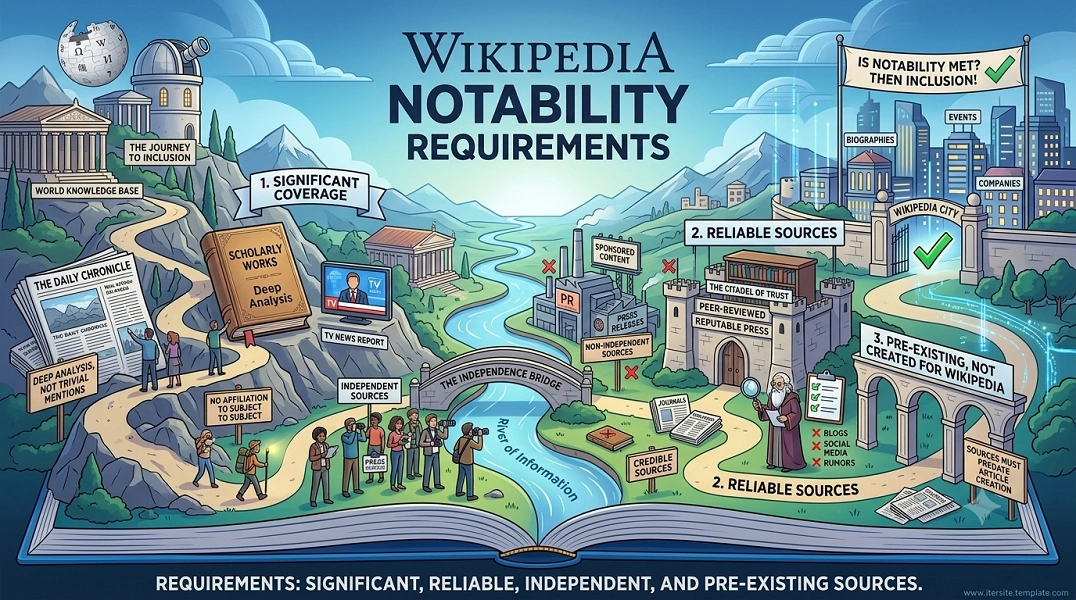
The article must still comply with other standards, including:
- Verifiability
- Neutral point of view
- Reliable sourcing
- No original research
- Copyright rules
- Conflict-of-interest disclosure
- Biographies of living persons policies, where applicable
Notability determines whether the subject deserves an article. It does not excuse promotional writing, unsupported claims, poor citations, or policy violations. (Wikipedia)
Quick Answer: What Does Someone Need to Qualify?
A person, company, or organization usually needs several sources that meet the following conditions:
- The coverage is significant.
The source discusses the subject in meaningful detail rather than mentioning the name once. - The source is reliable.
It has credible authors, editorial oversight, fact-checking, or an established publishing process. - The source is independent.
It was not written, paid for, controlled, or supplied by the subject. - The source is secondary.
It analyzes, reports on, evaluates, or interprets the subject instead of simply repeating the subject’s own statements. - There are multiple qualifying sources.
One good article may help, but Wikipedia normally expects coverage across more than one independent source. - The coverage is about the subject.
A passing mention in an article primarily about another person or business is usually insufficient. - The attention is more than temporary publicity.
Coverage produced during one brief promotional campaign may be weaker than independent attention developed over time.
A large number of weak sources does not necessarily establish notability. Two or three substantial, independent features can be more valuable than 50 short mentions, directory listings, or copied press releases.
What Does “Significant Coverage” Mean?
Significant coverage means that a source discusses the subject directly and in enough detail to support meaningful encyclopedic content.
A source does not need to be exclusively about the subject. Wikipedia notability requirements depend on many cases. However, it must provide more than a trivial mention.
Examples of potentially significant coverage
- A newspaper publishes a detailed profile of an entrepreneur.
- A respected business publication analyzes a company’s growth and market influence.
- A major magazine discusses an artist’s career and cultural impact.
- An academic publication evaluates a researcher’s contributions.
- A national news outlet investigates an organization’s activities.
- A respected trade journal publishes an independent feature about a company’s innovations.
Examples of coverage that is usually not significant
- A person’s name appears in a list of event attendees.
- A company is mentioned in one sentence about an industry trend.
- A product is included in a long shopping roundup without substantial analysis.
- A business appears in a local directory.
- An executive is quoted briefly in an article about another subject.
- A website automatically republishes a press release.
- A database contains basic company information.
The practical question is:
Could an editor use this source to write a meaningful section about the subject without adding unsupported assumptions?
When the answer is no, the coverage is probably too limited to establish notability.
What Makes a Source Reliable?
A reliable source normally has an established process for reviewing, editing, and correcting published information.
Reliability is evaluated in context. A publication may be dependable for one kind of information but unsuitable for another.
Editors may consider the Wikipedia notability requirements:
- The publication’s editorial standards
- The author’s qualifications
- Whether content is fact-checked
- Whether corrections are issued
- The publisher’s reputation
- The difference between news, opinion, and sponsored content
- Whether the source has a commercial relationship with the subject
- Whether the information is supported by evidence
Traditional newspapers, reputable magazines, academic journals, professionally published books, and established trade publications may qualify when the individual article is independent and substantial.
However, a famous domain name alone does not guarantee that every page on the website is reliable. Sponsored posts, contributor content, press-release sections, user-generated pages, and opinion columns may receive different treatment from staff-reported journalism.
What Does “Independent of the Subject” Mean?
An independent source has no meaningful connection to the person, business, or organization it covers.
The subject should not control the article, pay for it, approve it before publication, or provide most of its content.
Sources that are not independent include:
- The subject’s official website
- Company blogs
- Personal websites
- Employee-written articles
- Press releases
- Sponsored posts
- Paid interviews
- Advertorials
- Investor-relations materials
- Corporate reports
- Social media profiles
- Content published by a public-relations agency
- Articles written by business partners
- Materials from affiliated organizations
These sources may sometimes verify basic facts, such as an official product name, company address, executive appointment, or publication date. However, they generally do not prove that the wider world has taken independent notice of the subject. That is the Wikipedia notability requirements part.
Wikipedia notability is based on recognition from outside the subject’s own network.
What Is a Secondary Source?
A secondary source evaluates, interprets, analyzes, or reports on information originally produced elsewhere.
For example, a company announcement about a new product is a primary source. An independent technology publication analyzing that product’s market impact is a secondary source.
Primary-source examples for Wikipedia notability requirements
- Press releases
- Company websites
- Interviews in which the subject provides most of the information
- Speeches
- Financial reports
- Court filings
- Government records
- Personal social media posts
- Official biographies
- Product documentation
Secondary-source examples for Wikipedia notability requirements
- Independently researched news features
- Analytical magazine articles
- Academic studies discussing the subject
- Professionally published biographies
- Industry reports containing independent analysis
- Books written by unaffiliated authors
Primary sources can support straightforward facts. They are usually insufficient on their own to establish notability because they do not demonstrate independent recognition.
How Many Sources Are Needed for a Wikipedia Page?
Wikipedia does not provide a universal number that guarantees eligibility.
The guideline refers to multiple sources, but quality, depth, reliability, and independence matter more than a simple count.
For example:
- Ten copied press releases do not equal ten independent sources.
- Five one-sentence mentions may not establish significant coverage.
- Twenty directory listings usually provide little notability value.
- One detailed feature may be strong but still leave the article dependent on a single publication.
- Three independent, in-depth articles from respected publications may provide a much stronger foundation.
A sensible assessment should look for at least several genuinely independent sources, not several URLs repeating the same original story.
Watch for source duplication
News syndication can make one story appear on many websites. When multiple publications republish the same wire report or press release, Wikipedia editors may treat them as one underlying source rather than separate evidence.
Always identify the original publisher before counting syndicated coverage.
Wikipedia Notability vs. Popularity
Popularity and notability can overlap, but they are not the same.
A subject may be popular online without receiving meaningful independent coverage. Another subject may have a limited social media audience but extensive coverage in books, newspapers, journals, or respected industry publications.
Metrics that do not automatically establish notability
- Social media follower count
- Website traffic
- Revenue
- Number of customers
- Years in business
- Employee count
- Search volume
- Verified social media status
- App downloads
- YouTube views
- Podcast subscribers
- Advertising expenditure
- A high Google ranking
These metrics may demonstrate popularity, commercial success, or audience reach. Wikipedia notability asks a different question:
Have reliable and independent sources considered the subject important enough to cover in meaningful detail?
Wikipedia Notability Requirements for Companies and Brands
Businesses, startups, brands, products, and commercial organizations are evaluated carefully because corporate articles are frequently created for marketing purposes.
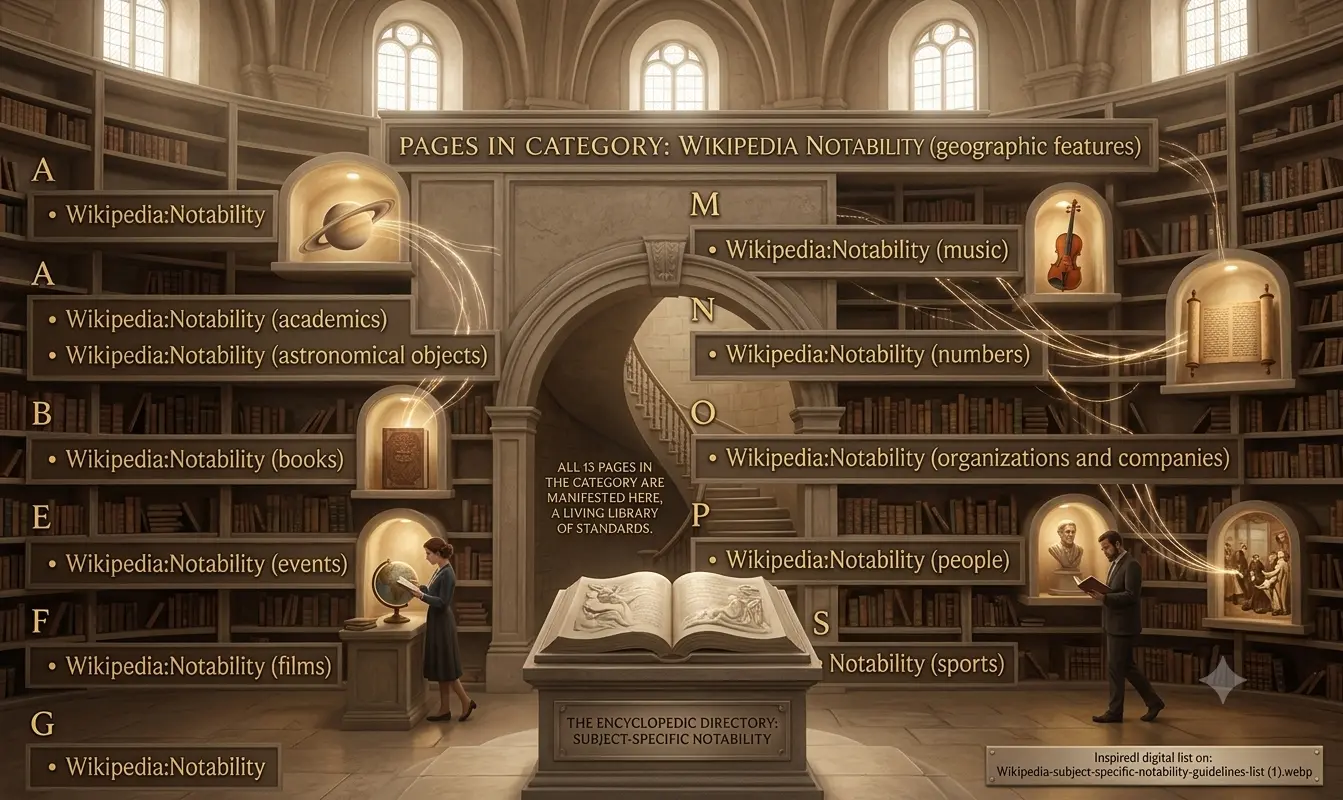
Under Wikipedia’s notability guideline for organizations and companies, a company normally needs significant coverage in multiple reliable, independent secondary sources.
A company does not automatically qualify because it:
- Has operated for many years
- Earns substantial revenue
- Employs many people
- Has raised investment
- Owns registered trademarks
- Has received routine business awards
- Works with famous clients
- Has offices in several countries
- Is publicly traded
- Has a large customer base
- Has a successful founder
- Is considered important by its industry
Those facts may be relevant to an article, but they do not replace independent coverage. (Wikipedia)
Stronger sources for business notability
Potentially useful company sources include:
- Detailed profiles in established business publications
- Independent analysis in respected trade journals
- Investigative reporting
- Books discussing the company’s history or influence
- Academic case studies
- National or international reporting about the company
- Substantive reporting on the business’s market impact
- Independent coverage of major controversies, innovations, or historical developments
Weaker sources for business notability
The following sources usually have limited value:
- Funding announcements based on press releases
- Product launch announcements
- Company interviews arranged by a PR agency
- Sponsored founder profiles
- “Top 10 company” listicles
- Business directory profiles
- Award announcements published by the award organizer
- Partner announcements
- Customer testimonials
- Affiliate reviews
- Company database entries
- Content produced by the company’s investors
A well-known founder also does not automatically make every company they establish notable. Wikipedia generally evaluates each subject independently.
Wikipedia Notability Requirements for People
A person may qualify when reliable, independent sources have covered their life, career, achievements, influence, or public role in substantial detail.
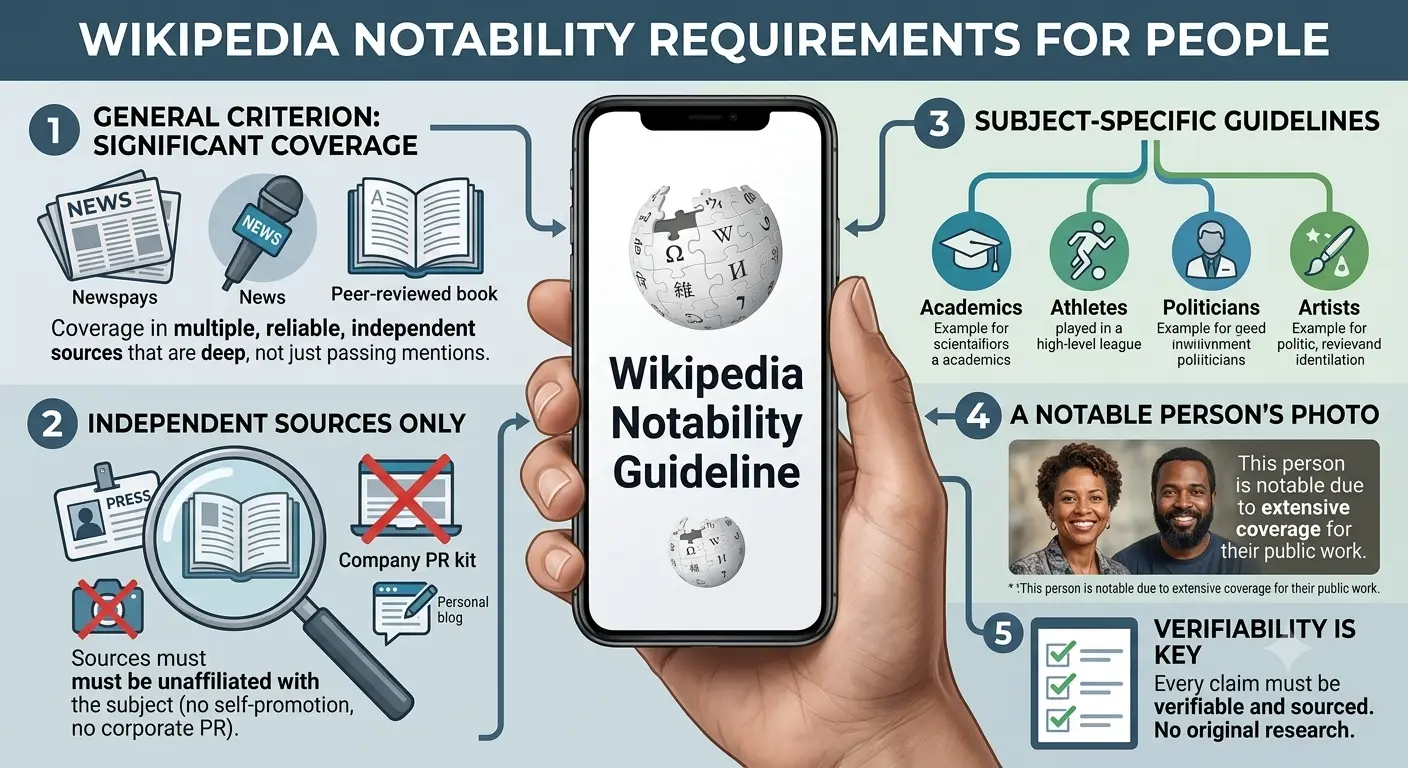
Possible sources include:
- Detailed newspaper or magazine profiles
- Independent biographies
- Academic publications
- Books from established publishers
- Documentary coverage
- Substantive interviews accompanied by independent reporting
- Significant coverage of the person’s work or public impact
Achievements that may support notability
Depending on the field, relevant achievements may include:
- Major awards
- Important public appointments
- Widely reviewed creative work
- Significant academic contributions
- National-level political activity
- Elite sports participation
- Leadership in major organizations
- Historically important accomplishments
However, an achievement is not always enough by itself. The most important evidence remains reliable, independent coverage.
A person may still have weak eligibility when:
- Most information comes from their own website.
- Coverage consists mainly of podcast appearances.
- Articles are paid profiles.
- Sources repeat the same biography.
- The person is mentioned only in connection with a notable employer.
- The individual is known mainly through social media.
- Awards have little independent recognition.
- Interviews contain no third-party analysis.
- Coverage is limited to promotional announcements.
Notability is also not inherited. Being related to a famous person, employed by a notable company, or associated with a well-known organization does not automatically qualify someone for an individual article.
Wikipedia Notability for Artists, Authors, Musicians and Creators
Creative professionals may be assessed through both the general notability guideline and subject-specific guidance.
Useful evidence may include:
- Reviews of books, films, albums, exhibitions, or performances
- Profiles in respected arts publications
- Coverage of major awards or nominations
- Academic analysis of creative work
- Books discussing the creator’s career
- Independent reporting on cultural influence
- Coverage from established industry publications
Self-published portfolios, personal websites, online stores, streaming profiles, IMDb-style database pages, social media accounts, and promotional interviews may verify individual facts but are generally weak evidence of notability.
Reviews should also be substantial. A brief star rating or one-paragraph customer review is not equivalent to an independently researched critical assessment.
Wikipedia Notability for Academics and Researchers
Academics may be evaluated under subject-specific standards as well as the general guideline.
Relevant indicators can include:
- Significant influence within an academic field
- Widely recognized scholarly contributions
- Major academic awards
- Election to prestigious scholarly societies
- Leadership of important academic institutions
- Substantial coverage in independent sources
- Highly influential publications
A publication list alone does not automatically establish notability. University profile pages, faculty biographies, Google Scholar records, personal CVs, and institutional announcements are often primary or affiliated sources.
They may verify employment and publication details, but stronger independent evidence may still be required.
Does Media Coverage Automatically Establish Notability?
No. “Media coverage” is too broad a term.
A source must be examined individually.
Ask the following questions:
- Who published it?
- Who wrote it?
- Was it independently researched?
- Did the subject pay for or arrange it?
- Does it discuss the subject in detail?
- Is it news, opinion, sponsored content, or a press release?
- Does it contain analysis or repeat promotional claims?
- Does the publisher exercise editorial control?
- Is the article primarily about the subject?
- Is it one original story or a syndicated copy?
A recognizable publication can host multiple types of content. Its staff journalism may be treated differently from its sponsored, contributor, or user-generated sections.
Do Press Releases Count Toward Wikipedia Notability?
Press releases generally do not establish notability.
A press release originates from the subject or an organization representing the subject. It is therefore not independent.
Republishing a press release on multiple websites does not transform it into independent journalism.
Press releases can sometimes verify limited facts, such as:
- The date of a product launch
- The appointment of an executive
- A company’s official statement
- The announced location of an event
- The title of a new publication
Even then, independent sources are normally preferable when available.
Do Interviews Count as Reliable Sources?
It depends on the interview.
A question-and-answer interview is often a primary source because the subject supplies the information. It may verify what the individual said, but it may provide limited evidence of independent notability.
An interview becomes more useful when it is part of a broader, independently researched profile containing:
- Reporting from the journalist
- Context from third parties
- Independent analysis
- Fact-checking
- Discussion of the subject’s wider impact
A promotional podcast appearance or paid interview normally carries less weight than an independently commissioned profile from an established publication.
Do Awards Establish Wikipedia Notability?
Awards can help, but not every award has equal value.
Editors may consider:
- The award’s reputation
- The selection process
- The number and quality of candidates
- Independent coverage of the award
- Whether the award is competitive
- Whether recipients are selected by recognized experts
- The award’s influence within the field
- Whether the recipient paid to enter or receive it
Routine certificates, local promotional awards, vanity awards, purchased honors, and “top professional” listings may offer little evidence of notability.
A major award may strongly support eligibility, particularly when it generates substantial independent reporting. However, the article still needs adequate sources from which neutral content can be written.
Does a Wikipedia Page Require National Media Coverage?
Not always.
A source does not automatically become unusable because it is local or specialized. A reputable local newspaper or respected trade journal can provide useful coverage.
However, the depth, independence, editorial quality, audience, and context matter.
For example, a detailed investigative feature may be valuable. A routine announcement that a new store has opened is unlikely to establish notability.
For companies, coverage limited to small local outlets, routine business announcements, or publications that profile nearly every business in the area may face greater scrutiny.
Can Sponsored Articles Be Used?
Sponsored articles normally do not establish independent notability.
Common labels include:
- Sponsored
- Paid post
- Partner content
- Brand voice
- Advertorial
- Promoted
- Contributor content
- Native advertising
- Presented by
- In collaboration with
Payment creates a relationship between the subject and the publication. Even when a sponsored article appears on a respected website, the individual page may not be editorially independent.
Trying to conceal sponsored coverage can create additional credibility and policy problems.
Can Social Media Prove Notability?
Social media does not normally establish Wikipedia notability.
Follower counts, verified badges, views, likes, shares, and engagement metrics may demonstrate popularity, but social platforms are generally self-published or user-generated.
They may verify limited statements, such as how a public figure described an event, but they do not replace reliable independent reporting.
The same principle applies to:
- LinkedIn profiles
- Facebook pages
- Instagram accounts
- X profiles
- TikTok accounts
- Personal YouTube channels
- Self-hosted podcasts
- Medium posts written by the subject
Can a Wikipedia Page Be Created With Only Primary Sources?
A page based almost entirely on primary sources is vulnerable.
Primary documents may verify facts, but an encyclopedia article should not depend on editors interpreting raw materials or deciding why a subject matters.
Without secondary sources, the article may become:
- A company profile
- A résumé
- A directory listing
- A product description
- A personal biography
- A collection of announcements
- Original research
Independent secondary sources provide the context needed to explain why the subject has received broader attention.
Wikipedia Notability Is Not Temporary
A subject that has genuinely become notable does not normally stop being notable simply because media attention decreases.
However, temporary publicity does not necessarily establish enduring notability in the first place. Wikipedia notability requirements
For example, one viral event, short controversy, product launch, or publicity campaign may generate many brief articles. Editors may still ask whether the coverage is substantial enough to support a complete standalone article.
The issue is not whether the subject is currently trending. The issue is whether reliable sources have documented the subject with enough depth to justify encyclopedic treatment. Wikipedia notability requirements
Wikipedia Notability Is Not Inherited
Notability does not automatically transfer between related subjects.
Examples include:
- A notable founder does not make every company notable.
- A notable company does not make every executive notable.
- A famous parent does not automatically make their child notable.
- A successful film does not make every cast member notable.
- A notable organization does not make every project notable.
- A popular product does not make its manufacturer independently notable.
- A notable musician does not make every album or song automatically notable.
Each proposed article must have its own appropriate evidence unless a subject-specific guideline clearly provides another route.
Wikipedia Notability Is Not a Reward
A Wikipedia article is not awarded for success, hard work, public service, business growth, or personal achievement.
Wikipedia is an encyclopedia, not a promotional platform, professional directory, social network, or recognition program.
A person or company can be respected and successful without meeting Wikipedia’s inclusion criteria. Conversely, Wikipedia may cover controversial or negatively perceived subjects when reliable sources have documented them extensively.
Notability does not mean “good,” “famous,” or “recommended.” It means the subject has received sufficient independent coverage for an encyclopedia article.
Wikipedia Notability Source Comparison
| Source type | Can verify facts? | Usually establishes notability? |
|---|---|---|
| Independent newspaper feature | Yes | Often, when substantial |
| Staff-written magazine profile | Yes | Often, when substantial |
| Academic journal analysis | Yes | Potentially |
| Professionally published book | Yes | Potentially |
| Respected trade publication | Yes | Potentially |
| Company website | Yes, for limited facts | No |
| Press release | Yes, for announcements | No |
| Sponsored article | Sometimes | Usually no |
| Social media profile | Limited use | No |
| Business directory | Basic facts only | No |
| Database listing | Basic facts only | Usually no |
| Routine event listing | Limited use | No |
| Independent investigative report | Yes | Often |
| Paid interview | Limited use | Usually no |
| Syndicated copy of one story | Yes | Counts as one underlying source |
A Step-by-Step Wikipedia Notability Assessment
Before drafting an article, conduct a source-based eligibility assessment.
Step 1: Define the exact proposed subject
Determine whether the article would be about:
- A person
- A company
- A brand
- A product
- An organization
- An event
- A book
- A film
- A musician
- An academic
- A website
Do not combine the notability of related subjects. A founder’s sources may not establish the company’s notability, and company coverage may not establish the founder’s personal notability.
Step 2: Collect all potentially relevant sources
Search for:
- Detailed news features
- Magazine profiles
- Books
- Academic publications
- Industry analyses
- Documentary coverage
- Substantive interviews
- Investigative reporting
- Historical archives
Search variations of the subject’s name, previous names, brand names, product names, abbreviations, and locations.
Step 3: Remove clearly affiliated sources
Separate:
- Official websites
- Press releases
- Social media
- Employee content
- Partner content
- Investor publications
- Sponsored articles
- PR agency placements
These sources may support minor facts later, but they should not form the foundation of the notability assessment.
Step 4: Identify primary and secondary sources
Determine whether each source independently analyzes the subject or merely repeats what the subject said.
Prioritize secondary sources for demonstrating notability.
Step 5: Measure the depth of coverage
Classify each source as:
- Trivial mention
- Short mention
- Moderate discussion
- Significant coverage
- In-depth profile or analysis
Only the stronger categories are likely to make a meaningful contribution to notability.
Step 6: Check reliability and editorial oversight
Look at the publication, author, article type, correction policy, ownership, and editorial process.
Do not evaluate reliability solely by domain authority or search ranking.
Step 7: Check for duplication
Determine whether several URLs repeat one press release, wire report, or original article.
Count original reporting rather than copies.
Step 8: Review subject-specific guidance
Companies, academics, musicians, athletes, politicians, creative works, events, and other subjects may have additional notability guidelines.
Meeting one criterion may create a presumption of notability, but adequate sources are still important for writing a verifiable article.
Step 9: Build a source-based article outline
Before writing, confirm that independent sources can support the major sections.
A company article might need sources for Wikipedia notability requirements:
- History
- Operations
- Products or services
- Market impact
- Reception
- Controversies
- Major developments
A biography might need sources for Wikipedia notability requirements:
- Early life
- Education
- Career
- Major work
- Reception
- Awards
- Public impact
When most sections depend on the subject’s own materials, the article may not yet have a strong independent foundation.
Step 10: Make a realistic decision
After reviewing the evidence, classify the subject as:
- Likely eligible
- Possibly eligible but source-limited
- Not currently eligible
- Requires specialist review
Do not force a positive answer. A careful “not yet” assessment is safer than submitting a weak promotional draft that may be declined or deleted.
Unofficial Wikipedia Notability Checklist
This checklist is not an official Wikipedia scoring system. It is a practical pre-assessment tool. So check the Wikipedia notability requirements checklist.
| Question | Yes | No |
|---|---|---|
| Are there multiple original sources? | ☐ | ☐ |
| Are the strongest sources independent? | ☐ | ☐ |
| Are they from reliable publishers? | ☐ | ☐ |
| Do they provide significant coverage? | ☐ | ☐ |
| Are most of them secondary sources? | ☐ | ☐ |
| Is the subject the main focus of several sources? | ☐ | ☐ |
| Is the coverage more than routine publicity? | ☐ | ☐ |
| Can an article be written without relying heavily on the official website? | ☐ | ☐ |
| Is the coverage spread across different publishers? | ☐ | ☐ |
| Does the subject meet any relevant specialist guideline? | ☐ | ☐ |
A large number of “no” answers indicates that the subject may not yet be ready.
Common Wikipedia Notability Mistakes
Counting every URL as a separate source
Wikipedia notability requirements. Several websites may copy one press release or syndicated report. They are not necessarily independent pieces of evidence.
Treating domain authority as editorial reliability
Wikipedia notability requirements also refer. A website can have strong SEO metrics while publishing sponsored, contributor, or user-generated content.
Relying on company-provided information
An article built mainly from an official website may read like marketing material and fail to demonstrate independent attention.
Confusing verification with notability
A government record can verify a registration date. It does not necessarily show that the organization is notable.
Using awards without evaluating them
Not every award is selective, respected, independent, or widely covered.
Assuming success guarantees eligibility
Revenue, investment, audience size, and professional achievements do not replace independent sourcing.
Writing before assessing the sources
A polished draft cannot repair a weak notability foundation.
Purchasing low-quality publicity
Sponsored profiles and disguised advertorials may create URLs but not legitimate independent coverage.
Believing someone can guarantee permanence
Wikipedia is community-edited. No outside person or agency controls the final outcome or can guarantee that an article will never be challenged.
Before choosing any provider, review the warning signs associated with fake Wikipedia page creators.
Can Wikipedia Notability Be Bought?
Notability itself cannot legitimately be purchased. But you can follow Wikipedia notability requirements to fulfil.
A business can pay for advertising, public relations, sponsored content, or professional writing. However, paid exposure is not the same as independent editorial recognition.
A professional service may help with:
- Source research
- Eligibility assessment
- Policy analysis
- Neutral drafting
- Citation formatting
- Conflict-of-interest disclosure
- Submission preparation
- Talk-page edit requests
- Monitoring and maintenance
It cannot ethically manufacture independent notability or guarantee a particular community decision.
Any provider promising guaranteed approval, permanent protection, secret administrator control, or immunity from deletion should be approached cautiously.
Can a Professional Service Help With Eligibility?
Yes, provided the service begins with an honest assessment.
A responsible evaluation should distinguish between:
- Strong independent sources
- Sources useful only for basic verification
- Sponsored content
- Affiliated publications
- Duplicate coverage
- Sources that are too brief
- Sources that may create neutrality concerns
Professional help is most useful when the subject already has a reasonable source foundation but needs assistance organizing evidence, writing neutrally, formatting citations, and following disclosure requirements.
You can review the available Wikipedia page creation service after confirming that the proposed subject has enough qualifying coverage.
What Should You Do If You Are Not Yet Notable?
Do not create fake coverage or repeatedly submit substantially similar drafts. That is important for So, you need to follow Wikipedia notability requirements.
Instead, focus on real-world work that may naturally attract independent attention.
Possible long-term actions include:
- Produce meaningful work within your field.
- Publish original research or creative work.
- Participate in newsworthy projects.
- Build genuine industry influence.
- Earn recognition from respected independent organizations.
- Make qualified experts and journalists aware of verifiable developments.
- Maintain accurate public information.
- Avoid deceptive or paid coverage presented as independent journalism.
- Allow time for genuine third-party coverage to develop.
The goal should not be to manipulate Wikipedia. The goal should be to build a record of work that independent publications consider worth covering.
Does Meeting Notability Guarantee Wikipedia Approval?
No.
A subject may meet the notability guideline while a particular draft still fails because it is:
- Promotional
- Poorly sourced
- Copied from another website
- Written with a conflict of interest
- Overly dependent on primary sources
- Structured like a résumé
- Filled with unsupported claims
- In violation of copyright
- Inappropriately detailed
- Missing important context
- Based on unreliable references
Notability is the foundation, not the entire building.
A successful article also needs neutral language, accurate citations, appropriate scope, balanced coverage, and compliance with Wikipedia’s editorial standards.
Frequently Asked Questions
What are the main Wikipedia notability requirements?
A subject generally needs significant coverage in multiple reliable, independent, secondary sources. Brief mentions, press releases, official websites, social media, and sponsored articles are usually insufficient on their own. So, you need to follow the FAQ of Wikipedia notability requirements.
How many reliable sources are needed for a Wikipedia page?
Wikipedia does not specify one universal number. Multiple sources are normally expected, but their quality and depth matter more than the total number of links.
Can a business qualify because it earns high revenue?
High revenue may demonstrate commercial success, but it does not automatically establish Wikipedia notability. The business still needs substantial independent coverage.
Do press releases count as Wikipedia sources?
Press releases can sometimes verify simple announcements, but they are not independent and generally do not establish notability.
Can sponsored articles help establish notability?
Sponsored articles are normally weak evidence because the subject paid for or influenced the coverage. Independent editorial reporting is more valuable.
Does having a famous founder make a company notable?
No. Notability is not inherited. The company must normally have sufficient coverage as a subject in its own right.
Does a large social media following qualify someone for Wikipedia?
No. Follower counts and engagement can demonstrate popularity but do not replace independent, reliable coverage.
Can one major newspaper article be enough?
One strong article may provide valuable evidence, but Wikipedia generally expects multiple independent sources. A page based on one publication may be vulnerable.
Can an interview prove notability?
An interview may help, but a basic question-and-answer format is primarily the subject’s own testimony. An independently researched profile with substantial journalistic analysis is stronger.
Can Wikipedia notability be purchased?
No. Services can provide research, drafting, formatting, and policy support, but legitimate notability depends on independent coverage that cannot simply be purchased.
Is Wikipedia notability permanent?
Genuine notability is not normally lost merely because a topic becomes less popular. However, a temporary burst of publicity may never have established sufficient notability in the first place.
Can a deleted Wikipedia page be created again?
Potentially, but only when the underlying problems have been resolved. Recreating substantially the same article without stronger sourcing or changed circumstances can lead to another deletion.
Final Thoughts
Wikipedia notability requirements are fundamentally about independent recognition.
So, you need to follow Wikipedia notability requirements. A person or business does not qualify simply because it is successful, popular, verified, profitable, or widely promoted. The strongest evidence comes from reliable third parties that have examined the subject in meaningful detail.
Before writing or submitting an article, evaluate every source for:
- Reliability
- Independence
- Depth
- Editorial oversight
- Secondary analysis
- Originality
- Relevance to the proposed subject
A careful notability assessment can prevent wasted time, rejected drafts, deletion discussions, and reputational damage.
For a source-based eligibility review, contact BuyWikiLinks before beginning the drafting process. A responsible assessment should identify both the strengths and weaknesses of your available coverage without promising an outcome that no outside service can control.
