


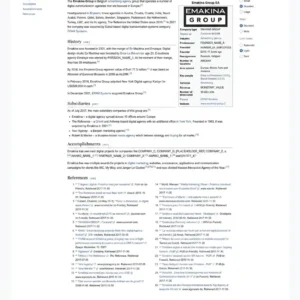
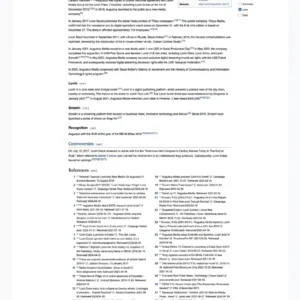
Wikipedia Notability Assessment & Source Audit Service
Price range: $199.00 through $499.00
Unsure whether a person, company, brand, organization, product, or public figure may qualify for a Wikipedia article? Our Wikipedia notability assessment reviews the available independent coverage, source reliability, depth of reporting, and potential eligibility concerns.
You will receive a written source-audit report, an overall eligibility finding, and practical recommendations for the next step. This is an advisory assessment and does not guarantee article acceptance, publication, or permanent retention.
- Independent-source and media-coverage review
- Source-by-source strength classification
- Person, company, brand, organization, or product assessment
- Identification of sponsored, promotional, and dependent sources
- Written eligibility finding and recommended next steps
- No publication or acceptance guarantees
Find Out Whether Your Subject May Qualify for a Wikipedia Article
A successful business, established career, recognizable brand, large social media audience, or impressive list of achievements does not automatically make a subject eligible for a Wikipedia page. Wikipedia eligibility is based mainly on the quality and depth of published coverage about the subject.
Our Wikipedia Notability Assessment and Source Audit Service helps you understand whether the available evidence may support a standalone article before you spend money on research, writing, or submission. We evaluate the subject, examine relevant publications, identify weak or dependent sources, and prepare a written assessment explaining the strongest next step.
This service is suitable for individuals, companies, founders, executives, artists, authors, professionals, nonprofit organizations, consumer brands, products, public figures, and other subjects considering a Wikipedia article.
For a detailed introduction to the eligibility standard, read our guide to Wikipedia notability requirements for people, companies, and brands.
What Is a Wikipedia Notability Assessment?
A Wikipedia notability assessment is a structured review of the published evidence surrounding a proposed article subject. Its purpose is to determine whether reliable and independent sources have discussed the subject in enough depth to support a neutral encyclopedia article.
Wikipedia’s general notability guideline explains that significant coverage should address a topic directly and in meaningful detail. A brief name mention, directory listing, quotation, social profile, or routine announcement will not normally provide the same evidentiary value as an independent feature, detailed profile, book chapter, academic analysis, or substantial industry report.
Our assessment does not simply count the number of links containing the subject’s name. We examine what each publication actually says, who produced it, how it was published, whether the subject influenced the coverage, and whether the material provides enough independent information for an encyclopedic article.
What You Receive
Your completed assessment provides a practical overview of the subject’s current Wikipedia eligibility position. Depending on the information available, the report may include:
- Overall eligibility finding: A clear explanation of whether the source base appears strong, borderline, limited, or currently insufficient.
- Source-by-source review: Individual evaluation of the publications most relevant to the proposed article.
- Source strength classification: Identification of stronger, moderate, weak, dependent, sponsored, promotional, or unusable sources.
- Coverage-depth analysis: Assessment of whether the subject receives meaningful attention or only passing mentions.
- Independence review: Examination of connections between the publisher, author, subject, client, employer, or public-relations activity.
- Reliability review: Consideration of editorial oversight, author information, publication reputation, fact-checking, and subject expertise.
- Article-scope assessment: Guidance on whether the subject may justify a standalone article or might be more appropriate within another topic.
- Risk identification: Explanation of potential rejection, deletion, sourcing, promotional-content, or conflict-of-interest concerns.
- Recommended next step: Practical guidance on whether to proceed, gather stronger sources, revise the proposed scope, or wait for additional independent coverage.
How We Assess Wikipedia Eligibility
1. Significant Coverage
We first examine whether publications discuss the subject directly and in sufficient detail. A source does not need to focus exclusively on the subject, but it should contain enough meaningful information to support encyclopedic writing without relying on assumptions or original analysis.
Examples of potentially useful coverage include an in-depth newspaper profile, a magazine feature, a detailed book section, independent industry analysis, scholarly discussion, investigative reporting, or substantial critical coverage.
A one-sentence mention in a well-known newspaper may be reliable, but it may still be too brief to demonstrate notability.
2. Independence
A source is stronger for notability when its publisher and author are independent of the subject. We look for possible financial, professional, personal, organizational, or promotional relationships that could affect editorial independence.
Company websites, employee biographies, press releases, public-relations materials, paid interviews, sponsored articles, partner websites, and content commissioned by the subject may help verify basic facts. However, they will not normally establish notability by themselves.
3. Reliability
We consider whether a source has recognizable editorial standards and an appropriate reputation for accuracy. Relevant factors may include professional oversight, named authors, publication dates, original reporting, subject expertise, corrections practices, and accountability for factual errors.
The suitability of a source also depends on the claim it supports. A trade publication may be useful for specialized industry information, while a scholarly publication may be more appropriate for academic or technical claims.
You can review Wikipedia’s official guidance on identifying reliable sources for additional context.
4. Secondary-Source Value
Independent secondary sources are especially important because they analyze, interpret, or report on a subject rather than simply repeating information supplied by the subject.
Primary sources such as corporate filings, official websites, personal statements, product documentation, and government records may verify specific facts. They do not necessarily demonstrate that the wider world has given the subject enough attention to justify a standalone article.
5. Multiple and Diverse Publications
Wikipedia does not use a universal rule requiring an exact number of sources. Quality, independence, depth, diversity, and duration of coverage matter more than a raw total.
Twenty short mentions copied from the same press release may be weaker than several detailed articles produced independently by reputable publishers over a meaningful period. We therefore examine whether the sources represent genuinely separate editorial decisions rather than repeated versions of the same announcement.
6. Subject-Specific Requirements
Different subjects may be affected by additional guidelines. A company, product, organization, person, academic, athlete, author, musician, politician, or creative professional may require a different type of evidence.
Companies and organizations are generally assessed according to significant coverage in multiple reliable and independent secondary sources. You can review the official Wikipedia guideline for organizations and companies.
Biographies of living people require especially careful sourcing. Contentious, private, or potentially harmful statements need strong published evidence and must be handled conservatively. See Wikipedia’s biographies of living persons policy.
Who Should Order This Service?
This assessment is particularly useful when:
- You are uncertain whether a person or company qualifies for Wikipedia.
- You have many media links but do not know which sources carry real weight.
- Your coverage includes a mixture of independent, sponsored, promotional, and self-published material.
- You want to reduce the risk of paying for a draft that lacks sufficient sourcing.
- A previous Wikipedia draft was declined or rejected for notability concerns.
- An earlier article was deleted, redirected, merged, or challenged.
- You need an independent review before choosing a page-creation package.
- You want to know whether the subject or one of its products should be the proposed article topic.
- You need a written explanation that can be shared with your internal marketing, communications, or legal team.
Subjects We Can Assess
A Wikipedia source audit may be performed for many types of subjects, including:
- Companies, startups, and established businesses
- Entrepreneurs, founders, and executives
- Artists, actors, musicians, and creative professionals
- Authors, journalists, and media personalities
- Academics, researchers, and industry specialists
- Athletes, coaches, and sports professionals
- Nonprofit organizations, charities, and associations
- Consumer brands, products, software, and services
- Public figures, speakers, and online creators
- Events, projects, institutions, and professional organizations
Eligibility is never assumed because of a profession, title, award, revenue figure, follower count, client list, or business valuation. Each subject is assessed according to the available published evidence.
Sources That May Strengthen a Notability Case
Although every source must be evaluated in context, potentially stronger evidence may include:
- Detailed articles from established newspapers
- Independent magazine profiles or features
- Books published by reputable independent publishers
- Peer-reviewed academic or scholarly publications
- Substantial coverage in respected trade publications
- Independent documentaries or broadcast reports
- Investigative reporting focused on the subject
- Meaningful critical reviews of notable creative work
- Historical coverage documenting long-term significance
- Independent analysis of a company, product, career, or public impact
Sources That Usually Do Not Establish Notability Alone
The following materials may help confirm basic facts, but they are commonly weak for proving eligibility when used without stronger independent coverage:
- Official websites and corporate blogs
- Personal websites and online portfolios
- Press releases and announcement-wire articles
- Sponsored articles, advertorials, and paid placements
- Social media accounts and verified profiles
- Business directories and database listings
- Employee biographies and speaker profiles
- Routine funding, appointment, partnership, or product announcements
- Customer testimonials and review-platform profiles
- Affiliate articles and guest posts
- Event listings and conference programs
- Brief quotations or name mentions in larger articles
- Interviews controlled or commissioned by the subject
A professional-looking layout or appearance on a recognized website does not automatically make an article independent. Sponsorship, editorial control, the origin of the information, and the relationship between the publisher and subject must still be considered.
What We Need From You
To prepare an accurate assessment, please provide as much of the following information as possible after placing your order:
- The subject’s full name and any former, alternate, or trading names
- The official website or primary online profile
- Links to news articles, profiles, books, interviews, reports, and other publications
- PDF copies or publication details for sources that are not freely accessible online
- The proposed Wikipedia language edition
- Any previous Wikipedia draft, article, submission, deletion discussion, or reviewer feedback
- A short explanation of the relationship between the purchaser and the subject
- The intended article topic, such as the company, founder, product, brand, or organization
Private documents, internal presentations, unpublished biographies, and confidential records may provide background information, but Wikipedia notability generally depends on publicly verifiable published evidence.
Our Assessment Process
- Information review: We organize the subject information and source links provided with the order.
- Source screening: We identify duplicate, inaccessible, promotional, sponsored, dependent, or potentially unreliable material.
- Detailed source audit: We examine the strongest publications for independence, reliability, depth, relevance, and secondary-source value.
- Eligibility analysis: We compare the available evidence with the relevant Wikipedia notability considerations.
- Risk review: We identify weaknesses that could result in rejection, deletion, merging, redirection, or sourcing challenges.
- Written conclusion: We provide an overall finding and explain the recommended next step.
Possible Assessment Outcomes
Potentially Ready for Drafting
The available source base appears strong enough to consider moving to research and drafting. This finding means that the evidence may support further work; it is not a guarantee that Wikipedia editors will accept or retain an article.
Borderline or Conditional
Some useful evidence exists, but important weaknesses remain. The report may recommend locating additional independent coverage, changing the proposed article scope, excluding unsuitable sources, or waiting before proceeding.
Not Currently Supported
The available evidence does not presently appear sufficient for a standalone article. We will explain the major gaps and identify realistic next steps rather than recommending premature submission.
What This Service Does Not Include
This product is a research and advisory assessment. Unless separately stated in the selected package, it does not include:
- Writing a complete Wikipedia article
- Submitting or publishing a draft
- Direct editing of an existing Wikipedia article
- Creating or supplying media coverage
- Guaranteeing that a source will be accepted by Wikipedia editors
- Guaranteeing publication, approval, permanence, or protection from deletion
- Controlling future edits or community decisions
- Removing legitimate criticism or unfavorable published information
- Bypassing Wikipedia policies or editorial review
Why Complete the Assessment Before Article Writing?
A well-written draft cannot repair a weak source base. Researching notability first can prevent unnecessary writing costs, reduce the risk of a premature submission, and help determine the correct article scope.
It can also reveal whether a company founder has stronger personal coverage than the company, whether a product belongs within its parent company’s article, or whether the available publications are mostly sponsored or promotional.
To understand the difference between assessment, writing, editing, and maintenance, see our guide to Wikipedia page creation and writing services.
What Happens After the Assessment?
If the evidence appears suitable for further work, you may review our Wikipedia page creation service or browse all Wikipedia page creation options.
You may also read our guide explaining what a professional Wikipedia article writing service should include.
If the subject is not yet ready, the assessment can help you avoid an unsuitable submission and focus on the evidence gaps. It is important not to manufacture notability through paid articles or artificial coverage. Eligibility should develop from genuine independent attention.
Paid Editing and Transparency
Wikipedia-related work should be approached transparently. The Wikimedia Foundation requires disclosure of the employer, client, intended beneficiary, and relevant affiliation for compensated contributions, subject to applicable project rules.
Learn more in our guide to Wikipedia paid-editing disclosure requirements or review the official Wikimedia paid-contribution disclosure information.
Frequently Asked Questions
Does this service guarantee that I qualify for a Wikipedia page?
No. The service provides a professional advisory opinion based on the available sources and applicable guidelines. Final editorial decisions are made independently by Wikipedia contributors.
How many sources are required for Wikipedia notability?
There is no universal minimum number. Several strong, independent, reliable, and substantial sources may be more useful than dozens of weak mentions, press releases, directories, or sponsored articles.
Can press releases establish notability?
Press releases can verify basic announcements, but they are produced by or for the subject and normally do not establish independent recognition by themselves.
Do articles in major publications always count?
No. The publication name is only one factor. We also consider the depth of coverage, author, editorial process, independence, sponsorship status, and whether the article contains original reporting or mainly repeats supplied material.
Can sponsored articles be used?
Sponsored articles may sometimes verify limited facts, but they are generally weak evidence of independent notability because the coverage was paid for or commissioned.
Can you assess a previously rejected Wikipedia draft?
Yes. Send the draft link, reviewer comments, deletion discussion, and available sources. The assessment can identify whether the principal problem concerns notability, source quality, promotional writing, article scope, or another issue.
Can a famous or successful person fail the notability test?
Yes. Commercial success, professional achievement, social-media popularity, and public recognition may be impressive, but Wikipedia eligibility still depends on appropriate published evidence or an applicable subject-specific guideline.
Can an eligible subject still have its article rejected?
Yes. Notability creates a basis for considering an article, not an automatic right to publication. A submission may still face concerns involving sourcing, neutrality, promotional language, conflicts of interest, article scope, copyright, or verifiability.
Which Wikipedia language edition will you assess?
Please identify the intended language edition when ordering. Different Wikipedia communities may apply different guidelines and local editorial practices.
Order Your Wikipedia Notability Assessment
Choosing an article-writing service before checking the source base can lead to unnecessary cost and avoidable rejection. A structured notability assessment gives you a clearer understanding of the subject’s current position, the quality of the available evidence, and the most responsible next step.
Select the appropriate assessment option above and submit the subject information and source links after checkout.
For questions about the required material or the most suitable service, contact the BuyWikiLinks team before ordering.
Independent-service disclaimer: BuyWikiLinks is an independent service and is not affiliated with, endorsed by, or operated by Wikipedia or the Wikimedia Foundation. Wikipedia is a collaboratively edited project, and its community retains control over article acceptance, content, editing, merging, redirection, and deletion.
| Wikipedia Notability Assessment | Wikipedia Maintenance & Update, Wikipedia Notability Audit, Wikipedia Page Editing, Wikipedia Training Courses |
|---|
Be the first to review “Wikipedia Notability Assessment & Source Audit Service”
Related products
Wikipedia Page Creation
Reviews
There are no reviews yet.