
How to Write a Neutral Wikipedia Article Without Promotional Language
Jul
How to Write a Neutral Wikipedia Article Without Promotional Language
Learning how to write a Wikipedia article requires more than collecting facts and arranging them into sections.
The article must be written from a neutral point of view. It should describe the subject without promoting it, attacking it, defending it, or telling readers what conclusion to reach.
This is especially difficult when the writer is connected to the subject.
A founder may naturally emphasize the company’s achievements. A publicist may focus on favorable coverage. A biographer may want to present a person as respected, successful, pioneering, or influential.
Those intentions may be appropriate for a company website, media kit, press release, personal biography, or sales page. They are not appropriate for an encyclopedia article unless reliable independent sources directly support the claims and the wording is presented with proper context.
A neutral Wikipedia article should answer questions such as:
- Who or what is the subject?
- What has the subject done?
- Why have independent sources covered it?
- Which events are important enough to include?
- How have reputable sources described its work or impact?
- Are there significant positive and negative viewpoints?
- How much attention should each viewpoint receive?
This guide explains how to replace marketing language with sourced facts, balance positive and negative coverage, use quotations correctly, and review a draft for neutrality before submission.
What Does Neutral Point of View Mean on Wikipedia?
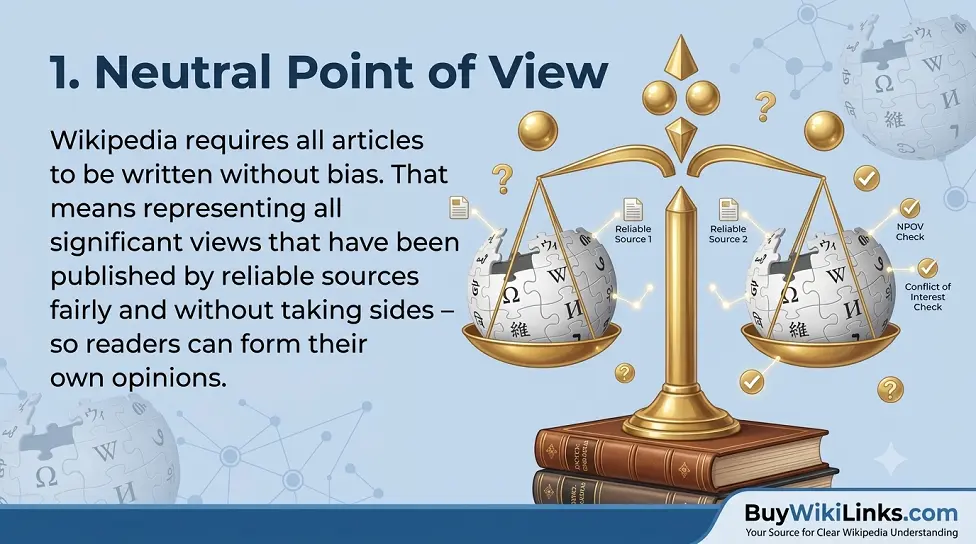
Wikipedia’s Neutral Point of View principle is commonly abbreviated as NPOV.
It means an article should fairly and proportionately represent significant viewpoints that have been published by reliable sources.
Neutrality does not mean every article must say equal numbers of positive and negative things.
It also does not mean every opinion must receive the same amount of space.
Instead, the article should reflect the balance found in high-quality published coverage.
When most reliable sources describe one interpretation as established and only a small number support another position, Wikipedia should not present both views as equally accepted.
The goal is to inform readers—not persuade them.
A neutral article:
- Describes rather than promotes
- Attributes opinions instead of presenting them as facts
- Uses nonjudgmental language
- Gives topics weight based on source coverage
- Includes significant criticism when appropriate
- Avoids giving minor controversies excessive attention
- Separates verifiable facts from interpretation
- Does not hide a writer’s preferred viewpoint in the article’s structure
Wikipedia’s official Neutral Point of View policy explains that neutrality applies to both what an article says and how it says it.
Neutrality Does Not Mean Removing Every Opinion
Wikipedia articles may include opinions, evaluations, criticism, praise, and disputed interpretations when those views have been published by reliable sources.
The important issue is attribution.
Instead of stating an opinion as a fact, identify who expressed it.
Opinion presented as fact
The novel is the author’s greatest work.
Properly attributed opinion
Literary critic Jane Morris described the novel as the author’s most accomplished work.
The second sentence does not require Wikipedia to agree with the critic. It reports that the critic expressed the opinion.
Attribution is especially important when:
- The claim is subjective
- Reliable sources disagree
- The statement is controversial
- The wording praises or criticizes the subject
- The claim concerns artistic quality
- A ranking or reputation is disputed
- The description comes from an interested party
Promotional Phrases to Avoid
Promotional language often appears harmless because it is common in marketing, business profiles, award announcements, and public relations materials.
In a Wikipedia article, these phrases can make an article sound like advertising.
Common promotional expressions include:
- Leading company
- Industry leader
- World-class
- Globally recognized
- Highly respected
- Renowned expert
- Visionary entrepreneur
- Innovative organization
- Revolutionary technology
- Trusted provider
- Prestigious brand
- Rapidly growing
- Best-in-class
- Cutting-edge
- Award-winning professional
- Premier service
- Groundbreaking solution
- Successful business leader
- Exceptional quality
- Unmatched expertise
These descriptions often create two problems.
First, they make a subjective judgment.
Second, they are frequently unsupported or supported only by the subject’s website, press releases, or sponsored content.
Replace praise with specific information
Instead of:
Nova Systems is a leading provider of innovative cybersecurity solutions.
Write:
Nova Systems is a cybersecurity company founded in 2017. It develops network-monitoring software for financial institutions.
The second version explains what the company does without claiming that it is leading or innovative.
Replace vague reputation claims with attributed coverage
Instead of:
Patel is a highly respected medical researcher.
Write:
In 2023, the Royal Medical Society awarded Patel its Clinical Research Medal for her work on antibiotic resistance.
The sourced achievement allows readers to form their own judgment.
Watch for Subtle Promotional Language
Not all promotional writing uses obvious praise.
A Wikipedia article draft can also become promotional through selection, structure, and omission.
Subtle warning signs include:
- Including every award but no criticism
- Listing all products in detail
- Describing ordinary business events as major milestones
- Giving charity work more space than independent sources do
- Repeating the company’s slogan
- Naming famous customers without a clear encyclopedic reason
- Including positive testimonials
- Using quotations from founders to explain the company’s importance
- Ending sections with favorable conclusions
- Giving routine media mentions their own section
Neutrality involves more than removing adjectives. The entire article must be proportionate.
Write From Independent Sources, Not the Subject’s Marketing Materials
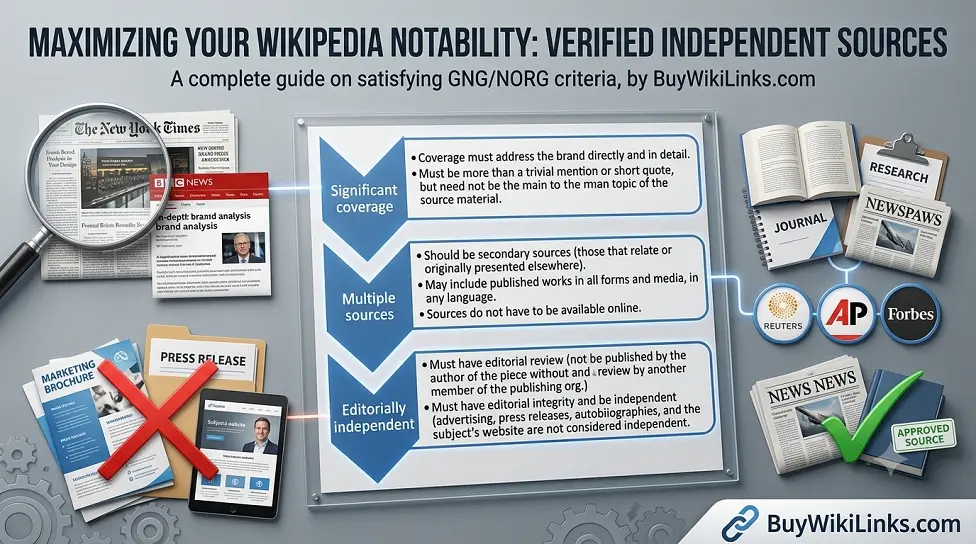
A neutral article should be built mainly from reliable sources that are independent of the subject.
Depending on the topic, these may include:
- Established newspapers
- Reputable magazines
- Books from credible publishers
- Academic journals
- Independent documentary coverage
- Specialist trade publications
- Government or regulatory reports
- Independent critical reviews
Official and connected sources may sometimes verify straightforward facts, but they should not determine the article’s overall framing.
Connected sources include:
- Official websites
- Personal websites
- Press releases
- Company blogs
- Executive biographies
- Marketing brochures
- Social media profiles
- Investor presentations
- Sponsored interviews
- Paid features
Why source independence affects tone
Official sources naturally present the subject from its preferred perspective.
A company website may emphasize:
- Growth
- Innovation
- Awards
- Customer success
- Mission
- Products
- Social responsibility
Independent reporting may also discuss:
- Competition
- Regulation
- Failed projects
- Lawsuits
- Criticism
- Ownership changes
- Financial difficulties
- Industry context
Using a range of independent sources makes it easier to produce a balanced article.
Before drafting A Wikipedia article, read our guide to creating a Wikipedia page without violating Wikipedia’s rules.
Do Not Start With the Client’s Preferred Narrative
A common mistake is to ask the subject or client which sections they want and then search for sources to support that story.
The safer process is the opposite:
- Collect the strongest independent sources.
- Identify the topics those sources cover.
- Determine which topics receive the most attention.
- Build the article structure from that evidence.
- Remove information that cannot be supported.
This prevents the draft from becoming a marketing profile with citations added afterward.
Handle Positive and Negative Coverage Proportionately
A neutral article does not need to contain an artificial 50–50 balance.
The amount of space given to praise, criticism, achievements, and controversies should reflect their prominence in reliable sources.
When positive coverage should be included
Positive material may be appropriate when independent sources substantially discuss:
- Important achievements
- Major awards
- Critical acclaim
- Industry impact
- Scientific contributions
- Commercial success
- Cultural influence
- Public service
A Wikipedia article should report the facts or attribute the evaluation.
When negative coverage should be included
Negative material may be appropriate when reputable sources substantially discuss:
- Lawsuits
- Regulatory action
- Professional criticism
- Product failures
- Public controversy
- Environmental concerns
- Labor disputes
- Financial problems
- Ethical questions
The article should not remove significant criticism merely because the subject dislikes it.
Avoid a criticism section built from minor complaints
Neutrality also requires avoiding excessive negative coverage.
A draft should not collect every:
- Customer complaint
- Negative review
- Social media dispute
- Minor lawsuit
- Critical quotation
- Short-lived controversy
A verifiable fact can still receive undue weight when it is given more space or prominence than the wider source record justifies.
Integrate Controversies Into the Article Naturally
Creating a separate “Controversies” section is not always the most neutral approach.
Sometimes criticism fits more naturally within:
- History
- Reception
- Operations
- Political career
- Product development
- Legal proceedings
For example, a regulatory investigation may belong in the chronological history rather than in an isolated section that makes it appear to define the entire company.
The structure itself can influence how readers interpret the subject.
Replace Marketing Claims With Sourced Facts
The most effective way to neutralize a draft is to replace vague praise with specific, verifiable information.
“Leading”
Promotional:
Apex is a leading renewable-energy company.
Neutral:
Apex operates solar farms in Spain and Portugal and reported a generating capacity of 620 megawatts in 2025.
“Award-winning”
Promotional:
Chen is an award-winning filmmaker.
Neutral:
Chen received the Jury Prize at the Northshore Film Festival in 2024 for the documentary After the Tide.
“Innovative”
Promotional:
The company developed an innovative payment system.
Neutral:
The company introduced a contactless payment system using biometric authentication in 2022.
“Fast-growing”
Promotional:
The startup became one of the fastest-growing companies in Europe.
Neutral:
The company’s workforce increased from 40 employees in 2021 to 280 in 2024, according to the Financial Review.
“Renowned”
Promotional:
Ahmed is a renowned architect.
Neutral:
Ahmed designed the River Arts Centre and received the National Architecture Medal in 2020.
The neutral versions do not avoid achievements. They express them through evidence.
Use Precise Verbs
Promotional drafts often rely on dramatic verbs.
Avoid unnecessary wording such as:
- Revolutionized
- Transformed
- Dominated
- Redefined
- Disrupted
- Pioneered
- Catapulted
- Empowered
- Elevated
- Spearheaded
Use precise verbs instead:
- Founded
- Developed
- Published
- Designed
- Acquired
- Introduced
- Expanded
- Served
- Produced
- Received
- Reported
- Opened
- Closed
“Pioneered” may be appropriate when reliable independent sources explicitly establish that the person or company was the first to develop something. Otherwise, use a less judgmental description.
Avoid Claims About Intentions
A writer may be tempted to explain why a company, organization, or person made a decision.
For example:
The company opened the program to empower underserved communities.
Unless a reliable source independently explains that intention, this wording may simply repeat the organization’s public relations message.
A more neutral version would be:
The company launched the program in 2022 to provide technical training in five rural districts.
If the company’s stated purpose is relevant, attribute it:
The company said the program was intended to expand access to technical training.
Proper Use of Quotations
In a Wikipedia article, direct quotations can add value, but overusing them may create bias, clutter, or copyright concerns.
A quotation should have a clear encyclopedic purpose.
Useful quotations may:
- Show a significant public position
- Capture a historically important statement
- Explain a disputed interpretation
- Represent a notable critical response
- Clarify how a source characterized an event
Do not use quotations as decoration
Avoid quotations included mainly because they sound impressive.
For example:
The founder said the company was “building a brighter, smarter and more connected future.”
This adds marketing language without providing useful independent information.
Do not let the subject define its own importance
A subject’s statement about itself is not independent evidence.
Weak:
The founder called the platform “the most significant innovation in modern retail.”
Better:
The founder described the platform as a major innovation; independent reviewers focused primarily on its use of automated inventory tracking.
Attribute every quotation clearly
Readers should know:
- Who said it
- Where it appeared
- When it was said
- Why it matters
Quote only what is necessary
When a long quotation can be summarized accurately, paraphrasing is often better.
Quotation-heavy writing can make the article feel like a collection of press statements rather than an encyclopedia entry.
Avoid Editorial Conclusions
A Wikipedia article should not add personal conclusions at the end of a paragraph or section.
Promotional conclusion:
This achievement confirmed the company’s status as a global leader.
Neutral ending:
The agreement expanded the company’s distribution network into six additional countries.
Promotional conclusion:
Her success has inspired millions worldwide.
Neutral ending:
By 2025, her educational videos had been translated into eight languages.
State what happened. Let readers interpret its importance.
Neutral Before-and-After Examples On Wikipedia Article
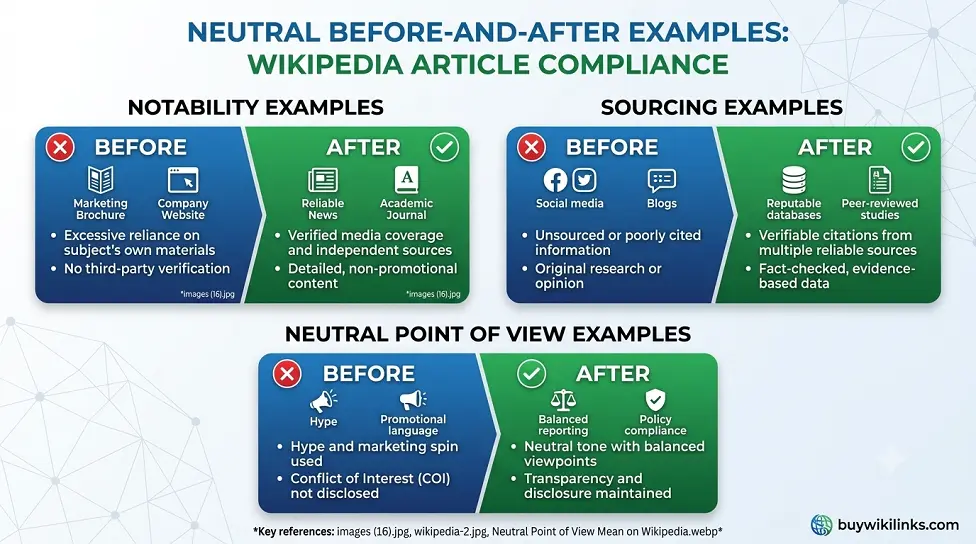
Example 1: Company Introduction for A Wikipedia article
Before
LumaTech is a globally recognized and award-winning technology company offering groundbreaking solutions that help businesses achieve exceptional results.
After
LumaTech is a Canadian software company founded in 2016. It develops customer-support applications for retail and telecommunications companies.
Why the revision works
The revised version removes unsupported praise and identifies the company’s country, industry, founding year, and activity.
Example 2: Entrepreneur Biography
Before
Maria Santos is a visionary entrepreneur whose passion and determination turned her into one of Latin America’s most influential business leaders.
After
Maria Santos is a Brazilian entrepreneur who founded the logistics company ViaNova in 2013. She served as its chief executive until its acquisition by Meridian Group in 2021.
Why the revision works
The revision replaces emotional and subjective language with verifiable career information.
Example 3: Product Description
Before
The company’s revolutionary platform offers an unmatched user experience and powerful features.
After
The platform allows users to schedule deliveries, track orders, and manage supplier invoices through a mobile application.
Why the revision works
The revised text explains the product’s functions instead of evaluating its quality.
Example 4: Award
Before
His outstanding contributions have earned him numerous prestigious international awards.
After
In 2022, Okafor received the International Engineering Council’s Materials Research Award.
Why the revision works
The revised version names a specific award and date.
Example 5: Market Position
Before
The company quickly became the country’s leading online retailer.
After
According to Market Business, the company recorded the country’s highest online retail revenue in 2024.
Why the revision works
The ranking is attributed to a named source and limited to a specific measurement and year.
Example 6: Positive Reception
Before
The novel was widely praised as a masterpiece.
After
Reviewers in the Daily Review and Literary Quarterly praised the novel’s narrative structure, while critic Helen Ward criticized its pacing.
Why the revision works
The revision identifies the sources and represents more than one significant response.
Example 7: Controversy
Before
The company was involved in a shocking scandal that exposed its unethical behavior.
After
In 2023, the Consumer Authority fined the company for failing to disclose recurring subscription charges. The company said it had updated its billing notices following the ruling.
Why the revision works
A Wikipedia article revision reports the action and response without dramatic language.
Example 8: Charity Work
Before
The organization is deeply committed to transforming disadvantaged communities.
After
In 2024, the organization funded three vocational-training centers in northern Kenya, according to the East Africa Journal.
Why the revision works
The statement identifies a specific activity rather than making a broad claim about commitment or impact.
Common Neutrality Problems in Article Structure
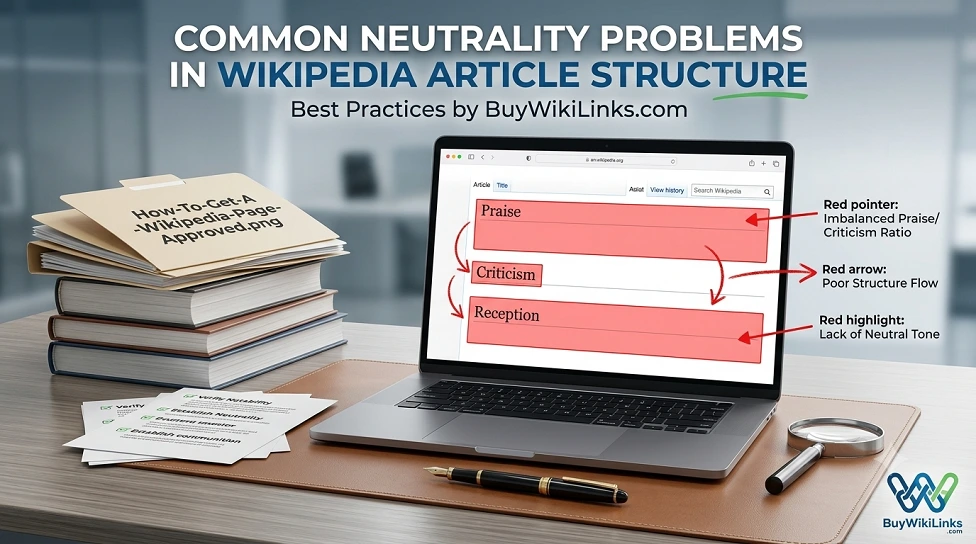
An article may contain individually factual sentences and still be unbalanced.
Review the overall structure for the following problems.
Achievement-heavy sections
A biography may contain long sections for awards, speaking events, publications, and charitable activities while giving little attention to the person’s main career.
Product catalogues
A Wikipedia article may describe every service package, product feature, and market segment.
Separate criticism sections with excessive detail
Minor disputes may appear more important when grouped together under a prominent heading.
Unbalanced lead sections
The introduction may include several achievements while omitting a major controversy discussed throughout the article.
Selective timelines
A company history may describe growth in detail while skipping closures, leadership changes, or regulatory events.
Repeated praise
The same achievement may appear in the introduction, career section, awards section, and conclusion.
Neutrality requires reviewing the complete article, not only individual words.
How to Review a Draft for Promotional Tone
Complete the review in several passes.
First pass: Highlight adjectives in a Wikipedia article
Mark words that praise, criticize, dramatize, or evaluate.
Ask whether each adjective is:
- Necessary
- Verifiable
- Attributed
- Proportionate
Second pass: Highlight unsourced conclusions
Look for claims such as:
- Became a leader
- Changed the industry
- Gained widespread respect
- Achieved global recognition
- Inspired millions
- Revolutionized the market
Replace them with specific evidence or remove them.
Third pass: Check every section against the sources
Ask:
- Do independent sources discuss this topic?
- Does the section receive more space than the sources justify?
- Is this information included mainly because the client requested it?
- Is significant criticism missing?
Fourth pass: Review the introduction last
The lead should summarize the finished article.
It should not introduce praise, claims, or achievements that are not explained and sourced in the body.
Fifth pass: Read the draft as a skeptical outsider
Imagine the article is about a company or person you have never heard of.
Does it inform you, or does it appear to be selling something?
Final Wikipedia Neutrality Checklist
Before submitting a draft, confirm the following in a Wikipedia article.
Tone
- The article describes rather than promotes.
- Subjective adjectives have been removed or attributed.
- The wording does not praise or attack the subject.
- Dramatic verbs have been replaced with precise language.
- The article does not contain slogans or calls to action.
Sources
- The article is based mainly on independent sources.
- Official sources are used only for appropriate limited facts.
- Sponsored articles are not presented as independent coverage.
- Every important statement is directly supported.
- Opinions are attributed to their sources.
Balance
- Significant positive and negative coverage is represented.
- Minor criticism does not receive excessive weight.
- Major controversies are not hidden.
- The structure does not favor one viewpoint.
- The lead fairly summarizes the full article.
Claims
- Awards are named and sourced.
- Superlatives such as “first,” “largest,” and “leading” have strong evidence.
- Claims of influence or reputation are attributed.
- Private intentions are not presented as facts.
- Unpublished information has been removed.
Quotations
- Every quotation has a clear purpose.
- The speaker is identified.
- Quotations are not used as promotional decoration.
- Long quotations have been summarized where possible.
- The subject’s own claims are not treated as independent proof.
Article purpose
- The page does not resemble a resume or a Wikipedia article.
- The page does not resemble a company About page.
- Products and services are summarized rather than advertised.
- External links are not included for lead generation.
- The article would remain useful even without the subject’s preferred branding.
Frequently Asked Questions
What is a neutral Wikipedia article?
A neutral article represents significant published viewpoints fairly and proportionately without endorsing or attacking the subject.
Can a Wikipedia article include positive information?
Yes. Positive achievements may be included when they are relevant, proportionate, and supported by reliable sources.
Can a Wikipedia article include criticism?
Yes. Significant criticism may be included when it is reliably sourced, neutrally written, and given appropriate weight.
Is using the word “leading” always prohibited?
No word is universally prohibited in Wikipedia article, but “leading” is often vague and promotional. Use it only when a reliable source provides a clear measurement or attributed assessment.
Can I use information from a company website?
An official website may support limited, noncontroversial facts. Independent sources should normally determine the article’s overall content and significance.
Should every opinion be placed in quotation marks?
No. Opinions can often be paraphrased and attributed. Direct quotations should be used selectively.
How many negative and positive statements should an article contain?
There is no required ratio for a Wikipedia article. The balance should reflect the prominence of each topic in reliable published coverage.
Can a client remove all unfavorable information from a draft?
A client can identify inaccuracies. Relevant and properly sourced criticism should not be removed merely because it is unfavorable.
Can neutral writing guarantee publication?
No. Neutrality is only one requirement. The subject must also meet notability, sourcing, verifiability, copyright, and other applicable standards.
Why does my draft still sound promotional after removing adjectives?
The problem may come from article structure, selected facts, missing criticism, product detail, repeated achievements, or reliance on official sources.
Final Thoughts
Learning how to write a Wikipedia article neutrally requires changing both the language and the research process.
Do not begin with the subject’s preferred message.
Begin with the strongest independent sources. Identify which events, achievements, viewpoints, and criticisms those sources treat as significant. Then summarize them using precise, nonjudgmental language.
A neutral Write a Wikipedia article should:
- Describe rather than advertise.
- Replace praise with specific facts.
- Attribute opinions.
- Use independent sources.
- Represent significant viewpoints proportionately.
- Include relevant criticism without exaggerating it.
- Use quotations selectively.
- Avoid editorial conclusions.
- Review the complete structure for bias.
- Allow readers to form their own judgment.
Neutral writing does not make a subject less impressive. It makes the article more credible, verifiable, and suitable for an encyclopedia.
Request a Professional Neutral-Tone Review
Write a Wikipedia article. Does your draft sound like a press release, company profile, resume, or reputation-management page?
A professional neutral-tone review can help identify:
- Promotional adjectives
- Unsupported reputation claims
- Excessive achievement lists
- Unbalanced positive or negative coverage
- Overreliance on official sources
- Improperly presented opinions
- Misused quotations
- Undue weight
- Marketing-style article structure
- Claims requiring stronger citations
Review our Wikipedia page creation services or request a professional neutral-tone review.
Include:
- The draft URL or document
- Subject name
- Official website
- Your relationship with the subject
- Strongest independent sources
- Any reviewer comments
- The planned Wikipedia language edition
We will review the article’s wording, structure, source balance, attribution, and overall encyclopedic tone before you write a Wikipedia article for submit or resubmit it.
