
Wikipedia Page
Why Wikipedia Pages Get Rejected: 10 Reasons and How to Fix Them
Jul
Why Wikipedia Pages Get Rejected: 10 Common Reasons and How to Fix Them
Getting a Wikipedia page rejected can be frustrating, especially after spending time collecting information, writing a draft, adding references, and submitting it for review. Many businesses, founders, public figures, artists, startups, authors, and agencies believe that once a draft is submitted, it should be accepted if the information is correct. Lets be details on Wikipedia Pages Get Rejected.
But Wikipedia does not work like a business directory, press release website, or company profile platform. A Wikipedia article must meet specific standards. It needs reliable sources, neutral writing, clear notability, proper structure, and verifiable information.
If your Wikipedia page was rejected, it does not always mean the topic can never qualify. In many cases, the draft failed because of fixable problems. However, before resubmitting the same article, you need to understand why it was rejected and what should be improved.
This guide explains the most common reasons Wikipedia pages get rejected and how to fix them safely.
If you need a professional review before resubmitting your draft, you can start with our Wikipedia account consultation service.
What Does It Mean When a Wikipedia Page Is Rejected?
A rejected Wikipedia page usually means the draft did not meet Wikipedia’s standards at the time of review. This can happen during the Articles for Creation process, during new page review, or after a page has already been published and later challenged by editors.
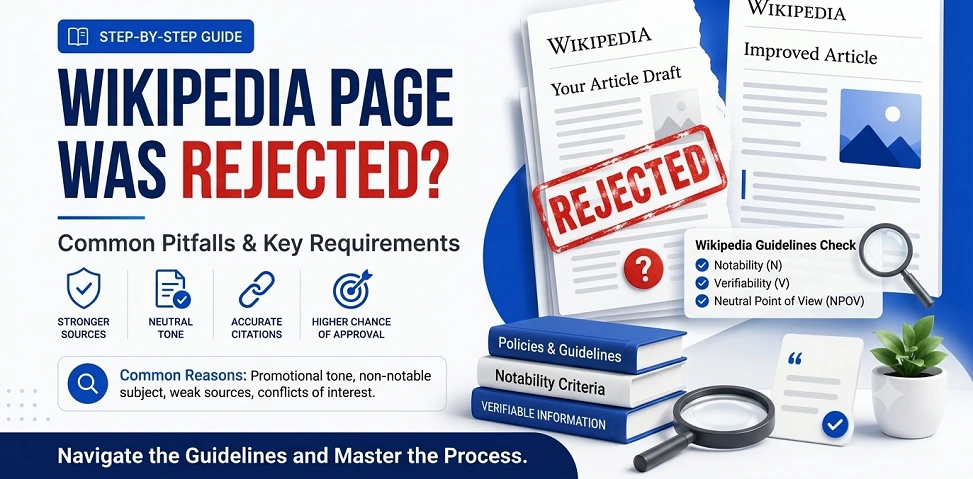
A rejection does not always mean the subject is unimportant. It usually means the article did not provide enough independent evidence, was written in the wrong tone, used weak sources, or failed to show why the topic belongs in an encyclopedia.
Wikipedia reviewers look for more than basic facts. They want to see whether the subject has received enough significant coverage from reliable, independent sources. They also check whether the article is written neutrally and whether the claims are properly supported.
Before trying again, the best step is to review the rejection reason carefully and fix the root problem.
1. The Topic Is Not Clearly Notable
The most common reason a Wikipedia page gets rejected is lack of notability.
Wikipedia notability is not the same as popularity, success, revenue, followers, awards, or personal importance. A company may be successful and still not qualify for Wikipedia. A person may be respected in their industry and still lack enough independent coverage.
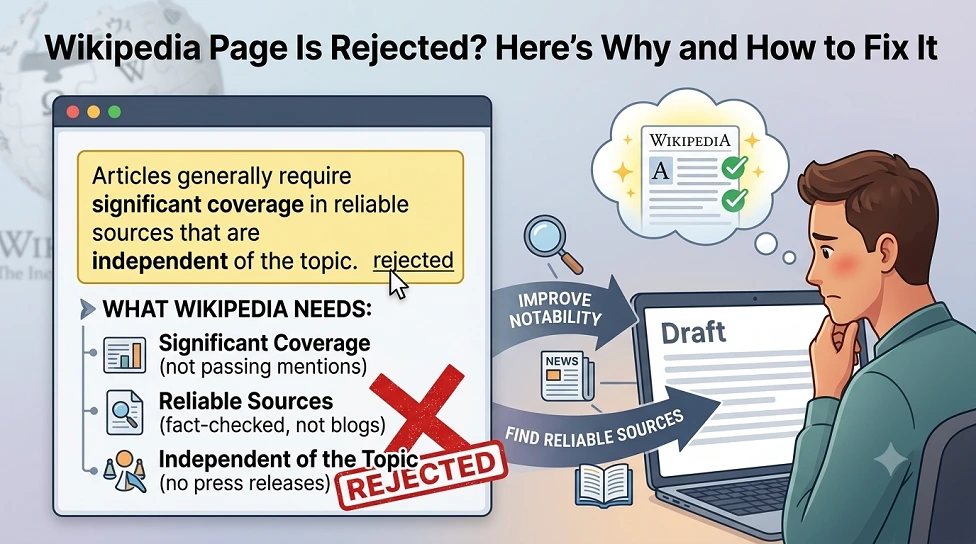
For Wikipedia, notability is usually proven through significant coverage in reliable sources that are independent of the subject.
This means your draft should not depend only on:
- Your official website
- Press releases
- Social media profiles
- Crunchbase
- IMDb
- Amazon author pages
- Company directories
- Paid interviews
- Sponsored content
- Self-published blogs
These sources may help confirm basic facts, but they usually do not prove notability.
How to fix it
Before resubmitting, collect stronger independent sources. Look for news articles, magazine features, books, interviews, industry publications, academic references, or trusted media coverage that discuss the subject in detail.
A short mention in a list is usually not enough. A source should provide meaningful coverage about the person, company, organization, product, or topic.
If you are unsure whether your sources are strong enough, request a source audit before editing again.
2. The Article Uses Weak or Unreliable Sources
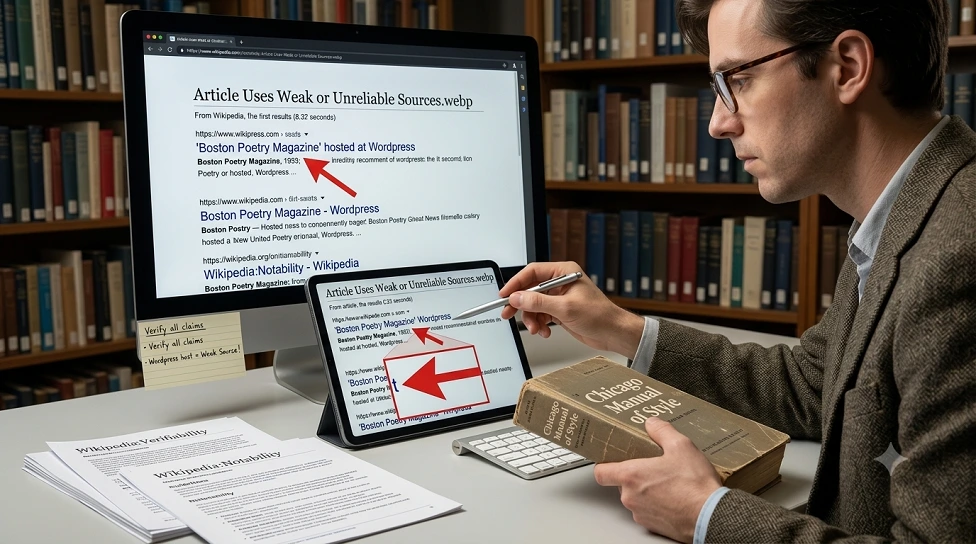
A Wikipedia draft can be rejected even when it has many references. The issue is not only the number of sources. The quality of those sources matters more.
Many rejected drafts include 20 or 30 links, but most of them are weak. Wikipedia reviewers may ignore sources that are promotional, self-published, paid, copied from press releases, or not independent.
Weak sources include:
- Company websites
- Personal websites
- Social media posts
- Press release websites
- Sponsored guest posts
- Affiliate blogs
- Basic database profiles
- User-generated platforms
- Promotional interviews
- Low-quality directories
Strong sources include:
- Independent newspapers
- Reputable magazines
- Books from credible publishers
- Academic journals
- Major industry publications
- Trusted broadcast media
- Independent investigative articles
- Reliable third-party profiles
Wikipedia’s own guidance on reliable sources explains why source quality is central to article acceptance.
How to fix it
Remove weak references before resubmitting. Do not try to hide poor sources inside a long reference list. Instead, build the article around the strongest independent coverage.
A good rejected-page review should separate sources into three groups:
- Strong sources that can support notability
- Basic sources that only verify simple facts
- Weak sources that should not be used
This helps you understand whether the article needs better writing or whether the subject needs more media coverage first.
3. The Draft Sounds Promotional
Promotional writing is another major reason Wikipedia pages get rejected.
Many businesses write their Wikipedia draft like an “About Us” page. They include marketing language, brand claims, service descriptions, slogans, testimonials, achievements, and sales-focused wording.
That style may work on a company website, but it does not work on Wikipedia.
Avoid phrases like:
- Leading company
- Best service provider
- Trusted by thousands
- Award-winning brand
- World-class platform
- Top-rated expert
- Innovative solution
- Fastest-growing company
- Industry leader
- Premium provider
Even if some of these claims are true, they can make the draft look like advertising unless they are clearly supported by independent reliable sources.
How to fix it
Rewrite the article in a neutral, encyclopedic tone.
Instead of this:
“XYZ Company is a leading digital agency offering world-class marketing solutions to global clients.”
Write this:
“XYZ Company is a digital marketing agency founded in 2018. The company provides search engine optimization, paid advertising, and content marketing services.”
The second version is simple, factual, and less promotional.
A strong Wikipedia article should describe the subject, not sell it.
4. The Draft Reads Like a Company Profile
A Wikipedia article is not a company profile, business listing, resume, or portfolio page. If the draft mainly talks about services, products, mission, values, client benefits, and contact details, it may be rejected.
Company-profile style content often includes:
- Service lists
- Pricing details
- Sales language
- Mission statements
- Founder quotes
- Client testimonials
- Product benefits
- Contact information
- Promotional milestones
- Calls to action
Wikipedia articles should not include calls to action or content written to attract customers.
How to fix it
Structure the article like an encyclopedia entry for Wikipedia Pages Get Rejected.
A better structure may include:
- Introduction
- History
- Background
- Products or activities
- Funding or growth, if independently covered
- Recognition, if supported by reliable sources
- Public controversies, if relevant and well-sourced
- References
The article should summarize what independent sources say about the company, not what the company wants customers to know.
5. The Sources Are Not Independent
Independence is very important on Wikipedia.
A source may be reliable in general but still not independent from the subject. For example, your own company website may be accurate, but it is not independent. A press release may be published on a news website, but if it was written by the company, it is not independent coverage.
Common non-independent sources include:
- The subject’s own website
- Company press releases
- Founder interviews controlled by the brand
- Sponsored posts
- Partner announcements
- Client case studies
- Employee-written articles
- Agency-created profiles
A Wikipedia reviewer wants to see that third parties have written about the subject without being controlled or paid by the subject.
How to fix it
Use independent coverage as the foundation. Your official website can support simple facts such as founding date, leadership, or services, but it should not be the main proof of notability.
Before resubmitting, ask:
- Did this source choose to cover the subject independently?
- Is the article written by a real editorial team?
- Does the source provide meaningful discussion?
- Is the coverage more than a short mention?
- Is it free from obvious promotion?
If most sources fail these questions, the draft may not be ready.
6. The Article Has Too Many Unsupported Claims
Wikipedia requires verifiable information. If your draft makes claims without references, reviewers may reject it or ask for major improvements.
Unsupported claims often include:
- Revenue numbers
- User counts
- Market position
- Awards
- Partnerships
- Client names
- Product claims
- “First” or “largest” statements
- Founder achievements
- Industry rankings
Even simple claims may need citations if they are important to the article.
How to fix it
Review every major sentence and ask: “Which reliable source supports this?”
If a claim cannot be supported, remove it. A shorter article with strong references is better than a long article filled with unsupported claims.
A clean, well-cited draft has a better chance than an overloaded draft with weak evidence.
7. The Page Was Created Too Early
Sometimes the draft is not the main problem. The timing is the problem.
Many companies and public figures try to create a Wikipedia page before they have enough independent coverage. They may have a new business, a growing brand, a product launch, or a few press releases, but not enough significant third-party attention.
Wikipedia usually follows public recognition; it does not create it.
If a topic has not yet received enough independent coverage, the article may be rejected no matter how well it is written.
How to fix it
If the topic is not ready, do not keep resubmitting the same draft. Instead, build stronger public coverage first.
This may include:
- Independent media features
- Interviews in reputable publications
- Industry analysis
- Book or journal references
- Trusted third-party profiles
- Meaningful coverage from established outlets
Once stronger sources exist, the draft can be reviewed again.
For businesses planning a new article, our Wikipedia page creation and editing support can help identify whether the timing is right.
8. The Draft Has Conflict-of-Interest Problems
A conflict of interest happens when someone connected to the subject writes or edits the article. This can include a founder, employee, publicist, agency, freelancer, friend, or paid consultant.
A conflict of interest does not automatically mean the Wikipedia Pages Get Rejected, but it creates extra risk if the draft is promotional, undisclosed, or written from the subject’s point of view.
Wikipedia editors may review connected editing more carefully because the article may not be neutral.
How to fix it
Be careful and transparent. If there is a paid relationship or direct connection, follow Wikipedia’s disclosure expectations and avoid direct promotional editing.
A safer process may include:
- Preparing a neutral draft
- Disclosing paid or connected contributions when required
- Using talk-page requests when appropriate
- Avoiding aggressive editing
- Letting independent editors review the content
- Keeping every claim source-based
If you need more details, read our guide on Wikipedia paid editing disclosure.
9. The Article Is Too Thin or Too Broad
Some Wikipedia Pages Get Rejected are too short and do not provide enough encyclopedic value. Others are too broad and try to include too much unrelated information.
A thin article may only include a few lines about the subject with weak references. A broad article may include too many services, achievements, biographies, product descriptions, and marketing claims without a clear structure.
Both can create problems.
How to fix it
Make the article focused and balanced.
A good Wikipedia draft should answer:
- Who or what is the subject?
- Why is the subject notable?
- What do reliable independent sources say?
- What are the key facts?
- What should be excluded because it is promotional or unsupported?
Do not add unnecessary content just to make the article longer. Length does not prove notability. Quality of coverage matters more.
10. The Draft Was Resubmitted Without Fixing the Main Issue
After a Wikipedia page gets rejected, many people make small changes and submit it again. They may change a few words, add one weak source, or remove one promotional paragraph.
This rarely works if the main issue remains.
If the first rejection was due to lack of notability, adding another press release will not fix it. If the problem was promotional tone, changing the introduction may not be enough. If the sources were weak, formatting changes will not solve the issue.
How to fix it
Before resubmitting, identify the main reason for rejection.
Ask:
- Was the topic not notable enough?
- Were the sources weak?
- Was the writing promotional?
- Was there a conflict-of-interest issue?
- Was the draft poorly structured?
- Were claims unsupported?
- Was the article submitted too early?
Then fix the real problem before submitting again.
Wikipedia’s Articles for Creation acceptance criteria can help you understand what reviewers look for before accepting a draft.
What to Do Immediately After a Wikipedia Page Is Rejected
If your Wikipedia Pages Get Rejected, do not panic and do not rush to resubmit.
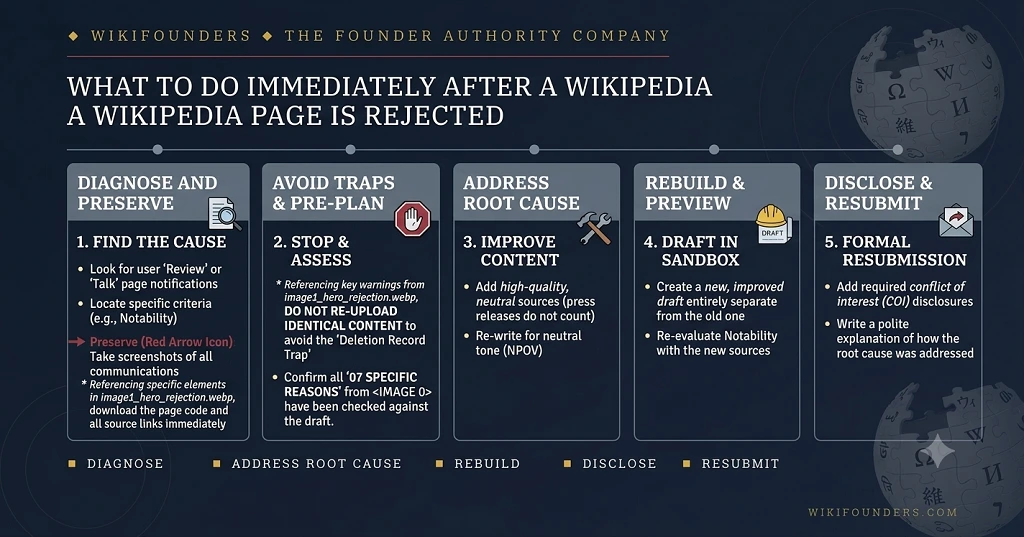
Follow this process:
Step 1: Read the Rejection Message Carefully
The reviewer may explain whether the problem is notability, sourcing, tone, formatting, or another issue. This message is important.
Step 2: Save the Current Draft
Keep a copy of the current version before making major changes. This helps you compare improvements later.
Step 3: Review the Sources
Check whether the sources are reliable, independent, and significant. Remove weak links that make the draft look promotional.
Step 4: Rewrite Promotional Sections
Remove marketing language and rewrite the article in a neutral tone.
Step 5: Check Notability Again
If the subject lacks enough independent coverage, wait until stronger sources are available.
Step 6: Get a Professional Review
A review can help you avoid repeating the same mistake. This is especially useful if the page is important for a business, founder, executive, artist, or public figure.
For help with rejected drafts, you can request a review through our Wikipedia account consultation service.
Can a Rejected Wikipedia Draft Be Fixed?
Yes, many rejected Wikipedia drafts can be fixed, but not all.
A rejected draft is more likely to be fixable if:
- The subject has strong independent sources
- The main issue is promotional tone
- The draft needs better structure
- The citations need cleanup
- The content needs rewriting
- The article was submitted too early but new sources now exist
A rejected draft may not be fixable yet if:
- There are no reliable independent sources
- The topic is too new
- Coverage is only from press releases
- The subject has only social media visibility
- All sources are controlled by the subject
- The article is mainly for promotion
The key is to be honest about the source quality. If the sources are not strong enough, rewriting alone will not solve the problem.
How Professional Wikipedia Review Helps
Professional review can save time because it identifies the actual reason Wikipedia Pages Get Rejected.
A proper rejected-page review may include:
- Notability check
- Source quality audit
- Draft structure review
- Promotional language removal
- Citation cleanup
- Conflict-of-interest risk check
- Resubmission strategy
- Recommendation on whether to wait for better sources
Good Wikipedia support should not promise guaranteed approval. Instead, it should explain what is realistic, what is risky, and what should be improved before the next attempt.
This is especially important for companies, public figures, startups, musicians, authors, agencies, and executives who need to protect their reputation.
How Rejected Wikipedia Pages Affect SEO and Brand Trust
A rejected Wikipedia page does not directly hurt your Google rankings, but it can affect your content strategy and brand trust if handled poorly.
For example, if a promotional draft becomes publicly discussed or repeatedly rejected, it can make the brand look unprepared. If weak sources are used, editors may question the subject’s notability. If multiple accounts are involved in suspicious editing, the situation can become more serious.
A safer approach is to treat Wikipedia as a credibility platform, not a quick SEO shortcut.
If your goal is related to citations or link opportunities, read our guide on how to get backlinks from Wikipedia before attempting edits.
Best Practices Before Resubmitting a Rejected Draft
Before resubmitting your Wikipedia draft, use this checklist:
- Remove promotional wording
- Keep only strong, relevant sources
- Add independent media coverage
- Delete unsupported claims
- Improve the introduction
- Use a neutral structure
- Avoid keyword stuffing
- Check conflict-of-interest issues
- Make sure the subject is notable
- Ask for review before submitting again
Wikipedia Pages Get Rejected draft should not be treated as a small editing problem. It should be treated as a strategy problem. The goal is not only to pass review but to create an article that can survive future community review.
Final Thoughts
A Wikipedia page can be rejected for many reasons, but the most common problems are weak sources, lack of notability, promotional writing, unsupported claims, and conflict-of-interest concerns.
The good news is that some rejected drafts can be improved. The bad news is that resubmitting without fixing the real issue can make the situation worse.
If your Wikipedia page was rejected, take a careful approach. Review the sources, remove promotional language, check notability, and understand the reason for rejection before trying again.
For businesses, public figures, agencies, and founders, professional review can help avoid repeated rejection and reduce risk. A strong Wikipedia strategy is built on reliable sources, neutral writing, transparency, and realistic expectations.
If you want to fix a Wikipedia Pages Get Rejected, start with a proper review instead of rushing another submission. A careful strategy gives your draft a better chance and protects your brand in the long run.
