
Wikipedia Page
Wikipedia Page Creation Service: Process, Deliverables and Red Flags
Jul
Wikipedia Page Creation Service: Process, Deliverables and Red Flags
A professional Wikipedia page creation service does more than write a biography or copy information from a company website.
The process should begin by determining whether the subject is eligible for a standalone Wikipedia article. It should then involve independent source research, neutral writing, citation preparation, transparent disclosure, independent review, and clearly defined post-submission support. Lastly, include details about the Wikipedia page creation service.
However, not every provider follows this process for Wikipedia page creation service.
Some services promise guaranteed publication, permanent pages, administrator approval, secret accounts, instant results, or complete control over the final article. These promises misunderstand—or deliberately misrepresent—how Wikipedia works.
No outside service owns Wikipedia, controls its volunteer community, or can guarantee that an article will remain published forever.
A legitimate provider can improve the quality of the research, draft, citations, disclosure, and submission. It cannot remove Wikipedia’s notability requirements or control future community decisions.
This guide explains Wikipedia page creation service:
- What a Wikipedia page creation service actually does
- How eligibility and sources should be evaluated
- What deliverables a client should receive
- How paid-contribution disclosure works
- What happens after submission
- Which provider red flags to avoid
- What to ask before paying for a service
What Is a Wikipedia Page Creation Service?
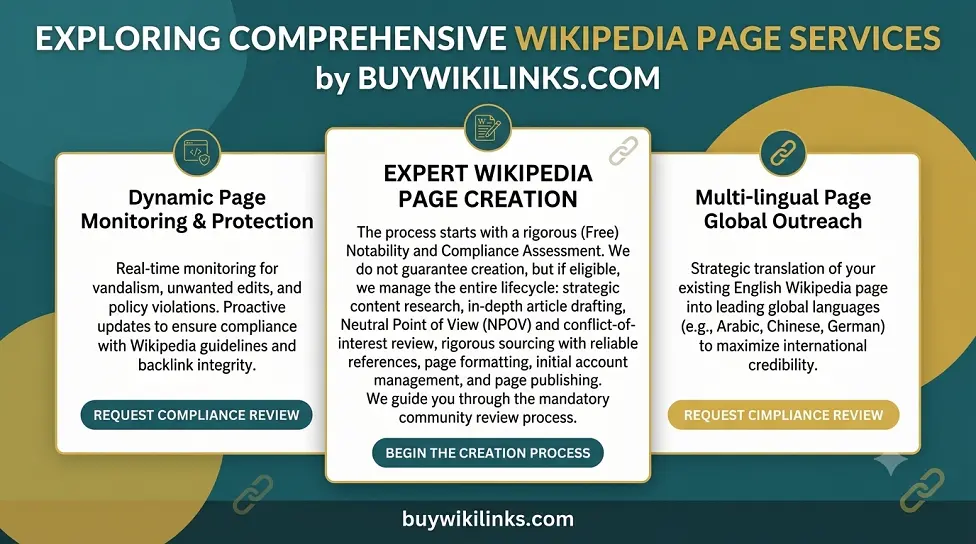
A Wikipedia page creation service is an independent professional service that helps a person, company, organization, brand, product, or public figure research and prepare a proposed Wikipedia article.
Depending Wikipedia page creation service on the package, the provider may offer:
- Preliminary eligibility screening
- Full notability assessment
- Independent source research
- Article planning
- Neutral draft writing
- Citation formatting
- Conflict-of-interest guidance
- Paid-contribution disclosure
- Draft-space preparation
- Articles for Creation submission assistance
- Reviewer-feedback revisions
- Talk-page edit requests
- Post-publication monitoring
The service provider is not Wikipedia.
It does not represent the Wikimedia Foundation unless it can independently prove an official relationship. It cannot sell ownership of an article, charge an official Wikipedia publishing fee, or guarantee community approval.
The client is paying for professional research and editorial assistance—not for control over Wikipedia.
What a Wikipedia Page Creation Service Should Not Promise
A responsible service should never promise:
- Guaranteed Wikipedia approval
- Permanent publication
- Ownership of the article
- A guaranteed Google Knowledge Panel
- Guaranteed search rankings
- Guaranteed social media verification
- Complete removal of criticism
- Administrator approval for any subject
- Immunity from deletion
- Secret publication without disclosure
- Permanent protection from community edits
- The ability to make a non-notable subject notable
A provider may guarantee its own deliverables, such as completing a research report or preparing a draft by an agreed date as per a Wikipedia page creation service.
It cannot guarantee decisions made by independent Wikipedia editors.
Who May Need Professional Wikipedia Assistance?
A page creation service may be useful for:
- Companies with substantial independent media coverage
- Entrepreneurs covered extensively outside their businesses
- Authors, artists, musicians, and filmmakers
- Academics and researchers
- Athletes for Wikipedia page creation service
- Public officials
- Nonprofit organizations
- Historically significant businesses
- Products receiving substantial independent analysis
- Brands with documented cultural or industry impact
- People whose previous drafts were declined
- Organizations needing help evaluating notability before drafting
Professional help is most valuable when the provider is willing to say that a subject is not currently ready.
A service that accepts every client without reviewing eligibility is likely selling writing rather than responsible Wikipedia assistance.
The Complete Wikipedia Page Creation Service Process
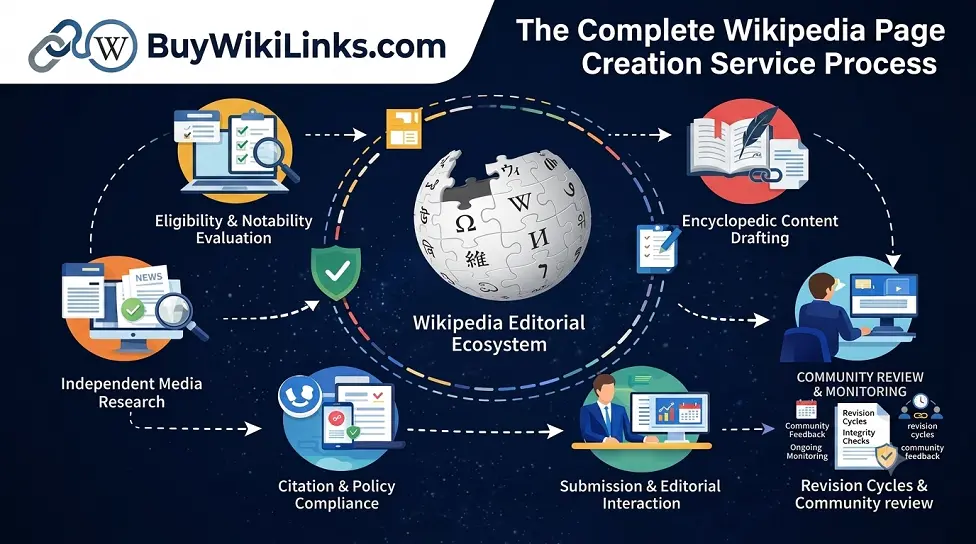
Step 1: Preliminary Eligibility Review
The first stage should be a preliminary eligibility review.
The provider examines whether the subject appears to have enough independent coverage to justify deeper research.
This review may consider:
- The subject’s full name
- Official website
- Profession or industry
- Country or geographic relevance
- Existing media coverage
- Books and academic publications
- Major awards
- Previous Wikipedia drafts
- Past deletion discussions
- Existing articles about related topics
- Possible conflicts of interest
The purpose is to identify obvious strengths and weaknesses before the client purchases a full writing package.
What the preliminary review should answer
A basic review should answer questions such as:
- Does an article already exist?
- Is the subject covered under another name?
- Are there multiple independent sources?
- Is most coverage promotional?
- Has a previous page been deleted?
- Does the topic appear suitable for a standalone article?
- Would it fit better inside another article?
- Is a detailed notability assessment necessary?
The result may be:
- Likely eligible for further assessment
- Potentially eligible but requiring more research
- Borderline
- Not yet ready
- Better suited to an existing article update
- Unlikely to qualify at this time
A preliminary review is not an approval guarantee. It is an early risk assessment.
Step 2: Full Notability Assessment
When the initial review shows potential, the next stage should be a detailed notability assessment.
Wikipedia notability is not based only on fame, revenue, followers, awards, years in business, or the client’s opinion of the subject’s importance.
The central question is whether reliable and independent published sources have covered the subject in meaningful depth.
A full assessment should examine:
- Source reliability
- Publisher reputation
- Source independence
- Coverage depth
- Primary versus secondary sources
- Sponsored content
- Press release syndication
- Passing mentions
- Source diversity
- Coverage over time
- Subject-specific notability guidelines
- Potential article structure
- Deletion risks
What the client should receive
As a Wikipedia page creation service, a professional notability assessment should produce a written recommendation.
It may classify the project as:
Proceed:
The subject appears to have enough suitable source coverage for drafting.
Proceed with caution:
The subject may qualify, but some sources or article sections present risks.
Conduct more research:
Potentially useful sources may exist but have not yet been fully located or evaluated.
Wait:
The current coverage is insufficient, too promotional, or too shallow.
Use another route:
The client may need an edit request, article expansion, merge proposal, or correction rather than a new page.
A provider should not hide an unfavorable assessment merely because it wants to sell a larger package.
Step 3: Independent-Source Research
If the subject appears eligible for Wikipedia page creation service, the provider should conduct independent research.
Client-supplied links are a starting point, not the complete source base.
Research may cover:
- Newspaper archives
- Magazine databases
- Books
- Academic journals
- Trade publications
- Government reports
- Court or regulatory records
- Documentary coverage
- Broadcast archives
- Regional media
- Historical archives
- Subscription databases
- Non-English publications
The researcher must separate credible editorial coverage from material that looks impressive but provides little value.
Stronger source types
Potentially strong sources may include:
- Detailed newspaper profiles
- Independent magazine features
- Books from reputable publishers
- Peer-reviewed analysis
- Investigative reporting
- Independent documentary coverage
- Established trade-publication analysis
- Significant critical reviews
Their actual value still depends on relevance, independence, and depth.
Weaker source types
Sources that usually provide weak evidence for notability include:
- Company websites
- Personal websites
- Press releases
- Sponsored articles
- Business directories
- Social media profiles
- Event listings
- Customer reviews
- Partner websites
- Affiliate articles
- Routine appointment announcements
- Copied press releases
- Brief quotation mentions
These materials may sometimes support limited factual claims, but they generally cannot form the main foundation of a credible new article.
What a source report should contain
A useful source research report should include:
- Source title
- Author
- Publisher
- Publication date
- URL or publication details
- Independence assessment
- Reliability assessment
- Primary or secondary classification
- Coverage-depth rating
- Sponsorship concerns
- Facts supported
- Overall usefulness
- Possible notability value
It should also identify duplicate material. Twenty websites republishing the same press release do not represent twenty independent sources.
Step 4: Article Scope and Structure
The provider should build the article around what reliable sources cover—not around the client’s marketing priorities.
Possible company article sections include:
- Introduction
- History
- Operations
- Products or services
- Acquisitions
- Industry impact
- Reception
- Controversies
- References
Possible biography sections include:
- Introduction
- Early life and education
- Career
- Major works
- Recognition
- Public positions
- Personal life, when relevant
- Controversies, when properly sourced
- References
Not every article needs every section.
The final structure should reflect:
- The amount of available source coverage
- The relative importance of each topic
- The need for balance
- Wikipedia’s summary style
- Whether sections can be supported independently
A client may want a long section about awards, products, clients, partnerships, or charity work as per Wikipedia page creation service. If reliable sources do not cover those subjects, the writer should not include them merely because the client supplied the information.
Step 5: Neutral Draft Preparation
The article should be written in a neutral, encyclopedic tone.
Wikipedia is not a platform for:
- Advertising
- Public relations
- Personal promotion
- Lead generation
- Reputation management
- Product marketing
- Resume publishing
- Corporate storytelling
A neutral draft describes the subject without instructing readers to admire, trust, contact, follow, or purchase from it.
Promotional wording to avoid
A draft should avoid expressions such as:
- Leading provider
- Globally renowned
- Highly successful
- Award-winning expert
- Revolutionary platform
- Innovative company
- Trusted brand
- Best-in-class service
- Prestigious organization
- Rapidly growing business
These statements are often subjective and promotional.
Example of promotional writing
Horizon Media is a leading and innovative marketing company delivering world-class solutions to clients worldwide.
Example of neutral writing
Horizon Media is a digital marketing company founded in 2014. It provides paid advertising and analytics services to retail and technology companies.
The second version identifies the organization without presenting a sales claim.
Balance and negative coverage
Neutrality does not mean writing an entirely positive article.
When reliable sources have substantially covered criticism, legal disputes, failed projects, regulatory action, or public controversy, some of that information may need to be included.
The amount of coverage should be proportionate to its significance in the reliable sources.
A professional provider should not promise to hide all negative information.
Step 6: Citation and Wikipedia Formatting
Every important claim should be supported by a source that directly verifies it.
Citation work may include:
- Inline references
- Citation templates
- Author and publication details
- Access dates
- Page numbers
- Archive links
- Book identifiers
- Journal identifiers
- Reference-list formatting
The provider may also prepare:
- Section headings
- Internal Wikipedia links
- Infobox data
- Draft templates
- Talk-page disclosure
- Article title
- Disambiguation notes
What citations should not do
Citations should not be added simply to increase the reference count.
A provider should avoid:
- Linking to irrelevant pages
- Citing a source that does not support the statement
- Using press releases to prove notability
- Adding several copies of the same story
- Hiding sponsored content among independent sources
- Citing search-result snippets
- Using fabricated publication details
- Citing inaccessible private documents
- Creating references that do not exist
A draft with eight strong citations can be more credible than one with fifty weak or misleading references.
For a broader explanation of drafting and submission, read our guide to creating a Wikipedia page without violating Wikipedia’s rules.
Step 7: Client Factual Review
The client should normally receive the draft before submission.
The purpose of client review is to identify factual errors, such as:
- Incorrect dates
- Misspelled names
- Wrong job titles
- Incorrect publication names
- Outdated company information
- Misidentified products
- Incorrect relationships between organizations
Client review should not become marketing approval.
A professional writer may need to reject requests to:
- Remove properly sourced criticism
- Add unsupported achievements
- Insert advertising language
- Add promotional external links
- Expand sections beyond the available coverage
- Claim market leadership without evidence
- Present opinions as facts
- Hide a relevant conflict of interest
The final draft should reflect reliable sources, not simply the client’s preferred narrative.
Step 8: Paid-Contribution Disclosure
Anyone receiving compensation for Wikipedia contributions must disclose the relevant employer, client, and affiliation.
Disclosure may be made through:
- The contributor’s user page
- The draft’s talk page
- The affected article’s talk page
- An edit summary
- An appropriate disclosure template
The exact approach depends on the type of project and the relevant language edition.
Wikipedia’s paid-contribution disclosure policy explains that paid editors must disclose who is paying them, who the client is, and any other relevant affiliation.
Why disclosure matters
A paid contributor may have incentives to Wikipedia page creation service:
- Focus on positive information
- Omit criticism
- Use marketing language
- Select only favorable sources
- Add unnecessary external links
- Resist independent changes
Disclosure allows volunteer editors to understand that relationship when reviewing the proposed content.
Disclosure does not guarantee acceptance. It helps make the process transparent.
Red flag: “We never disclose clients”
A provider that promises completely secret paid editing may expose both its accounts and the client to unnecessary risk.
The safest process is usually transparent, properly documented, and open to independent review.
Step 9: Choosing the Submission Route
There is no single submission route suitable for every project.
A provider may recommend one of the following.
Draft or sandbox preparation
The proposed article is prepared in a non-mainspace location while it is being researched and revised.
Articles for Creation
The draft is submitted for review by an independent volunteer.
This route is especially appropriate when the writer has a paid or personal conflict of interest.
The reviewer may:
- Accept the draft
- Decline it
- Reject it
- Request stronger sources
- Request neutral rewriting
- Identify copyright problems
- Recommend a merge
- Conclude that the subject is not currently notable
Talk-page edit request
When the client needs changes to an existing article, a specific talk-page request may be more appropriate than direct editing.
A useful request should include:
- The exact section
- The existing wording
- The proposed replacement
- Reliable supporting sources
- The reason for the change
- Conflict-of-interest disclosure
Direct editing
Direct editing of an affected article by someone with a conflict of interest is strongly discouraged on the English-language Wikipedia.
A provider should explain why a proposed route is appropriate rather than automatically choosing the fastest method.
Step 10: Revisions and Community Feedback
A declined draft does not necessarily mean that the project has permanently failed.
The reviewer may identify fixable issues, such as:
- Promotional language
- Incomplete citations
- Weak article structure
- Excessive detail
- Missing source information
- Copyright concerns
- Duplicate coverage
- Poorly supported claims
The provider should examine the reviewer’s comments and explain:
- Which issues can be corrected
- Which sources need replacement
- Whether additional research is required
- Whether the article should be shortened
- Whether the subject needs more independent coverage
- Whether resubmission is appropriate
Problems that rewriting cannot solve
Some problems cannot be fixed by changing the wording.
For example:
- The subject lacks notability.
- Independent sources do not exist.
- Coverage consists mainly of press releases.
- The topic duplicates an existing article.
- The subject is better covered within another page.
- The draft is based on original research.
- The client expects a promotional article.
A responsible provider should stop when the evidence does not support continued submission.
Repeatedly submitting the same weak draft without addressing the underlying problem can make the situation worse.
Step 11: Publication and Community Editing
If a draft is accepted, it becomes part of a collaborative encyclopedia.
Publication does not transfer ownership to:
- The client
- The writer
- The agency
- The subject
- The first editor
- An administrator
Other contributors may:
- Correct wording
- Remove weak sources
- Add independent coverage
- Shorten promotional sections
- Add criticism
- Reorganize the article
- Add maintenance notices
- Challenge notability
- Nominate the page for deletion
- Merge or redirect the article
A service provider should prepare the client for this outcome.
The published article may differ from the original draft over time.
Step 12: Post-Publication Monitoring
Monitoring involves observing the article for important changes after publication.
A monitoring service may watch for:
- Vandalism
- Unsupported additions
- Removed citations
- New maintenance notices
- Talk-page discussions
- Proposed deletion
- New reliable coverage
- Outdated information
- Changes involving living people
- Major article restructuring
What monitoring can do
Monitoring can identify changes and recommend an appropriate response.
The provider may:
- Send alerts
- Review new edits
- Prepare a sourced talk-page request
- Correct obvious vandalism
- Explain a maintenance tag
- Research a deletion nomination
- Prepare an updated draft
What monitoring cannot do
Monitoring does not provide:
- Ownership
- Permanent protection
- Control over community editors
- The right to restore every preferred sentence
- Guaranteed removal of criticism
- Guaranteed survival of the article
Ask whether the provider offers observation only or includes preparation of properly sourced responses.
Expected Wikipedia Page Creation Deliverables
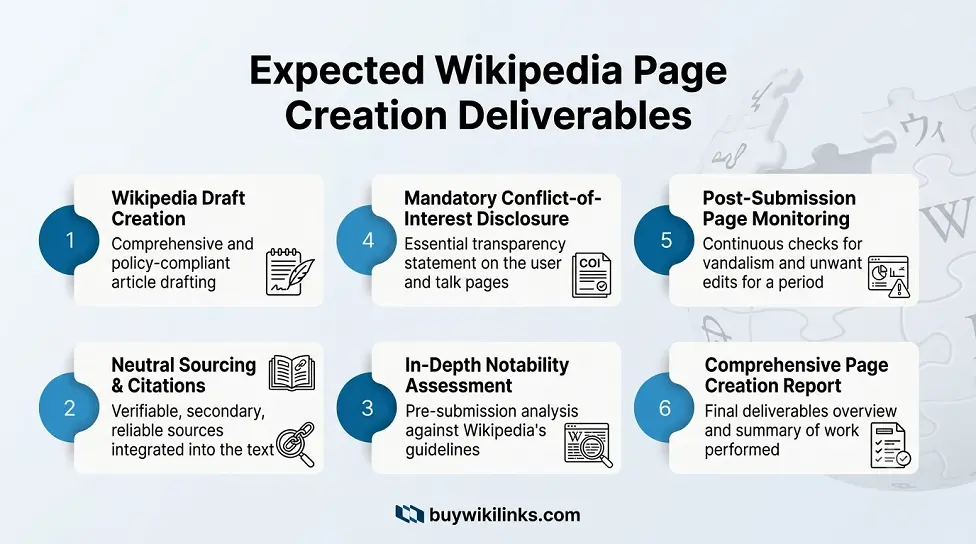
A service agreement should clearly list what the client will receive.
| Deliverable | What It Should Include |
|---|---|
| Eligibility opinion | Written assessment of whether the subject may qualify |
| Source research | Independent search beyond client-supplied links |
| Source-quality report | Reliability, independence, and coverage analysis |
| Article outline | Sections supported by available sources |
| Neutral draft | Complete encyclopedia-style article |
| Citation list | Clear link between sources and claims |
| Formatting | References, sections, internal links, and templates |
| Disclosure plan | How paid involvement will be disclosed |
| Submission plan | Draft, AfC, or talk-page process |
| Revision support | Number and type of included revisions |
| Monitoring | Defined period and scope |
| Final files | Research, citations, and draft copies |
Deliverables the provider controls
A provider can commit to:
- Completing research
- Producing a report
- Preparing the draft
- Formatting citations
- Making agreed revisions
- Providing disclosure guidance
- Meeting a delivery schedule
- Monitoring for a stated period
Outcomes the provider does not control
A provider cannot guarantee:
- Publication
- Review time
- Permanent survival
- Final wording
- Search rankings
- Knowledge Panel creation
- Social media verification
- Community agreement
The contract should distinguish between deliverables and outcomes.
Major Wikipedia Page Creation Service Red Flags
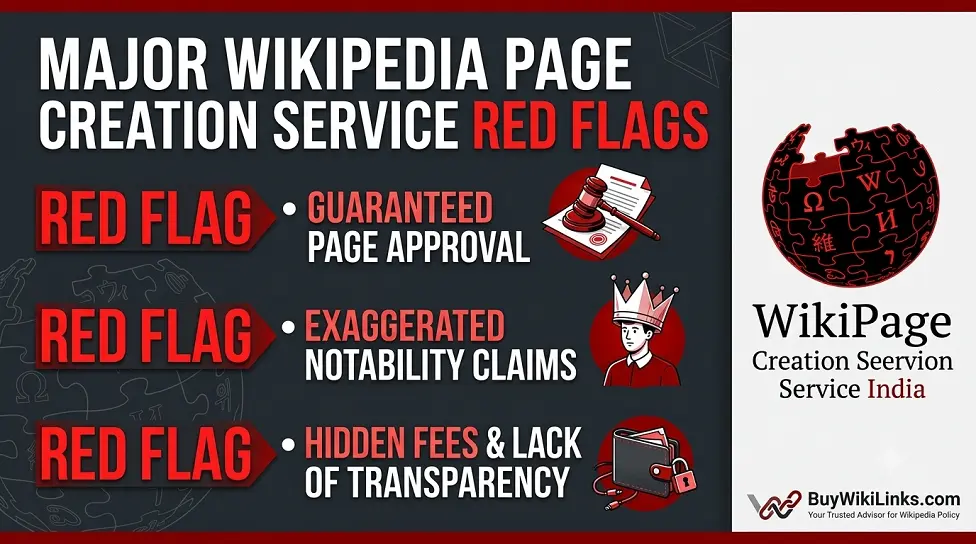
Red Flag 1: Guaranteed Publication
No independent provider controls Wikipedia’s volunteer reviewers.
A publication guarantee may mean the provider is:
- Misrepresenting the process
- Planning undisclosed editing
- Using risky accounts
- Ignoring notability
- Defining “delivery” only as temporary publication
- Hiding important conditions
Ask whether the guarantee covers a completed draft or actual permanent publication. These are not the same thing.
Red Flag 2: Guaranteed Permanent Page
A published article remains open to editing, review, merging, redirection, and deletion.
No seller can guarantee permanent inclusion.
Promises such as “lifetime page,” “never deleted,” or “permanent placement” should be treated cautiously.
Red Flag 3: Fake or Fabricated Sources
A provider should never:
- Invent articles
- Create fake publication details
- Alter source titles
- Misrepresent sponsored content
- Cite pages that do not support the claim
- Manufacture newspaper coverage
- Create fake authors
- Use private documents as public citations
Fabricated sources can damage the article and the client’s reputation.
Ask for the complete source list before submission.
Red Flag 4: Paid Media Presented as Independent Coverage
A provider may offer to publish sponsored articles and then use those same articles to prove notability.
Paid coverage is not genuinely independent.
Media outreach may have separate marketing value, but it should not be presented as guaranteed Wikipedia eligibility.
Red Flag 5: Secret or Shared Accounts
Be cautious when a seller promotes:
- Secret administrator accounts
- Shared editor credentials
- Purchased old accounts
- Undisclosed multiple accounts
- “Invisible” posting methods
- Accounts that cannot be connected to the service
Account age does not make promotional editing compliant.
A credible provider should explain its disclosure and review process rather than sell secrecy.
Red Flag 6: Administrator Approval Claims
Wikipedia administrators have technical tools, but they do not own articles or have unlimited editorial authority.
Administrator status cannot make a non-notable subject notable, turn a press release into an independent source, or make promotional writing neutral.
Red Flag 7: No Eligibility Review
A provider that begins writing immediately may be ignoring the most important question.
Ask:
- Which sources establish notability?
- Are they independent?
- Are they substantial?
- Are they reliable?
- Are they focused on the subject?
If the provider cannot answer, do not purchase a full writing package.
Red Flag 8: Copying the Client’s Website
Copying content from an official website creates two problems:
- Promotional tone
- Potential copyright infringement
A Wikipedia draft should summarize independent published sources in original wording.
Red Flag 9: Promising Only Positive Content
A credible article may need to include significant criticism or controversy when reliable sources cover it.
A provider promising a completely positive page may be preparing advertising rather than an encyclopedia article.
Red Flag 10: Vague Deliverables
Avoid packages described only as:
- Complete Wikipedia solution
- Full approval service
- Premium publication
- Guaranteed reputation
- Lifetime management
The agreement should specify:
- Research
- Draft length or scope
- Number of sources
- Revisions
- Disclosure
- Submission route
- Monitoring period
- Refund terms
Red Flag 11: No Written Refund Policy
A provider should explain:
- Which work is refundable
- Whether research fees are refundable
- What happens when the subject is ineligible
- What happens after a declined draft
- How many revisions are included
- The refund-request deadline
Red Flag 12: Unrealistic Delivery Time
A provider can promise its own research and drafting schedule.
It cannot guarantee how quickly volunteers will review a submission.
Claims such as “approved within 24 hours” or “guaranteed live in three days” should be examined carefully.
Red Flag 13: SEO Guarantees
A Wikipedia article may appear prominently in search results, but no provider can guarantee:
- A particular ranking
- A traffic volume
- Domain authority improvements
- A Knowledge Panel
- Verification on another platform
- Permanent backlinks
A Wikipedia article should exist because the subject qualifies for encyclopedic coverage—not only as an SEO tactic.
For additional warning signs, review our guide to fake Wikipedia page creators.
Wikipedia Page Creation Provider-Selection Checklist
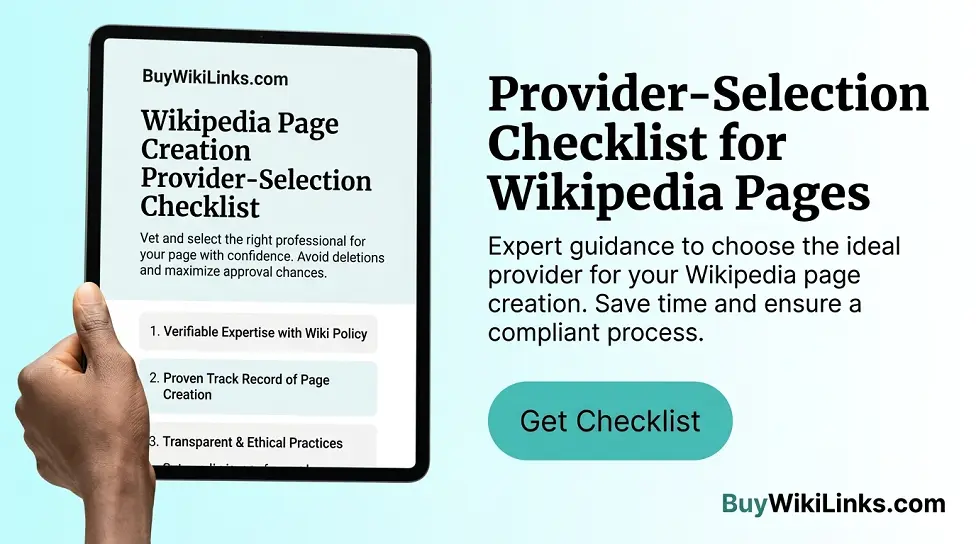
Use this checklist before hiring a provider.
Eligibility and research
- Does the provider assess notability before drafting?
- Does it search beyond the links I supply?
- Does it distinguish independent coverage from press releases?
- Does it identify sponsored articles?
- Does it evaluate previous deletion history?
- Will I receive a written source assessment?
Writing quality
- Is the draft written neutrally?
- Does the provider avoid marketing language?
- Are significant claims supported?
- Will relevant criticism be handled fairly?
- Is the wording original rather than copied?
- Can I review the draft for factual accuracy?
Transparency
- Does the provider disclose paid involvement?
- Does it explain its relationship to Wikipedia?
- Does it avoid secret accounts?
- Does it explain which submission route will be used?
- Does it distinguish draft delivery from publication?
- Does it acknowledge that the community controls the final article?
Deliverables
- Is the complete scope written clearly?
- How many revisions are included?
- Is reviewer feedback included?
- Will I receive the research report?
- Will I receive the draft and citation list?
- Is monitoring included?
- How long does support continue?
Guarantees and risk
- Does the provider avoid permanent-publication guarantees?
- Does it explain deletion risks?
- Does it explain what happens when a draft is declined?
- Does it provide a written refund policy?
- Does it avoid guaranteed SEO claims?
- Is it willing to recommend that I wait?
Security and ethics
- Does the provider avoid shared or purchased credentials?
- Does it refuse fake sources?
- Does it avoid undisclosed coordinated accounts?
- Does it follow conflict-of-interest rules?
- Does it avoid manipulating discussions?
- Does it explain the limits of administrator access?
A provider does not need to promise certainty. It needs to demonstrate a defensible process.
Sample Professional Wikipedia Page Creation Workflow
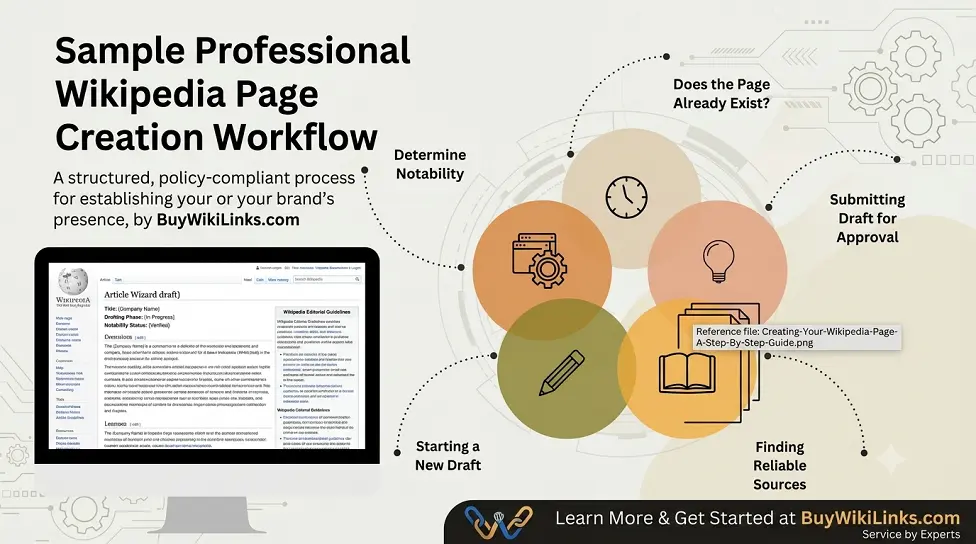
Phase 1: Intake
The client submits:
- Subject name
- Official website
- Industry or profession
- Country
- Existing coverage
- Books and academic sources
- Previous Wikipedia history
- Required language edition
Phase 2: Eligibility
The provider conducts:
- Preliminary screening
- Full notability review
- Source-quality analysis
- Risk assessment
Phase 3: Research
The provider searches:
- News archives
- Books
- Journals
- Trade publications
- Government sources
- Regional and international media
Phase 4: Drafting
The writer prepares:
- Article outline
- Neutral text
- Inline citations
- Appropriate structure
- Disclosure plan
Phase 5: Client Review
The client verifies:
- Names
- Dates
- Roles
- Factual accuracy
Promotional additions and unsupported claims are excluded.
Phase 6: Independent Review
The draft is submitted through an appropriate route, with the paid relationship disclosed.
Phase 7: Feedback
The provider:
- Reviews comments
- Revises fixable issues
- Replaces weak sources
- Explains unresolved eligibility problems
Phase 8: Monitoring
After publication, the provider observes:
- Major edits
- Maintenance tags
- Talk-page activity
- Deletion discussions
- Factual changes
This process does not guarantee publication, but it provides a transparent and professionally managed workflow.
Frequently Asked Questions
What does a Wikipedia page creation service do?
It may assess notability, research independent sources, prepare a neutral draft, format citations, disclose paid involvement, support submission, respond to feedback, and monitor the article.
Can a Wikipedia page creation service guarantee approval?
No independent service controls Wikipedia’s volunteer community. It can guarantee its own work, but not publication or permanence.
Is paying for Wikipedia assistance allowed?
Paid assistance is not automatically prohibited. Paid contributors must disclose the relevant employer, client, and affiliation and continue following all editorial policies.
How do I know whether my subject qualifies?
Eligibility normally depends on significant coverage in reliable, independent, published sources. A notability assessment should be completed before full drafting.
How many sources are required?
There is no universal number. Multiple strong, independent, substantial sources are generally more useful than many weak or connected sources.
Can company press releases be used?
Press releases may verify limited facts about what the company announced. They normally do not establish independent notability.
Can the service use sponsored articles?
Sponsored articles may have marketing value, but they are not independent evidence. They should not be presented as strong notability sources.
Will I own the article after publication?
No. Wikipedia articles are collaboratively maintained. Other editors may change the content.
Can I approve the final article?
You may review the draft for factual errors before submission. After publication, the community controls the article’s development.
Can a provider remove all negative information?
No. Properly sourced, relevant, neutrally presented criticism may remain. Unsupported, excessive, inaccurate, or policy-violating content can be challenged.
What happens if the draft is declined?
The provider should review the reasons, revise fixable problems, and explain whether stronger sources or more coverage are necessary.
What happens if the subject is not notable?
The provider should recommend waiting, improving an existing article, or using another online profile rather than forcing a weak submission.
Does a professional service guarantee a Google Knowledge Panel?
No. Google independently determines when and how Knowledge Panels appear.
Should monitoring be included?
Monitoring is useful for sensitive, frequently edited, or high-profile pages. The package should define the monitoring period and the actions included.
What is the biggest provider warning sign?
A combination of guaranteed publication, secret accounts, fake sources, and no disclosure is a serious warning sign.
Final Thoughts
A Wikipedia page creation service should sell a professional process—not a secret shortcut.
The strongest process includes:
- Preliminary eligibility screening
- Detailed notability assessment
- Independent source research
- Neutral article planning
- Original encyclopedic writing
- Accurate citation formatting
- Client factual review
- Paid-contribution disclosure
- Independent submission and review
- Responsible revisions
- Post-publication monitoring
Before hiring a provider, ask what it will deliver, which sources support eligibility, how it handles disclosure, and what happens when reviewers disagree.
Avoid services that promise:
- Guaranteed approval
- Permanent pages
- Administrator control
- Fake press coverage
- Secret accounts
- Only positive content
- Guaranteed SEO results
A provider’s willingness to explain risks—and sometimes recommend not proceeding—is one of the strongest signs of professionalism.
Request a Wikipedia Page Creation Review
Are you considering a Wikipedia article for yourself, your company, organization, product, or brand?
Our page creation process can include:
- Preliminary eligibility review
- Independent source research
- Notability assessment
- Neutral draft preparation
- Citation formatting
- Disclosure planning
- Submission support
- Defined revision rounds
- Post-publication monitoring
Review our Wikipedia page creation service and submit the following information:
- Subject name
- Official website
- Profession or industry
- Country
- Independent media coverage
- Books, journals, or offline publications
- Previous Wikipedia drafts
- Previous deletion discussions
- Preferred language edition
We will review the available information, explain the most appropriate next step, and recommend a service scope based on the actual research and risk involved.
