
Wikipedia Page
How to Create a Wikipedia Page for a Company
Jul
How to Create a Wikipedia Page for a Company
Creating a Wikipedia page for a company is not the same as creating a business profile on LinkedIn, Crunchbase, Google Business Profile, or a company directory.
Wikipedia is an encyclopedia. It does not automatically provide a page to every registered, successful, or established business.
A company must first demonstrate that it has received substantial attention from reliable sources that are independent of the business. Its article must then summarize those sources neutrally, without reading like advertising or public relations material. Let’s be detailed about a Wikipedia page for a company.
This is where many company-page attempts fail.
Businesses often begin by collecting information from their own website, press releases, executive biographies, product pages, awards, and social media profiles. Those materials may verify basic facts, but they generally do not prove that the company deserves a standalone encyclopedia article.
The correct process begins with independent evidence for a Wikipedia page for a company.
To create a Wikipedia page for a company responsibly, you should:
- Search for existing and deleted pages.
- Evaluate the company’s notability.
- Find significant independent media coverage.
- Separate strong sources from press releases and sponsored content.
- Build an article structure based on published coverage.
- Write in a neutral, encyclopedic tone.
- Cite every important or potentially disputed claim.
- Disclose any paid or professional relationship.
- Prepare the article in draft space.
- Submit it for independent review.
- Respond constructively to community feedback.
- Accept that no company owns or permanently controls its Wikipedia article.
This guide explains each stage and shows how to avoid the mistakes that commonly lead to rejection or deletion.
Quick Answer: Can a Company Create Its Own Wikipedia Page?
A company employee, founder, owner, marketing agency, or paid writer can technically prepare information about the business.
However, these people have a conflict of interest because they are connected to the subject of a Wikipedia page for a company.
On English Wikipedia, conflict-of-interest editors are strongly discouraged from directly creating or controlling affected articles. A more transparent approach is to:
- Disclose the relationship
- Research independent sources
- Prepare a neutral draft
- Submit the draft through Articles for Creation
- Allow uninvolved editors to review it
- Use talk-page edit requests for future changes
The company cannot purchase ownership of the page or dictate its final wording.
Even when a draft is accepted, other Wikipedia editors may revise, expand, challenge, merge, redirect, or nominate the article for deletion.
1. Check Whether a Company Article Already Exists on Wikipedia
Before creating anything, search Wikipedia carefully for a Wikipedia page for a company.
A company may already be covered:
- Under a former name
- Under its legal corporate name
- Under its trading name
- As a subsidiary of another company
- Within its founder’s biography
- Inside a parent-company article
- In a list of organizations
- In Wikipedia’s Draft namespace
- Under a different spelling
- As a redirect to another article
Creating a duplicate article can lead to immediate redirection, merging, or rejection.
You should also search for evidence of previous deletion.
Useful checks include starting a Wikipedia page for a company:
- Wikipedia’s article search
- Draft-space search
- Deletion logs
- Articles for Deletion discussions
- Draft submission history
- Talk-page archives
- Alternative company names
- Former parent companies
A previous deletion does not always mean that an article can never be created.
However, recreating substantially the same page without addressing the original problems can result in rapid deletion.
If the previous article was removed for lack of notability, the company will usually need substantial new independent coverage—not merely a rewritten version of the old content.
2. Understand the Company Eligibility Requirements on Wikipedia
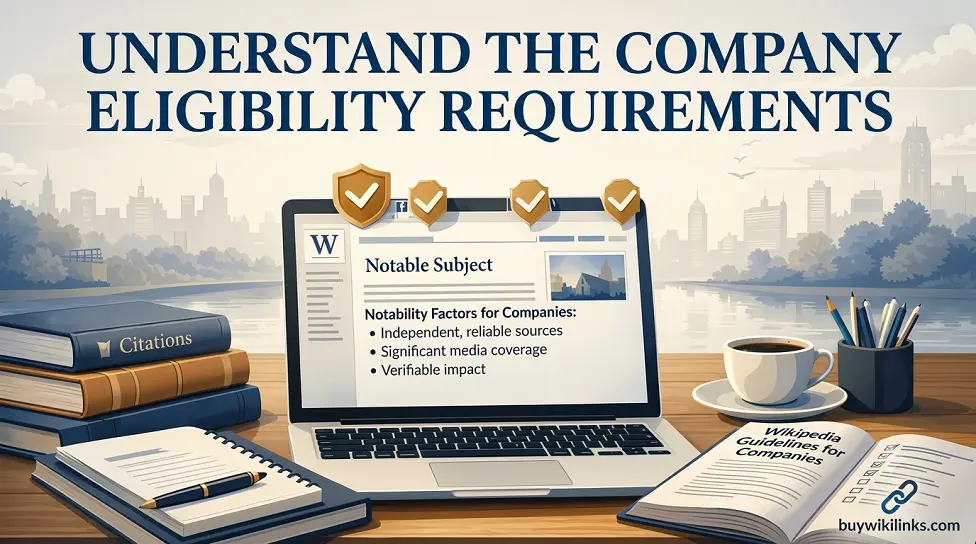
The most important requirement is not writing quality. It is company notability.
A company is generally considered suitable for a standalone Wikipedia article when it has received significant coverage in reliable, independent secondary sources.
That standard contains four important tests.
Significant
The source must discuss the company in meaningful depth.
A short mention, list entry, quotation, funding announcement, event listing, or address record is usually not enough.
Reliable
The publication should have an appropriate reputation for accuracy, editorial oversight, fact-checking, or subject expertise.
Independent
The source should not be created, funded, commissioned, controlled, or supplied by the company or its representatives.
Secondary
The source should analyze, report on, or discuss the company instead of merely repeating the company’s own claims.
The official Wikipedia guideline for organizations and companies explains that trivial or incidental coverage is insufficient and that an organization normally requires substantial coverage from independent, reliable secondary sources.
What Does Not Automatically Make a Company Eligible?
A company is not automatically eligible because it has:
- Been legally incorporated
- Operated for many years
- Earned substantial revenue
- Employed many people
- Opened several offices
- Raised investment funding
- Won an award
- Registered a trademark
- Served famous customers
- Ranked highly on Google
- Built a large social following
- Received customer reviews
- Published press releases
- Appeared in business directories
- Sponsored public events
- Been verified on social media
- Created a successful product
- Been mentioned in another Wikipedia article
These achievements may be relevant when independent sources discuss them. They do not independently create Wikipedia eligibility.
Public Companies and Stock Exchange Listings
A stock exchange listing can generate useful documentation, including:
- Financial filings
- Annual reports
- Regulatory disclosures
- Acquisition records
- Leadership information
- Shareholder notices
These materials can verify important facts.
However, most are primary sources produced by the company or a regulator. They do not necessarily demonstrate that independent publications have examined the company in enough depth to justify an article.
A publicly traded company may be easier to research, but listing status should not be treated as automatic notability. Let be more details of Wikipedia page for a company.
Startups and Venture-Funded Companies
Startups often have many online mentions connected to:
- Funding rounds
- Accelerator programs
- Product launches
- Founder announcements
- Partnerships
- Investment portfolios
- Award programs
Much of this content is routine or based on press releases.
A startup has a stronger case when independent publications provide substantial analysis of:
- Its technology
- Industry impact
- Business model
- Market influence
- Regulation
- Controversy
- Competition
- Historical development
The number of funding announcements matters less than the depth and independence of the reporting.
Local Businesses
Wikipedia page for a company for a local business can qualify for Wikipedia, but ordinary local popularity is usually insufficient.
Routine reports about an opening, anniversary, menu, promotion, sponsorship, or charity activity may not establish notability.
A local company may have a stronger case when independent sources document:
- Long-term historical importance
- Architectural significance
- Cultural influence
- Regional economic impact
- Major legal or regulatory events
- A distinctive contribution to an industry
- Substantial coverage extending beyond routine business news
Subsidiaries and Parent Companies
A subsidiary does not automatically qualify because its parent company is notable.
Likewise, a notable subsidiary does not automatically make the parent company eligible.
Editors may decide that the subsidiary is better covered:
- In the parent company’s article
- As a section within another page
- Through a redirect
- In an industry list
- In a broader history article
The available independent coverage should determine whether the business merits its own standalone page.
Products and Brands
A company’s product may be notable even when the company is not—or the reverse may be true.
A separate product or brand article usually requires significant coverage focused specifically on that product or brand.
Routine product listings, retailer pages, customer reviews, affiliate posts, and company announcements normally provide weak evidence.
Before drafting, review our complete guide to Wikipedia notability requirements and assess the company separately from its founder, products, and parent organization.
3. Find Significant Independent Media Coverage
Wikipedia page for a company for Independent source research is the foundation of a credible company article.
Do not begin with the company’s preferred story. Begin with what established publications have reported.
Potential research locations include:
- Newspaper archives
- Business magazines
- Trade publications
- Books
- Academic journals
- Government reports
- Regulatory publications
- Documentary programs
- Regional media archives
- Industry databases
- Library catalogues
- Non-English publications
- Subscription-only news databases
Examples of Potentially Strong Company Sources
Depending on their quality and independence, useful sources may include:
- An in-depth newspaper profile
- A magazine feature covering the company’s history
- An independent investigation
- A trade-publication analysis
- A book chapter examining the company
- Academic research discussing its industry influence
- Detailed reporting about an acquisition
- Independent coverage of a major controversy
- A documentary focusing substantially on the company
- An analytical report from a reputable publisher
The company does not need to be the only subject of the publication. However, the coverage must be detailed enough to support meaningful encyclopedic content.
Passing Mentions Are Usually Insufficient
A company may appear in a reliable publication without receiving significant coverage.
Examples of passing mentions include:
- A one-sentence quotation
- Inclusion in a list
- A brief funding announcement
- A product name in a shopping guide
- An event sponsorship mention
- A conference listing
- A short appointment notice
- A sentence naming several competitors
- A photo caption
- A business-address record
These mentions may verify narrow facts, but they usually contribute little toward company notability.
A one-line mention in a major newspaper remains a one-line mention.
The reputation of the publication does not turn brief coverage into substantial analysis.
Coverage Should Come From More Than One Publisher
There is no universal number of sources that guarantees eligibility.
However, relying on one publication creates several risks:
- The coverage may be exceptional rather than sustained.
- The article may lack enough material for balanced sections.
- The source may later be challenged.
- The publication may have a hidden connection to the company.
- The information may reflect only one viewpoint.
Several substantial sources from genuinely independent publishers normally create a stronger foundation.
Coverage Over Time
Coverage appearing across multiple years may demonstrate that public attention is more than temporary.
This does not mean a new company can never qualify. It means that a single short publicity campaign may provide less persuasive evidence than sustained independent reporting.
Ask whether the available coverage represents:
- Long-term editorial interest
- One breaking-news event
- A coordinated public relations campaign
- Repeated versions of the same announcement
- Genuine analysis by different publications
4. Why the Company Website Is Insufficient
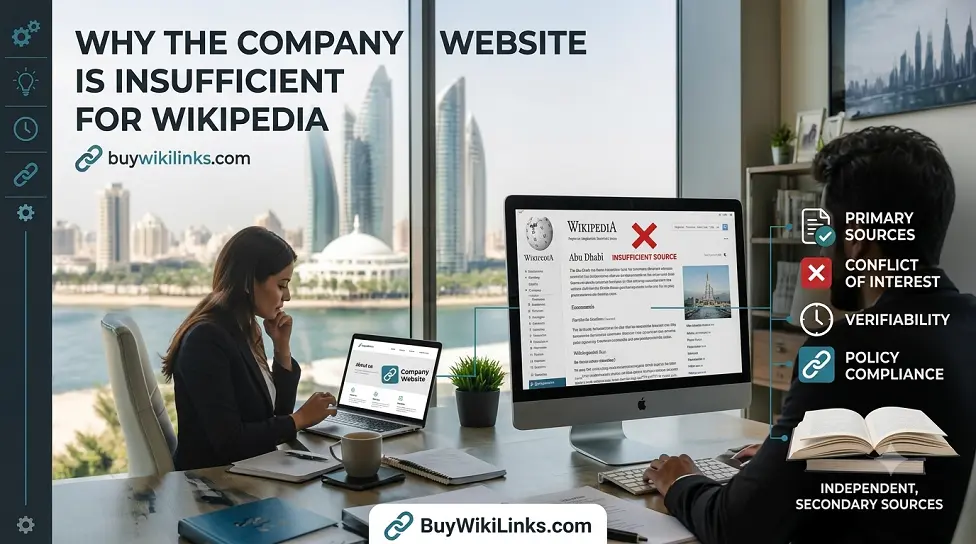
A company website can confirm that the business exists. It generally cannot prove that the business is independently notable.
The website is controlled by the subject.
It usually presents as the Wikipedia page for a company :
- The preferred company history
- Selected achievements
- Positive testimonials
- Product descriptions
- Leadership biographies
- Mission statements
- Marketing claims
- Press releases
- Awards
- Customer logos
This information may be accurate, but it is not independent.
What a Company Website May Support
An official website may sometimes be used cautiously for basic, noncontroversial facts such as:
- Official company name
- Headquarters
- Product names
- Current leadership titles
- Officially announced launch dates
- Company-stated mission
- Contact information
Even these details should be checked against stronger sources when possible.
What a Company Website Cannot Independently Prove
An official website should not be used as the only evidence that the company is:
- An industry leader
- Globally influential
- Highly trusted
- Award winning
- Innovative
- Fast growing
- Historically significant
- The largest provider
- The first to develop a technology
- Widely recognized
These are claims of significance and require independent support.
Company Blogs
A company blog remains connected to the business for a Wikipedia page for a company.
It may provide useful background or technical explanation, but it does not become independent merely because a named employee or expert wrote the post.
Press Releases
Press releases are created to communicate the company’s preferred announcement.
They may verify that the company announced:
- A partnership
- A product
- A funding round
- An acquisition
- A leadership change
- A new office
- An award
They do not independently prove that the announcement was important.
Syndicated Press Releases
A single press release may appear on dozens of websites.
That does not create dozens of independent sources.
When the headline, quotations, wording, and sequence of facts are nearly identical, the pages may all originate from the same company-supplied release.
Sponsored Articles
Sponsored profiles and advertorials may look like ordinary journalism.
They may include:
- A professional headline
- A byline
- Photographs
- Interviews
- A publication date
- A familiar media layout
If the company paid for or commissioned the article, it is not independent evidence of notability.
Our guide to Wikipedia reliable sources explains how to evaluate journalism, trade publications, interviews, books, sponsored content, and connected sources.
5. Plan the Company Article Structure
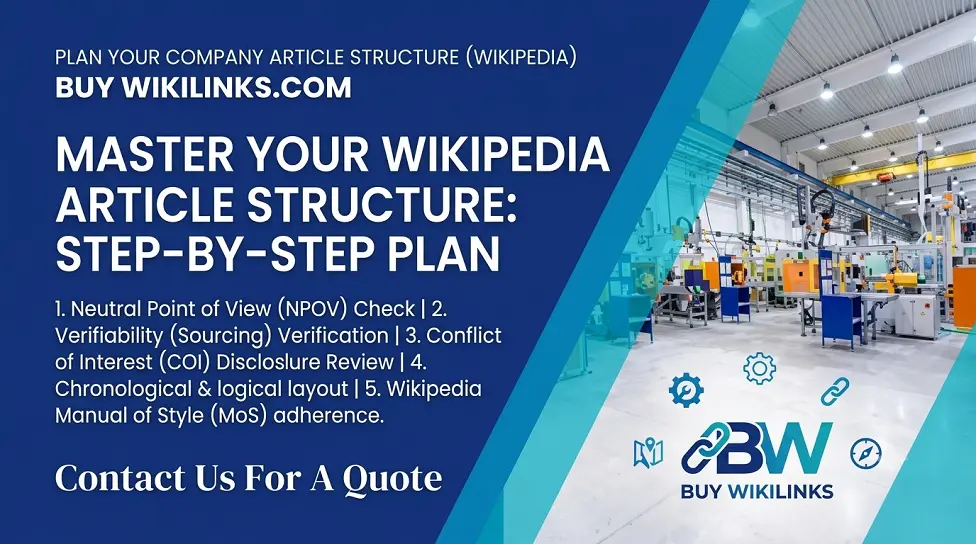
A company Wikipedia page should not reproduce the structure of a corporate website.
The article should be organized according to the independent coverage available.
A typical structure may include:
- Lead section
- History
- Operations
- Products or services
- Acquisitions or corporate changes
- Reception, impact, or criticism
- References
Not every company article needs every section.
The structure should reflect what reliable sources consider important.
Lead Section
The opening should identify the Wikipedia page for a company clearly and summarize its most important characteristics.
It may include:
- Company type
- Industry
- Headquarters
- Founding year
- Founders
- Major area of operation
- Significant historical context
The lead should summarize the article rather than act as a sales pitch.
Promotional introduction
AlphaCore is an award-winning, globally trusted technology leader providing innovative solutions to thousands of satisfied clients.
Neutral introduction
AlphaCore is a British software company founded in 2012. It develops inventory-management systems for retail and manufacturing businesses.
The neutral version provides verifiable information without subjective praise.
History Section
The history section should explain the company’s development using independent sources.
Possible topics include:
- Founding
- Early operations
- Changes in ownership
- Significant growth
- Major product development
- Funding
- Acquisitions
- Rebranding
- International expansion
- Regulatory events
- Closures or restructuring
Do not turn the history into a year-by-year list of every internal milestone.
Include events that reliable sources have treated as significant.
Operations Section
An operations section may cover:
- Business model
- Main markets
- Facilities
- Regional presence
- Corporate structure
- Manufacturing
- Distribution
- Workforce, when independently reported
- Financial performance, when relevant and sourced
Avoid listing every office, department, service area, or customer.
Products and Services Section
This section should summarize important products or service categories.
It should not read like a catalogue.
Include products when independent sources have discussed:
- Their development
- Market impact
- Technical importance
- Public reception
- Sales significance
- Controversy
- Discontinuation
- Regulatory issues
Routine descriptions copied from product pages should be avoided.
Reception, Impact, or Criticism
A neutral article may need to summarize how independent sources have evaluated the company.
This could include:
- Critical reviews
- Industry impact
- Customer controversies
- Labor disputes
- Environmental concerns
- Legal cases
- Regulatory action
- Public campaigns
- Academic analysis
- Awards receiving meaningful coverage
The section should give each topic weight in proportion to the reliable coverage.
6. Write the Company History Neutrally
The history section is often where company drafts become promotional.
Businesses naturally want to emphasize growth, vision, awards, milestones, and leadership. Wikipedia requires a different approach.
The article should summarize published evidence without trying to shape the reader’s opinion.
Avoid Corporate Storytelling
Marketing language often presents company history as a journey:
Founded with a bold vision, the company quickly became a trusted global leader through its commitment to excellence and innovation.
This wording is unsuitable because it contains subjective praise and unsupported conclusions.
A neutral version would be:
The company was founded in Manchester in 2011 by Sara Ahmed and James Cole. It initially provided logistics software to regional retailers before expanding into warehouse automation in 2016.
The neutral version states what happened without presenting a brand narrative.
Attribute Opinions
When a reliable source expresses an opinion, attribute it clearly.
Instead of:
The acquisition transformed the industry.
Write:
The Financial Review described the acquisition as a significant consolidation within the regional logistics market.
The attribution shows that the conclusion belongs to the publication rather than Wikipedia’s writer.
Do Not Add Unpublished Knowledge
Employees and founders may know details that have never appeared in public sources.
These details should not be added merely because the company confirms them.
Examples include:
- Internal reasons for decisions
- Private financial figures
- Unannounced customers
- Confidential contracts
- Undocumented founding stories
- Internal employee counts
- Unpublished development timelines
Wikipedia summarizes published knowledge. It is not the place to introduce new corporate history.
Include Relevant Setbacks
A neutral history should not present uninterrupted success when reliable sources document:
- Failed launches
- Financial problems
- Lawsuits
- Regulatory action
- Layoffs
- Closures
- Leadership disputes
- Product recalls
- Public criticism
These issues should not be exaggerated, but they should not be removed merely because the company dislikes them.
7. Cover Products Without Turning the Page Into Advertising
A Wikipedia page for a company article should summarize significant products, not promote them.
Avoid:
- Prices
- Sales offers
- Product specifications copied from the website
- Calls to action
- Customer testimonials
- Promotional comparisons
- Every available product
- External purchase links
- Claims unsupported by independent reviews
When a Product Deserves Mention
A product may be included when reliable sources have covered:
- Its launch
- Development
- Technical characteristics
- Market impact
- Reception
- Controversy
- Awards
- Discontinuation
- Regulation
The amount of text should reflect the amount of meaningful coverage.
When a Product May Need Its Own Article
A separate product page may be appropriate when the product itself has substantial independent coverage.
The company’s notability does not automatically establish product notability.
Editors may instead decide to:
- Keep the product in the company article
- Merge an existing product article
- Redirect the product title
- Include it in a product list
8. Handle Controversies Carefully
Company controversies require reliable sourcing, neutral wording, and proportionate coverage.
Possible topics include:
- Lawsuits
- Regulatory investigations
- Product safety
- Environmental impact
- Labor disputes
- Data breaches
- Consumer complaints
- Political activity
- Advertising disputes
- Financial misconduct
- Public criticism
Do Not Create a Criticism Dump
A controversy section should not become a collection of every complaint found online.
The information should be:
- Covered by reliable sources
- Relevant to the company
- Important enough for an encyclopedia
- Written without sensational language
- Presented with appropriate context
- Balanced with the company’s response when reliable sources report it
Do Not Remove Properly Sourced Criticism
A company cannot demand removal merely because the material is negative.
Content may be challenged when it is:
- Unsupported
- Incorrect
- Outdated
- Misrepresented
- Excessive
- Based on unreliable sources
- Given undue weight
- Written non-neutrally
The correct approach is to identify the exact problem and propose a sourced correction.
9. Explain Acquisitions and Corporate Changes Clearly
Acquisitions can be important to a company’s history, but routine deal announcements should not dominate the article.
Include an acquisition when reliable sources discuss:
- Its value
- Strategic significance
- Regulatory consequences
- Industry impact
- Resulting restructuring
- Changes in ownership
- Integration problems
- Public response
Avoid Listing Every Transaction
A company may have completed many minor deals.
Wikipedia does not need a complete corporate transaction database.
Focus on acquisitions that independent sources treat as significant.
Explain Relationships Accurately
Corporate structures can become confusing.
The article should distinguish among:
- Parent company
- Subsidiary
- Former owner
- Acquirer
- Brand
- Division
- Joint venture
- Trading name
- Legal entity
Use independent sources and official records to verify the relationships.
10. Disclose Conflicts of Interest
A conflict of interest exists when someone writes about a company with which they have a close relationship.
This includes for a Wikipedia page for a company:
- Owners
- Founders
- Employees
- Executives
- Investors
- Marketing agencies
- Public relations firms
- Lawyers acting for the business
- Paid consultants
- Family members
- Business partners
Having a conflict of interest is not automatically an accusation of dishonesty. It means the person’s external relationship may affect—or appear to affect—their editorial judgment.
Paid-Contribution Disclosure
A paid editor must disclose:
- Who is paying
- Who the client is
- The relevant affiliation
Disclosure may be placed on:
- The editor’s user page
- The draft talk page
- The article talk page
- An edit summary
The provider should explain the disclosure plan before beginning work.
Direct Editing Is Strongly Discouraged
Employees and paid representatives should generally avoid directly creating or substantially editing the company article.
A safer route is to:
- Disclose the relationship.
- Prepare a properly sourced draft.
- Submit it through Articles for Creation.
- Allow independent editors to review it.
- Use talk-page edit requests for later changes.
No Company Owns Its Article
Publication does not create company control.
Other editors may:
- Change wording
- Add sources
- Remove weak claims
- Add criticism
- Restructure sections
- Question notability
- Nominate the article for deletion
A Wikipedia article is not an official corporate profile.
11. Choose the Correct Draft Submission Option
There are several ways to prepare and submit a company article.
User Sandbox
A sandbox is a personal workspace connected to a Wikipedia account.
It can be used to:
- Practice formatting
- Build an outline
- Test references
- Revise the draft
A sandbox is publicly viewable and should not contain confidential information.
Draft Space
Draft space is designed for articles under development.
A draft can be improved before being submitted for publication.
It is often easier for other editors to find and assist with a draft-space page than a personal sandbox.
Article Wizard
Wikipedia’s Article Wizard guides users through creating a draft.
It helps new contributors begin in the appropriate area instead of immediately publishing an unfinished article.
Articles for Creation
Articles for Creation, commonly called AfC, provides independent review of new drafts.
A reviewer may:
- Accept the draft
- Decline it with feedback
- Reject it
- Request stronger sources
- Identify promotional language
- Raise copyright concerns
- Suggest a merge
- Conclude that the company is not notable
AfC acceptance does not guarantee permanent publication. The article remains open to wider community review.
Talk-Page Edit Request
When the company already has an article, a new page is usually unnecessary.
Employees and paid representatives can propose changes on the article’s talk page.
A strong request should include:
- The exact section
- Current wording
- Proposed wording
- Reliable supporting source
- Reason for the change
- Clear conflict-of-interest disclosure
Direct Mainspace Creation
An uninvolved, experienced editor may sometimes create an article directly when the subject clearly qualifies.
For a company employee, owner, or paid representative, independent draft review is generally the safer and more transparent route.
12. Respond to Draft Reviews Properly
A declined draft is not always a permanent rejection.
The reviewer may identify fixable issues such as:
- Promotional tone
- Missing citations
- Weak structure
- Excessive product detail
- Poor formatting
- Copyright problems
- Unsupported claims
- Irrelevant external links
Read the reviewer’s explanation carefully.
Revise the draft only after understanding the actual issue.
Problems That Writing Cannot Fix
Some problems require more than editing for a Wikipedia page for a company.
A draft cannot be repaired through wording changes when:
- Significant independent coverage does not exist.
- The company does not meet notability requirements.
- Most sources are sponsored or connected.
- The topic duplicates an existing article.
- The company is better covered as part of a parent organization.
- The draft depends on original research.
- The client insists on advertising language.
Repeatedly resubmitting without addressing the underlying issue is unlikely to help.
13. Common Reasons Company Wikipedia Pages Are Deleted
Lack of Notability
The article does not demonstrate substantial independent coverage.
This is one of the most common problems.
Promotional Content
The page reads like:
- Advertising
- A press release
- A company profile
- A brochure
- A sales page
Purely promotional pages may be removed quickly.
Weak or Connected Sources for a Wikipedia page for a company
The article relies mainly on:
- Company websites
- Press releases
- Sponsored content
- Directories
- Social profiles
- Routine announcements
Copyright Infringement
Text copied from a company website, press release, brochure, or another publication may be removed.
Changing a few words is not enough. The writer must summarize information independently.
Undisclosed Paid Editing
Secret commercial editing can lead to increased scrutiny, account sanctions, and reputational damage.
Recreated Deleted Content
A company recreates an article without addressing the reason it was previously deleted.
Duplicate Topic
The company is already covered under another name or within a parent-company page.
Original Research
The article includes unpublished information, analysis, or conclusions not found in reliable sources.
Fabricated or Misleading Citations
References do not exist, do not support the claims, or are represented inaccurately.
No Credible Indication of Importance
A new article provides only basic company information without showing why the subject may merit encyclopedic coverage.
Excessive Product or Service Listings
The page functions as a catalogue rather than an encyclopedia article.
Inappropriate External Links
The article contains promotional links, sales pages, affiliate links, or unnecessary company URLs.
Unbalanced Reputation Management
The draft removes significant criticism, exaggerates achievements, or presents the company entirely through its preferred public relations narrative.
Company Wikipedia Page Checklist
Before submission, confirm the following.
Eligibility for a Wikipedia page for a company
- The company has multiple substantial independent sources.
- The sources are reliable.
- Coverage is more than passing mentions.
- Sponsored content is not being treated as independent.
- The company appears to merit a separate article.
Research for a Wikipedia page for a company
- News archives have been searched.
- Books and trade publications have been considered.
- Duplicate press releases have been removed.
- Previous deletion history has been reviewed.
- Sources cover more than one aspect of the company.
Writing for a Wikipedia page for a company
- The introduction is factual.
- Promotional language has been removed.
- Claims are supported by citations.
- The history section follows independent coverage.
- Products are summarized rather than advertised.
- Relevant criticism is represented proportionately.
- The wording is original.
Compliance
- Paid involvement has been disclosed.
- The contributor is not pretending to be independent.
- No shared or purchased accounts are being used.
- The correct submission route has been selected.
- The client understands that publication is not guaranteed.
Technical Preparation
- The article title is appropriate.
- An existing page does not already cover the subject.
- Citations are complete.
- Links point to the correct sources.
- Categories and internal links are relevant.
- The draft contains no confidential information.
Frequently Asked Questions
Can any company create a Wikipedia page?
Wikipedia page for a company can technically be proposed as a topic, but only companies meeting Wikipedia’s notability and sourcing requirements are likely to sustain standalone articles.
How does a company qualify for Wikipedia?
A company generally needs significant coverage in reliable, independent secondary sources. Routine mentions, press releases, and official profiles are normally insufficient.
How many news articles does a company need?
There is no fixed number. Several substantial independent sources are usually more valuable than dozens of brief or promotional mentions.
Can a company website be used as a source?
Wikipedia page for a company may support limited, noncontroversial facts. It is not independent and normally cannot establish company notability.
Do press releases count?
Press releases may confirm what the company announced. They generally do not prove independent recognition or notability.
Do sponsored articles count?
Sponsored articles are connected to the subject through payment and are therefore weak for establishing independent notability.
Can a startup have a Wikipedia page?
Yes, when it has substantial independent coverage. Funding announcements and accelerator profiles alone may not be sufficient.
Can the company write its own history?
Employees may provide factual corrections, but unpublished internal knowledge should not be added. The history should be based on verifiable published sources.
Can a marketing agency create the page?
An agency can research and prepare a draft, but it should disclose its paid relationship and use an appropriate independent review process.
Is Articles for Creation mandatory?
It is strongly recommended for new editors and conflict-of-interest contributors. Requirements and practices may vary between Wikipedia language editions.
How long does approval take?
There is no guaranteed review time. The process depends on reviewer availability, source quality, article complexity, and required revisions.
Can a service guarantee publication?
No outside service controls Wikipedia’s volunteer community. A provider can guarantee research or draft delivery, not community approval or permanence.
Can the company control the article after publication?
No. Other editors can modify the article according to sources, policies, discussion, and consensus.
Can negative information be removed?
Unsupported, inaccurate, outdated, excessive, or policy-violating material can be challenged. Relevant criticism supported by reliable sources may remain.
Why was our company page deleted?
Wikipedia page for a company. Common reasons include lack of notability, promotional writing, weak sourcing, copyright infringement, duplicate content, and undisclosed paid editing.
Can a deleted company page be recreated?
Possibly, when the original problems have been resolved and substantial new evidence exists. Recreating the same content without improvement may result in another deletion.
Final Thoughts
Learning how to create a Wikipedia page for a company begins with understanding that the company cannot treat the article as a marketing asset it owns.
A responsible process is based on independent evidence:
- Search for existing and deleted pages.
- Evaluate company notability.
- Find substantial independent sources.
- Separate journalism from promotional coverage.
- Build an article structure based on those sources.
- Write the company history neutrally.
- Summarize products without advertising.
- Cover acquisitions and controversies proportionately.
- Cite every important claim.
- Disclose paid or professional involvement.
- Submit through an appropriate draft-review process.
- Accept that the Wikipedia community controls the final article.
The strongest writing cannot overcome weak eligibility.
Complete the company notability assessment before investing in a full draft.
Request a Company Notability Assessment
Are you considering a Wikipedia article for a company, startup, organization, brand, subsidiary, or product?
A company notability assessment can help determine:
- Whether substantial independent coverage exists
- Which sources may support eligibility
- Which sources are sponsored or connected
- Whether the company merits a separate article
- Whether a previous deletion creates additional risk
- Which article sections the sources can support
- Whether you should proceed, wait, merge, or use another option
Request a company notability assessment and include:
- Company name
- Official website
- Country and industry
- Founding year
- Parent company or subsidiaries
- Existing independent media coverage
- Books, journals, or trade publications
- Previous Wikipedia drafts
- Previous deletion discussions
- Preferred Wikipedia language edition
We will review the source Wikipedia page for a company base first and recommend whether full company article research and drafting are justified.
