
Wikipedia Account
Can You Buy an Old or Aged Wikipedia Account? Risks and Safer Alternatives
Jul
Can You Buy an Old or Aged Wikipedia Account? Risks and Safer Alternatives
Businesses, public relations agencies, SEO professionals, and individuals sometimes search for ways to buy an old Wikipedia account because they believe an aged profile will make publication or editing easier.
Sellers may advertise accounts with:
- Several years of account age
- Thousands of previous edits
- Autoconfirmed or extended-confirmed access
- Reviewer permissions
- Administrator access
- A clean contribution history
- An established reputation
- Guaranteed page publication
- Protected or permanent edits
These offers can make an old account look like a shortcut around Wikipedia’s editorial review process.
It is not.
An account’s age, edit count, or historical permissions do not make weak sources reliable, promotional writing neutral, or a non-notable subject eligible for an article. They also do not guarantee that new activity will be trusted.
Buying an account introduces additional problems involving credential sharing, account security, identity continuity, undisclosed paid editing, changed behavior, possible block evasion, and seller fraud.
Wikipedia’s username policy says accounts should represent individuals, and account or password sharing is not permitted. Wikimedia’s Terms of Use also place responsibility for credentials on the user and say they should not be disclosed to third parties.
The safer approach is to create your own account, disclose relevant relationships, build a transparent contribution history, and request independent review when you have a conflict of interest.
This guide explains why people search for aged accounts, what account history actually means, why transferred accounts are risky, and what compliant alternatives are available.
Quick Answer: Can You Buy an Old Wikipedia Account?
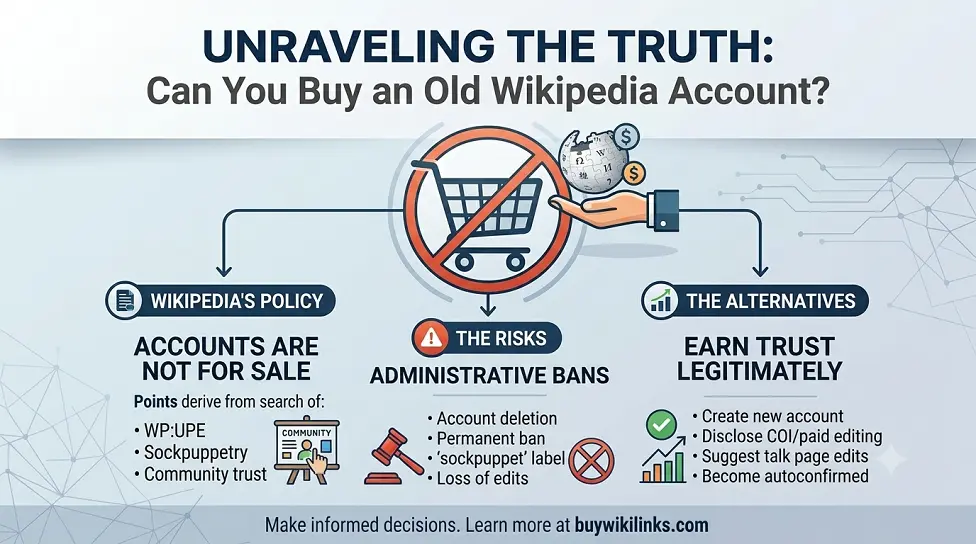
Old or aged Wikipedia accounts are offered for sale by third-party websites, private sellers, and online marketplaces.
However, purchasing and taking over another person’s account conflicts with Wikipedia’s prohibition on account sharing and Wikimedia’s password-security requirements. A transferred account may also be treated as compromised when its credentials, ownership, location, or behavior suddenly changes.
Buying the account does not provide:
- Ownership of Wikipedia articles
- Guaranteed publication
- Guaranteed edit acceptance
- Protection from account investigation
- Administrator approval
- Permanent backlinks
- Immunity from blocks
- Permission to hide paid work
- Control over other editors
- The right to evade previous restrictions
You are paying for credentials whose future usefulness and security the seller cannot control.
Why Do People Search for Aged Wikipedia Accounts?
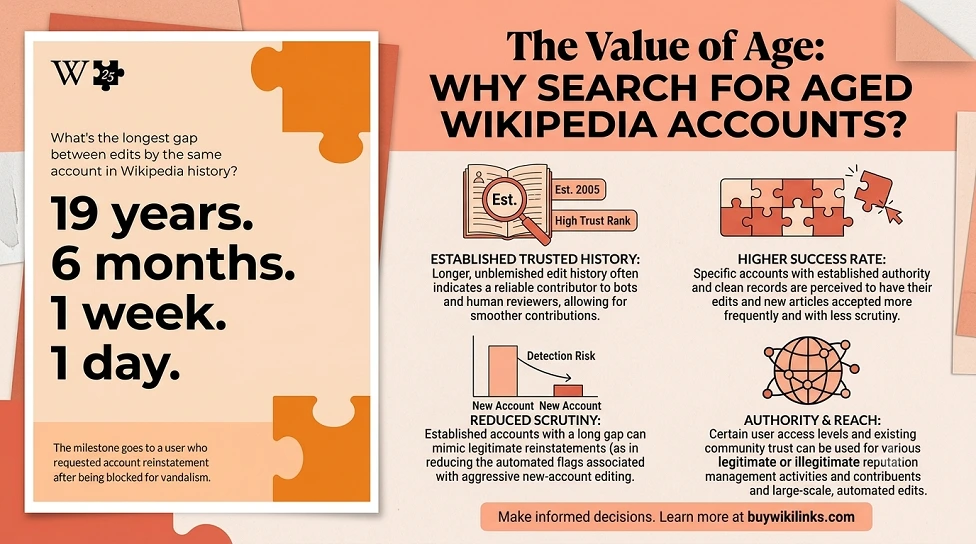
Most buyers are looking for speed or perceived authority.
Common goals include:
- Publishing a company page
- Creating a personal biography
- Editing a protected article
- Inserting a backlink
- Removing criticism
- Bypassing new-account restrictions
- Appearing to be an experienced volunteer
- Avoiding disclosure of a client relationship
- Recovering after another account was blocked
- Gaining access to advanced permissions
Some Wikipedia functions are limited according to account age, contribution history, or community-granted rights. This can lead buyers to believe that purchasing an established account is easier than building their own record.
The assumption ignores how Wikipedia works.
Permissions may allow an account to perform certain technical actions, but they do not make those actions correct. Other editors can still review, revert, challenge, or report the account’s contributions.
A long-established account that suddenly begins publishing promotional company articles or adding commercial links may attract more scrutiny—not less.
What Do Account Age and Edit Count Actually Mean?
Account age shows when the account was registered.
Edit count shows how many recorded edits the account has made.
These figures may provide limited context, but they do not prove that the current operator is:
- Experienced
- Neutral
- Reliable
- Trusted
- Independent
- Authorized to represent Wikipedia
- Able to guarantee publication
Account age
An older account may have existed for many years while making few meaningful contributions.
It may also have been inactive for long periods.
Age alone does not demonstrate:
- Policy knowledge
- Current community standing
- Subject expertise
- Editorial judgment
- Account security
Edit count
A large edit count may include:
- Typographical corrections
- Automated edits
- Reverts
- Talk-page comments
- Minor formatting changes
- Edits in unrelated subjects
- Work performed many years earlier
Twenty thousand edits do not automatically mean that an editor can successfully create a compliant company biography.
The quality, context, subject area, and behavior behind the edits matter more than the raw number.
User rights
Some permissions are granted automatically after basic thresholds. Others are assigned by the community following discussion or demonstrated need.
Administrator and advanced rights are tools for maintaining the encyclopedia. They are not commercial publishing licenses.
Wikipedia’s user-group guidance explains that advanced tools exist to assist editing and maintenance. They do not eliminate content policies or community review.
Why Account History Does Not Guarantee Trust
Wikipedia trust is not a transferable asset stored inside a username.
Any reputation associated with an established account was built through the previous operator’s:
- Editing patterns
- Subject interests
- Communication style
- Relationships with other editors
- Policy knowledge
- Geographic and technical behavior
- Participation in discussions
- Judgment over time
A new buyer does not inherit those qualities merely by receiving the password.
Other editors may notice when an account that previously edited literature, geography, or technical topics suddenly begins:
- Creating promotional biographies
- Adding links to one commercial domain
- Editing one client repeatedly
- Participating in paid-content disputes
- Using unfamiliar language patterns
- Avoiding established collaborators
- Editing from a new region or schedule
The age and edit count remain visible, but the behavior no longer matches the historical editor.
That inconsistency can raise questions about whether the account was sold, shared, hacked, or otherwise compromised.
Credential-Transfer and Security Concerns
Buying a Wikipedia account requires transferring login credentials from one person to another.
This creates serious security problems.
The seller may retain access
You cannot know whether the seller has kept:
- The password
- Recovery email access
- Two-factor authentication codes
- Backup codes
- Browser sessions
- Proof of original ownership
- Other recovery information
The seller may regain access after payment or resell the same account to another buyer.
Recovery may favor the original owner
When an account is disputed, the buyer may have difficulty proving legitimate ownership because:
- The account was created by someone else.
- Earlier email records belong to the seller.
- The contribution history belongs to another person.
- The buyer cannot explain past edits.
- The account’s security details have changed.
Wikipedia’s account-security guidance warns that compromised accounts may be blocked and that recovery is not always possible.
Advanced rights increase the risk
A transferred account with administrator or other advanced permissions poses a greater security concern because those tools can affect pages, accounts, and site maintenance.
Compromised privileged accounts may have their access removed, be blocked, or be globally locked to protect the platform.
Shared access is not permitted
Wikipedia’s username policy states that sharing an account or password with another person is not permitted. Depending on the circumstances, the account may be required to stop the practice, change its password, or face sanctions including a block.
Purchasing credentials is not a reliable way to obtain a personal editing identity.
Changed Wikipedia Behavior and Community Scrutiny
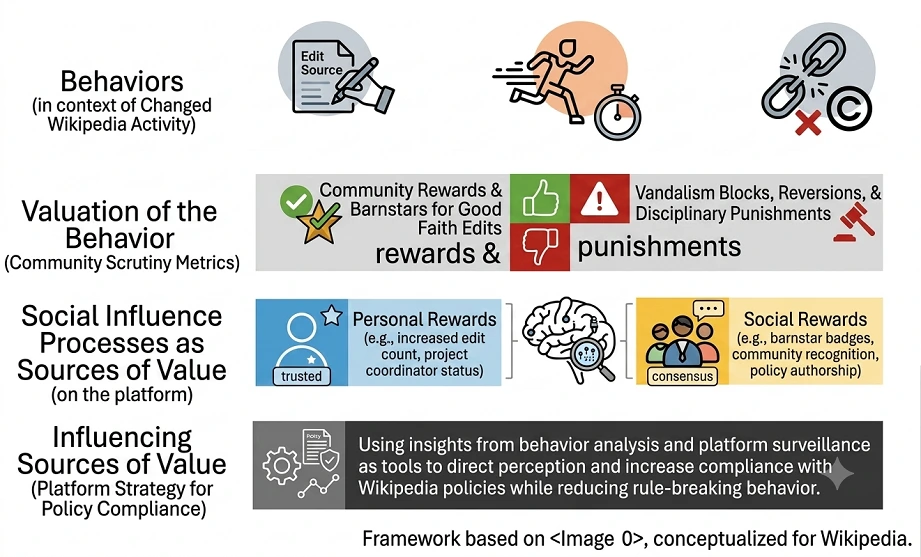
Wikipedia maintains public contribution histories.
Editors can examine:
- Which pages an account edited
- What changes it made
- When it was active
- How it communicated
- Whether its edits were reverted
- Which subject areas it previously covered
- Whether it participated in disputes
A sudden behavioral change may become visible through:
- Different grammar
- Different time zone
- Different technical knowledge
- New commercial interests
- Promotional editing
- Repeated client-related edits
- Different interaction style
- Long inactivity followed by intensive editing
No single change proves that an account was purchased. However, a pattern of unexplained changes may lead to increased review.
An old account can therefore make suspicious behavior more noticeable because editors can compare its current actions with years of previous history.
Block-Evasion Risks
Using a purchased account to continue editing after another account was blocked can be treated as block evasion.
Wikipedia’s sockpuppetry policy prohibits using multiple accounts to deceive other contributors, distort consensus, avoid sanctions, or evade blocks.
Block-evasion risk can arise when:
- A buyer previously had an account blocked.
- The seller’s account was associated with another restricted user.
- The account is used to recreate previously deleted content.
- The account is used to avoid an article or topic ban.
- Several purchased accounts support the same proposal.
- One account is used after another receives warnings.
Consequences may affect more than the purchased account.
Related accounts may be investigated, blocked, or globally locked, and their edits may receive broader scrutiny.
Sockpuppetry and Manufactured Consensus
A buyer may be tempted to purchase several accounts to make a discussion look as though multiple independent editors support the same page or request.
This is deceptive.
Prohibited uses can include:
- Voting several times
- Supporting your own proposal
- Defending your own link
- Creating false agreement
- Participating on both sides of a discussion
- Avoiding scrutiny
- Editing after a block
Wikipedia generally expects editors to use one account, apart from limited legitimate reasons for alternate accounts. Alternate accounts must not be used to mislead or manipulate.
Undisclosed Paid-Editing Risks
Buying an old account does not remove paid-editing disclosure requirements.
A person who receives or expects compensation for a Wikipedia contribution must disclose the relevant:
- Employer
- Client
- Affiliation
This requirement applies regardless of whether the account is:
- New
- Old
- Autoconfirmed
- Extended confirmed
- An administrator
- Purchased
- Borrowed
- Operated by an agency
Wikimedia’s paid-contribution requirements also prohibit deceptive activities such as misrepresenting affiliations, impersonation, and fraud.
An established account used to hide paid work may create stronger concerns because the buyer is using another person’s history to appear independent.
Read our guide to Wikipedia paid editing disclosure before commissioning or performing compensated editing.
Why an Aged Account Cannot Guarantee Publication
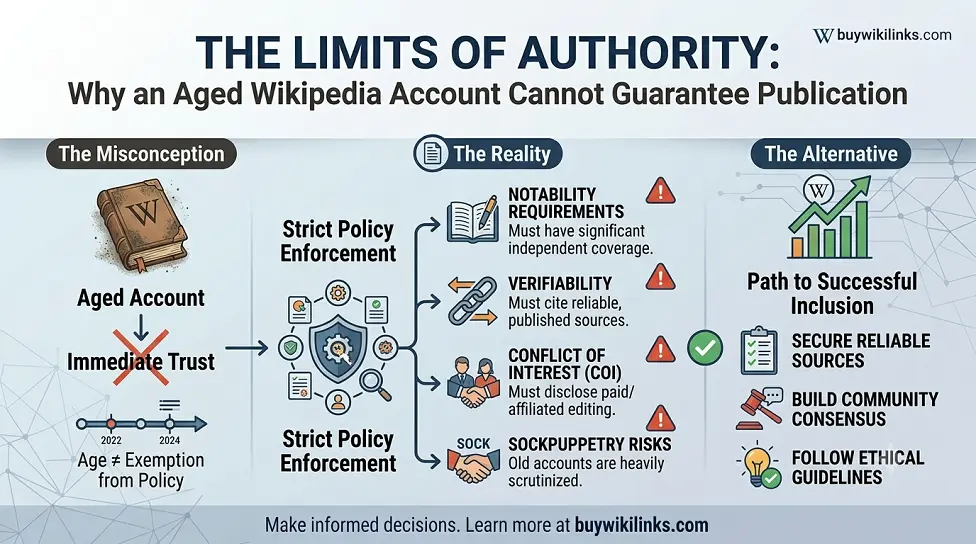
Aged-account sellers often suggest that account history makes page approval easier.
However, publication depends primarily on the article—not the age of the account submitting it.
Reviewers and other editors may examine:
- Subject notability
- Independent coverage
- Source reliability
- Neutrality
- Copyright
- Verifiability
- Duplication
- Living-person claims
- Conflict-of-interest disclosure
- Promotional intent
An old account cannot turn:
- Press releases into independent sources
- Sponsored profiles into notability evidence
- Marketing copy into neutral writing
- Unsupported achievements into verified facts
- A copied biography into original content
- A non-notable company into a notable one
Even administrators cannot guarantee publication or permanent survival.
A draft may be declined, and a published page may later be nominated for deletion, regardless of who created it.
For a safer overview, read How to Create a Wikipedia Page Without Violating Wikipedia Rules.
Why an Administrator Account Is Not a Publishing Pass
Administrators receive technical tools after a community trust process.
Those tools may include the ability to:
- Protect pages
- Delete certain pages
- Block disruptive users
- Review deleted material
- Perform maintenance actions
These permissions do not authorize administrators to:
- Ignore notability
- Publish advertisements
- Guarantee a client’s page
- Protect paid backlinks
- Remove valid criticism
- Overrule community consensus
- Sell permanent placement
Administrator actions can be reviewed, reversed, or challenged.
An account advertised as “admin access” creates additional risk because transferred privileged credentials may be treated as a serious platform-security issue.
Safer Alternative 1: Create Your Own Account
Creating your own account provides a clear and personal editing identity.
You do not need to buy another person’s history.
A safer account setup includes:
- A unique username representing one individual
- A strong, unique password
- A secure recovery email
- Two-factor authentication where available
- Honest disclosure of relevant relationships
- No shared organizational login
- No purchased credentials
Your account history should reflect your own work.
You can build useful experience by contributing constructively to subjects unrelated to a client, such as:
- Correcting grammar
- Repairing formatting
- Improving citations
- Updating outdated facts
- Reverting obvious vandalism
- Participating politely on talk pages
Do not make unrelated edits merely to manufacture an edit count. The goal is to learn Wikipedia’s standards and contribute responsibly.
Safer Alternative 2: Use a Disclosed Paid-Editing Account
Paid editors can use their own personal accounts while clearly disclosing their employer, client, and relevant affiliation.
A transparent user-page disclosure may identify:
- That the editor performs paid work
- The service provider or employer
- Current clients
- Relevant articles or drafts
Disclosure should also remain clear in affected discussions and edit requests.
The account should not use a company name as a shared organizational identity. Wikipedia’s conflict-of-interest guidance states that accounts are personal and should not be shared company accounts.
Safer Alternative 3: Submit a Draft for Independent Review
When creating a new article for a client, prepare it in draft space and use an independent review route.
A transparent process includes:
- Notability assessment
- Independent source research
- Neutral drafting
- Paid-contribution disclosure
- Articles for Creation submission
- Reviewer feedback
- Policy-based revisions
This route does not guarantee acceptance, but it avoids pretending that the contributor is independent.
Safer Alternative 4: Use Talk-Page Edit Requests
When an article already exists, a connected editor can propose a change on the article’s talk page.
A strong edit request should contain:
- Exact current wording
- Exact proposed wording
- Reliable supporting source
- Concise explanation
- Conflict-of-interest disclosure
Example:
I am a paid representative of Example Company. In the History section, please replace the acquisition year “2021” with “2022.” The Financial Review source below confirms that the acquisition closed in March 2022. I will not implement the change directly.
An independent editor can then accept, modify, discuss, or decline the proposal.
Safer Alternative 5: Hire a Compliance Consultant
A legitimate consultant can assist with work that does not require transferring an account.
This may include:
- Account-safety guidance
- Paid-editing disclosure
- Notability assessment
- Source research
- Neutral draft preparation
- Talk-page request writing
- Draft submission support
- Reviewer-feedback analysis
- Existing-page monitoring
The consultant should use their own disclosed account or provide instructions for your own account.
The service should not include secret access, purchased credentials, or guaranteed publication.
Account-Purchase Scam Warning Signs
Account marketplaces create opportunities for fraud because the buyer cannot independently verify ownership, security, or future access.
Avoid sellers making the following claims.
“Permanent account ownership”
The seller may retain recovery access, and the platform may lock the account when transfer is suspected.
“Guaranteed publication”
Account age cannot control community decisions.
“Administrator immunity”
Administrator rights can be removed, and admin actions remain reviewable.
“No block risk”
No seller can guarantee that future behavior will not result in warnings, blocks, or locks.
“Clean history guaranteed”
The account may have hidden associations, old disputes, private warnings, or connections to restricted operators.
“Instant delivery with full security”
Immediate credential delivery does not prove that the seller has surrendered all access.
“Safe for undisclosed client work”
Paid editing requirements apply regardless of account age.
“Replacement account after a block”
Using replacement accounts to continue restricted activity can create block-evasion and sockpuppetry concerns.
“Use several accounts for faster approval”
Multiple accounts must not be used to manufacture consensus or appear independent.
Provider Due-Diligence Checklist
Before purchasing any Wikipedia-related service, ask:
Account practices
- Will the provider require access to another person’s account?
- Are credentials shared?
- Does the provider sell old or administrator accounts?
- Who controls recovery information?
- Does the contract explain security risks?
Disclosure
- Will paid status be disclosed?
- Will the employer, client, and affiliation be identified?
- Which account will be used?
- Is the account personal to the editor?
- Will disclosure remain visible in discussions?
Editorial process
- Is notability assessed first?
- Are independent sources required?
- Is the draft submitted for review?
- Are talk-page requests used for existing articles?
- Can the provider recommend not proceeding?
Guarantees
Avoid claims of:
- Guaranteed publication
- Permanent pages
- Permanent backlinks
- Administrator approval
- Block immunity
- Deletion immunity
- Secret editing
- Account anonymity
- Guaranteed SEO results
Contract safety
The agreement should prohibit:
- Purchased accounts
- Password sharing
- Deceptive multiple accounts
- Block evasion
- Undisclosed paid editing
- Fabricated sources
- Manipulated discussions
Frequently Asked Questions
Can I legally buy a Wikipedia account?
Third parties may offer credentials for sale, but Wikipedia prohibits account and password sharing, and Wikimedia’s Terms of Use say credentials should not be disclosed to third parties. A purchase also creates fraud, contract, and security concerns that may vary by jurisdiction.
Is it safe to buy an aged Wikipedia account?
No seller can guarantee safety. The account may be reclaimed, locked, blocked, investigated, or connected to earlier misconduct.
Does an old Wikipedia account have more authority?
Account history may show prior activity, but authority is not automatically transferred to a new operator. Article content remains subject to ordinary sourcing and policy review.
Can an aged account publish pages more easily?
It may have access to certain technical functions, but it cannot bypass notability, sourcing, neutrality, copyright, or deletion review.
Can I buy a Wikipedia administrator account?
Accounts advertised with administrator access create especially serious credential and platform-security risks. Administrator status is not a publishing license.
Will an old account hide paid editing?
No. Compensation must still be disclosed. Using another person’s account to appear independent can create additional deception concerns.
What happens when Wikipedia detects account sharing?
The account may be required to stop sharing, change its password, or face sanctions including blocking. Suspected compromised accounts may also be locked or have privileges removed.
Can I use a purchased account after my account was blocked?
Doing so may be treated as block evasion and sockpuppetry.
Is creating my own account free?
Yes. A standard Wikipedia account can be created without purchasing credentials.
Can my company have one shared account?
Wikipedia’s conflict-of-interest guidance says accounts should be personal rather than shared organizational accounts.
Can I hire an editor without buying their account?
Yes. A consultant can provide research, drafting, disclosure, edit-request, and submission assistance while using a personal disclosed account.
Can a compliance consultation guarantee publication?
No. It can identify risks and recommend an appropriate process, but independent editors control publication and future changes.
Final Thoughts
Buying an old Wikipedia account may appear to provide instant age, edit history, and permissions.
In reality, it transfers credentials without transferring the original editor’s reputation, knowledge, identity, or community relationships.
The major risks include:
- Prohibited account and password sharing
- Seller retention of recovery access
- Account compromise or global locking
- Sudden behavior changes attracting scrutiny
- Block-evasion concerns
- Sockpuppetry allegations
- Undisclosed paid-editing violations
- Loss of advanced permissions
- Publication or link guarantees that cannot be honored
- Financial scams and repeated resale
An aged account cannot make an unsuitable page compliant.
The safer options are to:
- Create your own account
- Protect your credentials
- Disclose paid and professional relationships
- Submit new drafts for independent review
- Use talk-page requests for existing articles
- Hire a consultant for research and compliance—not account access
Wikipedia trust is built through transparent behavior and useful contributions. It cannot be safely purchased as a username and password.
Request a Wikipedia Compliance and Account-Safety Consultation
Are you considering a Wikipedia project but unsure which account, disclosure, or submission process to use?
A compliance and account-safety consultation can help with:
- Personal account setup principles
- Account-sharing risk review
- Paid-contribution disclosure
- Employer, client, and affiliation identification
- Conflict-of-interest assessment
- New-article submission planning
- Talk-page edit requests
- Previous block or account-history concerns
- Provider-contract review
- Safer alternatives to account purchasing
Review The Truth Behind Fake Wikipedia Page Creators or request a Wikipedia compliance and account-safety consultation.
Please provide:
- Your intended Wikipedia task
- Whether an article already exists
- Your relationship with the subject
- Whether compensation is involved
- Any previous account warnings or blocks
- Previous draft or deletion history
- The provider offer you are evaluating
- Whether account credentials have been offered
- Your preferred Wikipedia language edition
The consultation will recommend a transparent account and editing process. It will not provide transferred credentials or guarantee publication.
