
Wikipedia Article Writing Service: What Is Included and What Should You Expect?
Jul
Hiring a Wikipedia article writing service is not the same as paying a writer to produce a blog post, press release, company profile, or personal biography.
A normal content writer works from the information provided by the client. A responsible Wikipedia writer must first determine whether reliable, independent publications have already covered the subject in enough depth to support an encyclopedia article.
That difference affects every part of the service.
A professional Wikipedia article project may include:
- Eligibility and notability assessment
- Independent source research
- Source-quality evaluation
- Article planning
- Neutral draft preparation
- Citation formatting
- Infobox preparation
- Category research
- Client factual review
- Paid-contribution disclosure
- Draft submission assistance
- Reviewer-feedback revisions
- Post-publication monitoring
However, a writing service cannot sell ownership of a Wikipedia page or guarantee that an article will be published permanently.
The service provider controls the quality of its research, writing, formatting, and support. Wikipedia’s volunteer community controls whether the subject qualifies, whether the draft is accepted, how the published article changes, and whether it remains a separate page.
This guide explains what a Wikipedia article writing service should include, what clients should receive, and which expectations are unrealistic.
What Is a Wikipedia Article Writing Service?
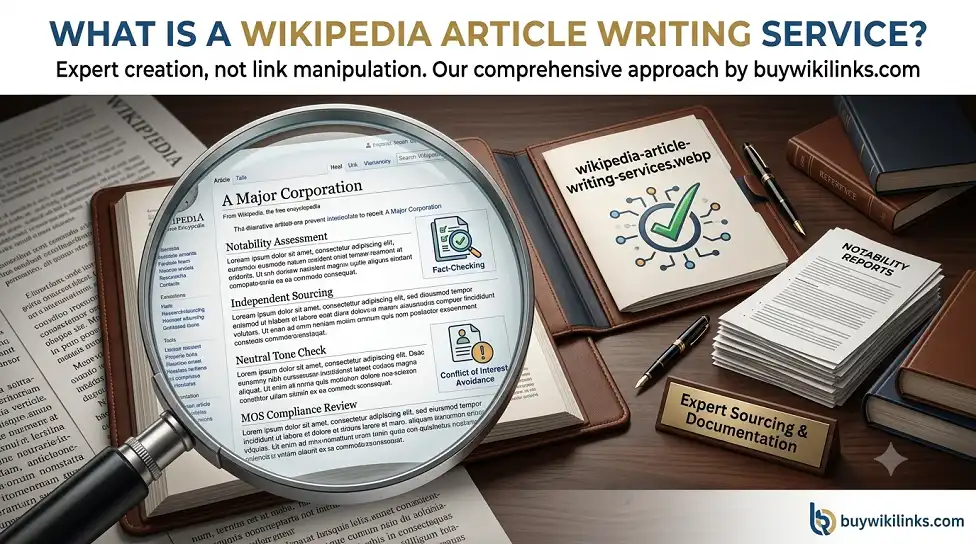
A Wikipedia article writing service helps prepare proposed encyclopedia content for a person, company, organization, brand, product, event, or other potentially eligible subject.
The provider may employ or contract:
- Source researchers
- Content researchers
- Wikipedia-formatting specialists
- Neutral-style writers
- Copy editors
- Policy reviewers
- Monitoring specialists
The provider should be independent of Wikipedia and the Wikimedia Foundation unless it can prove an official relationship.
A commercial service does not receive special publication authority merely because it has worked on many drafts or employs experienced Wikipedia contributors.
The provider is selling professional labor and expertise—not Wikipedia approval.
Wikipedia Writing and Wikipedia Publishing Are Different
The most important distinction is the difference between writing an article and publishing an article.
What article writing means
Article writing may include:
- Researching the subject
- Evaluating sources
- Planning sections
- Writing neutral text
- Adding references
- Preparing an infobox
- Formatting the draft
- Correcting grammar
- Reviewing policy risks
These are service deliverables controlled by the provider.
What publication means
Publication means that a proposed draft becomes an article in Wikipedia’s main encyclopedia space.
That outcome may depend on:
- Whether the subject meets notability requirements
- Whether the sources are reliable and independent
- Whether the writing is neutral
- Whether the content violates copyright
- Whether the draft duplicates another article
- Whether a reviewer accepts the submission
- Whether the wider community later challenges it
A provider can submit a completed draft through an appropriate process. It cannot force independent editors to accept it.
Draft delivery is not publication
Some services advertise “Wikipedia article delivery” when they mean only that the client will receive a completed draft.
The service agreement should state clearly whether the package includes:
- Research only
- Draft writing only
- Wikipedia formatting
- Submission assistance
- Reviewer-response support
- Post-publication monitoring
Do not assume that “writing included” automatically means “publication included.”
Do not assume that “submission included” means “approval guaranteed.”
1. Eligibility and Notability Check

A responsible Wikipedia article writing service should begin with eligibility—not with writing.
Wikipedia does not provide a standalone page to every successful person, registered company, published author, established organization, or popular brand.
The subject generally needs substantial coverage in reliable sources that are independent of it.
A preliminary eligibility screening may examine:
- The subject’s full name
- Official website
- Industry or profession
- Country
- Existing media coverage
- Books or journals
- Major awards
- Previous Wikipedia drafts
- Deletion history
- Related Wikipedia articles
- Possible duplicate topics
The initial screening should determine whether a full source assessment is worthwhile.
A detailed notability assessment may examine:
- Coverage depth
- Publisher reputation
- Source independence
- Primary versus secondary sources
- Sponsored content
- Press release syndication
- Passing mentions
- Source diversity
- Coverage across time
- Profession-specific standards
- Possible article structure
- Rejection or deletion risks
The assessment should produce a realistic recommendation.
Possible outcomes include:
- Proceed with drafting
- Proceed with caution
- Conduct more research
- Wait for stronger coverage
- Expand an existing article instead
- Cover the subject within a broader page
- Do not proceed at this time
A service that accepts every client without checking eligibility may be selling documents rather than credible Wikipedia support.
2. Independent Source Collection
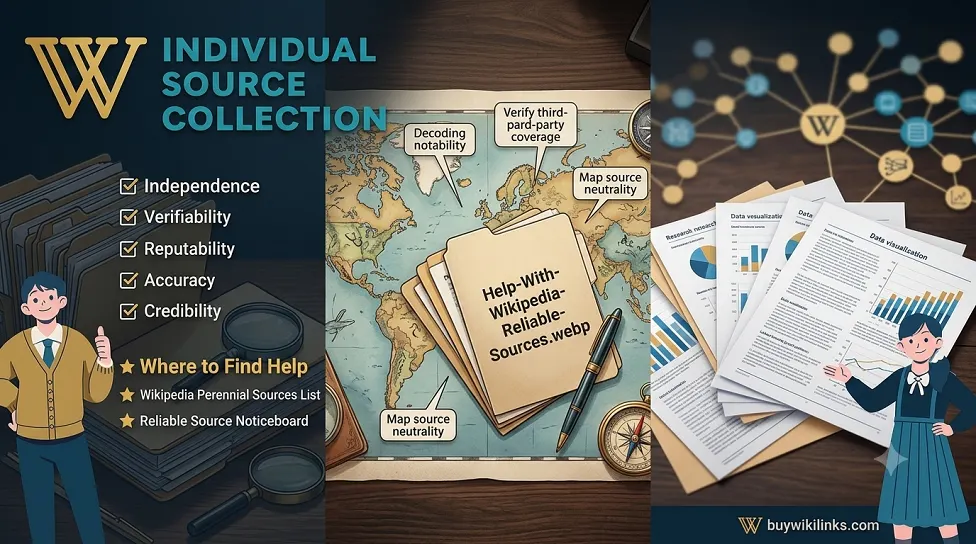
Once the subject appears potentially eligible, the service should research sources beyond the materials supplied by the client.
Clients often provide:
- Official biographies
- Company websites
- Press releases
- LinkedIn profiles
- Social media pages
- Product descriptions
- Interviews
- Awards
- Sponsored articles
These sources may help identify facts, but they are often connected to the subject and may provide weak evidence of notability.
Professional research may include:
- Newspaper archives
- Established magazines
- Books
- Academic journals
- Trade publications
- Government reports
- Regulatory records
- Documentary programs
- Regional media
- Library catalogues
- Subscription databases
- Non-English publications
Why independent research matters
An article based mainly on client-supplied material may reflect the subject’s preferred story rather than its documented public history.
Independent sources may contain:
- Industry context
- Critical analysis
- Public controversies
- Historical details
- Market impact
- Regulatory issues
- Competing viewpoints
- Information omitted from official profiles
This wider evidence helps the writer prepare an encyclopedia article rather than a promotional biography.
3. Wikipedia Source Evaluation
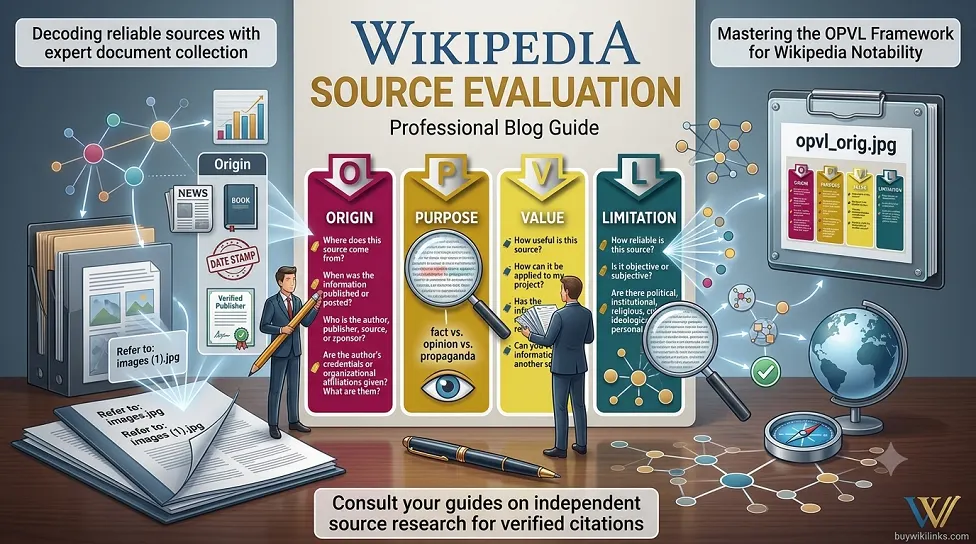
Collecting links is not enough.
Every source should be evaluated for reliability, independence, relevance, and coverage depth.
A source may be:
- Reliable but connected
- Independent but unreliable
- Reliable and independent but only a passing mention
- Detailed but sponsored
- Useful for one fact but unsuitable for notability
- Secondary in one section and primary in another
A professional source report should identify:
- Source title
- Author
- Publisher
- Publication date
- URL or publication details
- Reliability
- Independence
- Primary or secondary status
- Depth of coverage
- Sponsorship concerns
- Facts supported
- Overall usefulness
Stronger sources may include:
- Detailed newspaper profiles
- Independent magazine features
- Books from reputable publishers
- Academic analysis
- Investigative reports
- Independent documentary coverage
- Substantive trade-journal articles
Weaker sources commonly include:
- Official websites
- Company blogs
- Personal websites
- Press releases
- Sponsored profiles
- Business directories
- Social media pages
- Routine event listings
- Customer reviews
- Affiliate websites
- Brief quotation mentions
- Republished announcements
A draft containing forty weak references may be less credible than one supported by eight carefully selected independent sources.
4. Article Structure and Planning
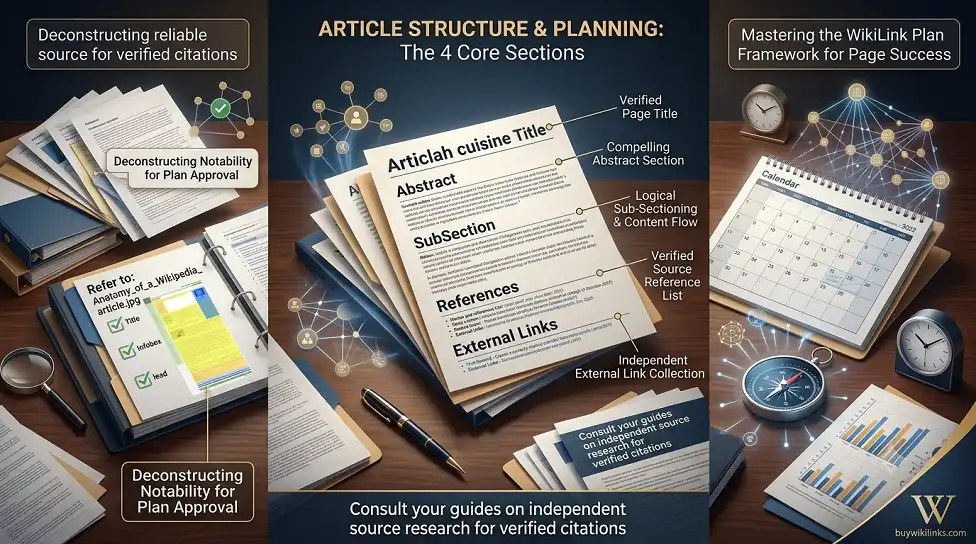
The writer should build the article around the source coverage—not around the client’s preferred marketing message.
A person’s biography might include:
- Introduction
- Early life and education
- Career
- Major works
- Recognition
- Personal life, when relevant
- Controversies, when significantly covered
- References
A company article might include:
- Introduction
- History
- Operations
- Products or services
- Acquisitions
- Reception
- Criticism or controversies
- References
An organization article might include:
- Formation
- Purpose
- Activities
- Leadership
- Programs
- Public impact
- Reception
- References
Not every article needs every section.
The structure should reflect what reliable sources consider significant.
What should not determine the structure
The article should not be designed around:
- SEO keywords
- Sales priorities
- Product categories
- Client testimonials
- Every career achievement
- Every award
- Every office location
- Every partnership
- A company’s website navigation
- Reputation-management goals
The result should resemble an encyclopedia entry, not a branded landing page.
5. Neutral Article Writing
Wikipedia articles must be written from a neutral point of view.
Neutrality does not mean writing only positive information. It means summarizing significant published viewpoints fairly and in proportion to their coverage.
Promotional writing
Daniel Cooper is a renowned entrepreneur and visionary leader who has transformed the global technology industry.
Neutral writing
Daniel Cooper is a British technology entrepreneur who founded ConnectData in 2014. He served as its chief executive until the company’s acquisition by Orion Systems in 2022.
The neutral version presents specific facts without telling the reader how to judge the subject.
Promotional phrases to avoid
- Leading company
- World-class service
- Visionary founder
- Prestigious organization
- Highly respected expert
- Trusted provider
- Revolutionary product
- Fast-growing platform
- Award-winning leader
- Global authority
When a reliable publication uses an evaluative description, the article may attribute it to that source rather than present it as an unquestioned fact.
Handling criticism and controversy
A professional writer should not promise an entirely positive article.
When reliable sources have substantially covered:
- Legal disputes
- Product failures
- Regulatory action
- Professional criticism
- Public controversy
- Financial problems
- Political activity
- Employment disputes
some of that information may need to appear in the article.
The writer should avoid both suppression and exaggeration.
6. Citation Formatting
Wikipedia citations allow readers and editors to verify the article’s claims.
Citation preparation may include:
- Inline references
- Author names
- Article titles
- Publication names
- Publication dates
- Page numbers
- Book publishers
- ISBNs
- Journal volume and issue numbers
- Digital object identifiers
- Archive links
- Access dates
Every source must directly support the statement attached to it.
Common citation problems
A professional service should check for:
- Sources that do not support the claim
- Broken links
- Incomplete publication information
- Duplicate references
- Press releases presented as independent reporting
- Sponsored articles presented as journalism
- Search-result snippets used as citations
- References placed too far from the supported statement
- Claims combining information from unrelated sources
- Fabricated publication details
Good formatting cannot make an unsuitable source reliable. The citation process begins with source quality.
7. Infobox Preparation
An infobox is the summary box that appears near the top of many Wikipedia articles.
Depending on the subject, it may display information such as:
- Name
- Logo or image
- Date of birth
- Nationality
- Occupation
- Founding date
- Headquarters
- Industry
- Founder
- Key people
- Products
- Parent company
- Website
An infobox is not mandatory
Not every article requires one.
The writer should use an established template that fits the subject rather than inventing a promotional information panel.
Infobox information needs support
The information should match the article and reliable sources.
Avoid using the infobox to insert unsupported:
- Revenue
- Employee numbers
- Net worth
- Political affiliations
- Awards
- Market positions
- Slogans
- Customer counts
Frequently changing information should be dated clearly or excluded when reliable sourcing is unavailable.
8. Category Preparation
Wikipedia categories group related articles.
A biography may be categorized by:
- Nationality
- Profession
- Birth year
- Field of work
- Major institutional connection
A company may be categorized by:
- Industry
- Country
- Founding year
- Ownership type
- Headquarters location
Categories must be accurate and established
A provider should not create excessive or promotional categories merely to increase visibility.
Avoid:
- Unverified profession categories
- Subjective labels
- Categories unsupported by the article
- Extremely narrow categories created only for the client
- Duplicate parent and child categories
- Categories based on temporary positions
Category selection is a technical editorial task, not an SEO-link-building exercise.
9. Internal Linking
A properly formatted draft may include links to related Wikipedia articles.
Internal links can help readers understand:
- Locations
- Organizations
- Historical events
- Professional fields
- Technologies
- Industries
- Notable people
The writer should not link every repeated word or create unnecessary links to loosely related subjects.
External links to the client’s website should also be limited. Wikipedia is not a directory for commercial links.
For a broader explanation of the compliant creation process, read How to Create a Wikipedia Page Without Violating Wikipedia Rules.
10. Client Factual Review
The client should normally receive the draft before submission.
The review is intended to identify factual errors such as:
- Incorrect names
- Misspelled titles
- Wrong dates
- Outdated job positions
- Incorrect company relationships
- Misidentified products
- Incorrect publication details
Client review does not mean the client owns the editorial process.
Appropriate client feedback
- “The company was founded in 2013, not 2014.”
- “This person left the role in May 2021.”
- “The book title is misspelled.”
- “The cited article discusses a different company with the same name.”
Inappropriate client demands
- “Remove all criticism.”
- “Describe us as the leading company.”
- “Add our entire service list.”
- “Include every minor award.”
- “Add sales links.”
- “Remove a reliable source because it is negative.”
- “Guarantee that no editor will change this paragraph.”
A professional writer should explain why unsupported or promotional requests cannot be included.
11. Copyright and Original Writing Review
Wikipedia content should not be copied from:
- Official websites
- Press releases
- Published biographies
- News reports
- Books
- Product descriptions
- Marketing brochures
- Previous copyrighted drafts
A client may own its website content, but copying it into Wikipedia can still create licensing and attribution complications.
The article should be written in original language by summarizing the relevant facts.
Changing several words while preserving the source’s sentence structure may still be too close to the original.
A writing package should include a copyright or close-paraphrasing review before submission.
12. Conflict-of-Interest Disclosure
A conflict of interest exists when the writer has a personal, professional, financial, or organizational relationship with the subject.
This includes:
- Paid writers
- Agencies
- Employees
- Founders
- Family members
- Publicists
- Marketing representatives
- Lawyers
- Business partners
Paid contributors must disclose the relevant employer, client, and affiliation.
Disclosure may be made through:
- The contributor’s user page
- The draft talk page
- The article talk page
- An edit summary
- An appropriate disclosure statement
A legitimate writing service should explain its disclosure process before submission.
Warning sign: secret paid editing
A provider that advertises hidden publishing, invisible accounts, undisclosed administrators, or anonymous client work may expose the project to additional risk.
Transparency does not guarantee acceptance, but secrecy can weaken trust in the submission.
13. Draft and Submission Routes
The correct submission route depends on the subject, contributor, and project.
User sandbox
A sandbox allows a contributor to prepare and revise content before publication.
Draft space
Draft space is designed for unfinished proposed articles.
Article Wizard
The Article Wizard helps new contributors start a draft in the appropriate location.
Articles for Creation
Articles for Creation allows an independent volunteer to review the draft.
A reviewer may:
- Accept it
- Decline it
- Reject it
- Request better sources
- Identify promotional writing
- Raise copyright concerns
- Suggest a merge
- Question notability
Talk-page edit request
When an article already exists, a client may need an update rather than a new page.
A disclosed representative can prepare a specific talk-page request containing:
- Current wording
- Proposed wording
- Supporting sources
- Reason for the change
- Conflict-of-interest disclosure
Direct editing of an affected article by a paid or connected contributor is strongly discouraged on English Wikipedia.
14. Revision Support
A professional package should state how many revisions are included.
Revisions may occur during:
- Internal editorial review
- Client factual review
- Policy review
- Citation checking
- Volunteer reviewer feedback
- Post-publication correction
Fixable reviewer concerns may include:
- Promotional tone
- Incomplete citations
- Poor structure
- Excessive detail
- Formatting problems
- Close paraphrasing
- Unsupported minor claims
Problems that rewriting cannot solve
Some problems require more than another draft:
- The subject lacks notability.
- Independent coverage does not exist.
- Most sources are sponsored.
- The topic duplicates another page.
- The article depends on unpublished information.
- The subject is too new.
- The client requires promotional content.
A responsible provider should explain when continued revision is unlikely to help.
15. Post-Publication Monitoring
A published article can continue changing.
Monitoring may include:
- Tracking edits
- Reviewing new references
- Identifying vandalism
- Watching maintenance notices
- Monitoring talk-page discussions
- Detecting deletion nominations
- Identifying outdated information
- Preparing sourced edit requests
Monitoring is not page ownership
A monitoring service cannot guarantee that:
- Every preferred sentence remains
- Criticism will be removed
- The article will never be deleted
- Other editors will stop making changes
- The page will rank in a particular position
The agreement should define:
- Monitoring duration
- Alert frequency
- Types of changes reviewed
- Whether edit requests are included
- Whether new research costs extra
- Whether urgent issues have separate fees
What Should a Wikipedia Article Writing Package Include?
A clear service package may include the following deliverables:
| Deliverable | Expected Work |
|---|---|
| Eligibility assessment | Review of notability and previous Wikipedia history |
| Source research | Search beyond client-supplied materials |
| Source evaluation | Reliability, independence, and depth analysis |
| Article outline | Sections supported by the source material |
| Neutral draft | Original encyclopedia-style writing |
| Citation formatting | Complete inline references |
| Infobox preparation | Appropriate template and sourced details |
| Category research | Accurate established categories |
| Client review | Factual correction stage |
| Copyright review | Originality and close-paraphrasing check |
| Disclosure plan | Paid and conflict-of-interest transparency |
| Submission support | Draft, AfC, or talk-page preparation |
| Revisions | Defined number of correction rounds |
| Monitoring | Defined post-publication period |
| Final files | Draft, source list, and research report |
The contract should also state which services are excluded.
What Cannot Be Guaranteed?
No Wikipedia article writing service can legitimately guarantee the following outcomes.
Guaranteed publication
Volunteer editors independently evaluate drafts.
Permanent page survival
Published articles may later be challenged, merged, redirected, moved to draft, or deleted.
Complete content control
Other editors may revise the article according to sources, policies, and consensus.
An entirely positive biography
Relevant criticism supported by reliable sources may need to be included.
A fixed publication date
A provider can control its own writing deadline but not volunteer review times.
Google rankings
A Wikipedia article may appear prominently in search results, but no particular position can be guaranteed.
A Google Knowledge Panel
Google independently decides when and how Knowledge Panels appear.
Social media verification
Wikipedia publication does not guarantee verification on Facebook, Instagram, X, TikTok, LinkedIn, or another platform.
Permanent backlinks
External links can be removed when editors consider them promotional, unnecessary, or unsupported.
Administrator protection
Administrators do not own articles or have unlimited authority to approve content.
Any provider offering guaranteed publication, secret administrator approval, purchased accounts, or permanent article ownership should be examined carefully. Read The Truth Behind Fake Wikipedia Page Creators before paying for a service.
Questions to Ask a Wikipedia Article Writer
Before hiring a provider, ask:
- Do you check notability before writing?
- Which independent sources support the subject?
- Is independent research included?
- Will I receive a source report?
- How do you identify sponsored content?
- Will the draft be written neutrally?
- How many revisions are included?
- Is citation formatting included?
- Will you prepare the infobox and categories?
- Can I review the draft for factual accuracy?
- How will paid involvement be disclosed?
- Which submission route will be used?
- What happens if the draft is declined?
- Is reviewer-feedback support included?
- Is post-publication monitoring included?
- What outcomes do you guarantee?
- What is your refund policy?
- Will I receive the final research and draft files?
The strongest provider is not the one making the biggest promise. It is the one offering the clearest process.
Frequently Asked Questions
What does a Wikipedia article writing service do?
It may assess eligibility, research sources, prepare a neutral draft, format citations, create an infobox, identify categories, disclose paid involvement, support submission, revise the draft, and monitor the published page.
Is a Wikipedia writing service the same as a publishing service?
No. Writing and formatting are provider-controlled services. Publication is an independent Wikipedia editorial outcome.
Can I hire someone to write my Wikipedia biography?
You can hire research and writing assistance. The person must still meet eligibility requirements, and the paid relationship should be disclosed.
Does the service include independent research?
A professional package should clearly state whether research is included. Relying only on client-supplied links can create sourcing and neutrality problems.
How many sources does an article need?
There is no universal number. Several substantial independent sources are generally more useful than many weak or connected references.
Can the writer use my company website?
An official website may verify limited facts, but it is connected to the subject and generally cannot establish notability.
Can I approve the article before submission?
You should be able to review the draft for factual errors. That review should not turn the article into marketing content.
Is an infobox required?
No. An infobox is helpful for many subjects but is not mandatory for every article.
Can the service guarantee approval?
No provider controls the independent decisions of Wikipedia’s volunteer community.
What happens if the draft is declined?
The provider should review the feedback, correct fixable issues, and explain whether stronger sources or a different approach are needed.
Who owns the article after publication?
No client, writer, or agency owns a published Wikipedia article. It remains open to community editing.
Does monitoring stop unwanted edits?
Monitoring identifies changes and supports appropriate responses. It does not create permanent control over the page.
Final Thoughts
A Wikipedia article writing service should provide more than polished text.
A responsible service should combine:
- Eligibility analysis
- Independent research
- Source evaluation
- Article planning
- Neutral writing
- Citation formatting
- Infobox and category preparation
- Client factual review
- Copyright checking
- Paid-contribution disclosure
- Appropriate submission
- Reviewer-feedback revisions
- Post-publication monitoring
The service should explain the difference between what it can deliver and what Wikipedia’s community controls.
You can pay for thorough research, accurate writing, transparent disclosure, and professional support.
You cannot purchase ownership, guaranteed approval, permanent publication, fixed search rankings, or immunity from future edits.
Order a Professional Wikipedia Article Writing Service
Our Wikipedia article writing service can include:
- Preliminary eligibility screening
- Detailed source research
- Notability assessment
- Neutral article preparation
- Citation formatting
- Infobox and category planning
- Client factual review
- Disclosure guidance
- Submission support
- Defined revision rounds
- Post-publication monitoring
Review the main Wikipedia article writing and page creation service and submit:
- Subject name
- Official website
- Profession or industry
- Country
- Existing independent coverage
- Books, journals, or trade publications
- Previous drafts
- Previous deletion discussions
- Preferred Wikipedia language edition
- Required service level
The source base should be assessed before complete writing begins. The final scope should reflect the subject’s eligibility, research difficulty, article complexity, and level of submission support required.
