
Wikipedia Guides
What Is Wikipedia? How It Works, Who Writes It, and Why People Trust It
Jul
What Is Wikipedia? How It Works, Who Writes It, and Why People Trust It
Wikipedia appears near the top of search results for questions about people, companies, historical events, places, science, technology, culture, and thousands of other subjects. Most internet users have visited it, but many do not fully understand how it works.
Who writes Wikipedia articles? Does Wikipedia employ a team of professional writers? Can anyone change the information? What happens when someone adds something false? And should readers trust what they find there?
Wikipedia is different from a traditional encyclopedia. It does not have one central editorial office that writes every article. Instead, it depends on a worldwide community of volunteers who research, write, review, discuss, and improve its content.
This open system gives Wikipedia both its greatest strength and its most important limitation. An article can be improved quickly by many contributors, but information can also be incomplete, disputed, outdated, or temporarily incorrect.
Understanding how Wikipedia works helps you use it more intelligently, judge its information more carefully, and understand why creating a new Wikipedia page requires much more than simply writing a company profile.
What Is Wikipedia?
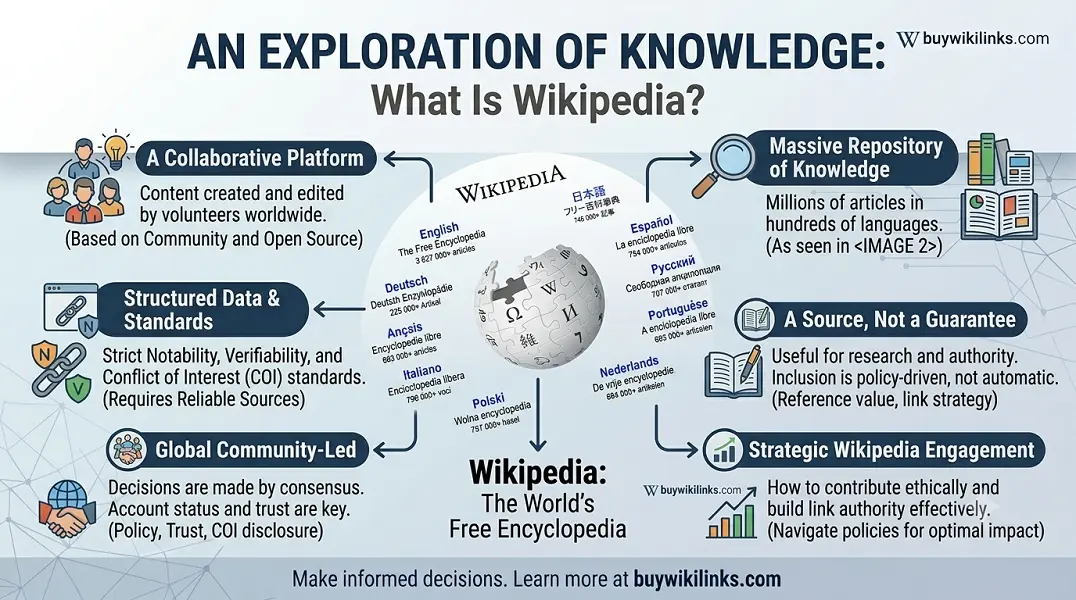
Wikipedia is a free, collaboratively written online encyclopedia.
The word “wiki” refers to a website that allows people to create and edit pages together. Wikipedia combines this collaborative technology with the purpose of an encyclopedia: organizing established knowledge about notable subjects.
Unlike a personal blog, business directory, social media profile, or company website, Wikipedia is not meant to publish whatever a person or organization wants to say about itself. Its articles are expected to summarize information that has already appeared in reliable, published sources.
A proper Wikipedia article should therefore be:
- Informational rather than promotional
- Based on published evidence
- Written in a neutral tone
- Supported by citations
- Focused on a notable subject
- Open to review and improvement by other editors
Wikipedia is free for readers. Most of its content can also be reused under its applicable open-content licenses, provided the license conditions are followed.
Wikipedia Is Not a Business Directory
One common misunderstanding is that Wikipedia works like a business listing platform.
A company cannot simply register, submit its services, add contact information, and receive a permanent article. Wikipedia does not exist to help businesses promote products, control their reputation, or improve their search rankings.
A company, person, product, organization, or event generally needs meaningful coverage in reliable sources that are independent of the subject. A business’s own website, social media profiles, press releases, advertisements, and sponsored articles usually do not prove that the business deserves a separate encyclopedia article.
Writing a draft is only one part of the process. The subject must first have enough independent coverage to support an article.
Businesses considering a Wikipedia presence can review our Wikipedia page creation service to understand the research, writing, sourcing, and review stages involved.
What Is the Difference Between Wikipedia and the Wikimedia Foundation?
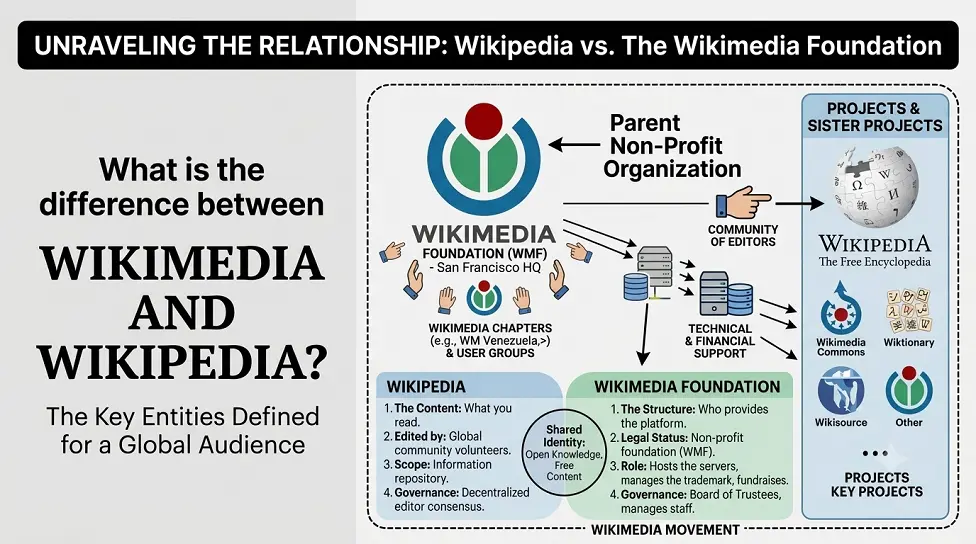
Wikipedia and the Wikimedia Foundation are closely connected, but they are not the same thing.
Wikipedia is the online encyclopedia. It contains the articles that people read and edit.
The Wikimedia Foundation is the nonprofit organization that hosts Wikipedia and supports the technical and legal infrastructure behind it. The Foundation maintains servers, develops technology, protects the projects legally, and supports the wider free-knowledge movement.
However, the Wikimedia Foundation does not normally choose what should be written in individual Wikipedia articles.
Editorial decisions are made by Wikipedia’s volunteer community. Editors develop policies, review sources, debate disputed content, monitor changes, and build consensus about what an article should contain.
A simple way to understand the difference is:
- Wikipedia is the encyclopedia.
- The Wikimedia Foundation supports and hosts the encyclopedia.
- Volunteer editors create and manage the encyclopedia’s content.
The Wikimedia Foundation also supports other free-knowledge projects, including Wikimedia Commons, Wikidata, Wikisource, and Wiktionary.
Who Writes and Edits Wikipedia Articles?
Wikipedia articles are written by volunteers commonly known as Wikipedians.
These contributors come from many backgrounds. Some are researchers, teachers, students, journalists, subject specialists, librarians, technical professionals, or experienced hobbyists. Others are ordinary readers who notice a spelling mistake, outdated date, missing citation, or unclear sentence and decide to correct it.
Wikipedia does not require every contributor to hold a formal qualification in the subject being edited. Instead, the content is judged primarily by whether it accurately represents reliable published sources and follows Wikipedia’s editorial rules.
Different editors may perform different tasks:
- Adding information from reliable sources
- Correcting grammar and formatting
- Removing promotional or unsupported claims
- Reverting vandalism
- Reviewing new drafts
- Discussing disputed information
- Adding categories, templates, or citations
- Updating outdated statistics
- Checking possible copyright violations
- Protecting sensitive or frequently vandalized pages
More experienced community members may receive additional technical permissions. Administrators, for example, can perform actions such as protecting pages, blocking disruptive accounts, and deleting pages under established procedures.
Administrators do not own Wikipedia, control article subjects, or have the power to guarantee that a particular article will remain published. Their permissions are tools for supporting community decisions.
How Do Wikipedia Editors Make Decisions?
Wikipedia does not operate through a traditional manager who has the final word on every article.
Editors usually make decisions through discussion and consensus. When contributors disagree about wording, source reliability, relevance, or neutrality, they can discuss the issue on the article’s talk page.
A talk page is a separate discussion area connected to an article. It allows editors to explain proposed changes, raise concerns, present sources, and work toward an acceptable version.
Consensus does not always mean that every participant agrees completely. It generally means that editors evaluate the arguments using Wikipedia’s policies, available evidence, and reliable sources rather than personal preference.
For difficult disputes, editors may seek input from a wider group of contributors or use one of Wikipedia’s formal dispute-resolution processes.
What Are Wikipedia’s Five Basic Principles?
Wikipedia summarizes its basic philosophy through the Five Pillars. These principles guide the community and help editors understand the purpose of the project.
Readers can view the official Wikipedia Five Pillars for the complete community explanation.
1. Wikipedia Is an Encyclopedia
Wikipedia is intended to summarize established knowledge.
It is not a personal blog, advertising platform, social network, web directory, collection of personal opinions, or place to publish original research. Articles should be about subjects that belong in an encyclopedia and have enough source material to support meaningful coverage.
This principle is particularly important for companies and public figures. A Wikipedia article should not read like a biography written for a personal website or a sales page written by a marketing department.
2. Wikipedia Is Written From a Neutral Point of View
Wikipedia articles should describe important viewpoints fairly and without taking sides.
Neutrality does not mean that every opinion must receive equal space. The amount of coverage given to a viewpoint should generally reflect how it is represented in reliable sources.
For example, a widely accepted scientific conclusion should not be presented as equal to a fringe theory simply because both viewpoints exist.
Neutral writing also avoids promotional language such as:
- Industry-leading
- World-class
- Revolutionary
- Highly successful
- Trusted by everyone
- The best company
- A legendary entrepreneur
Unless a description is directly relevant, properly attributed, and supported by a suitable source, it normally does not belong in an encyclopedia article.
3. Wikipedia Contains Free Content
Wikipedia’s text is published under an open license that allows people to read, share, and reuse it under specified conditions.
Editors must respect copyright rules. Copying large sections from company websites, newspapers, books, or other protected publications is not acceptable merely because the information is factual.
Editors should summarize reliable sources in their own words and provide proper citations.
4. Wikipedia Editors Should Treat One Another With Respect
Wikipedia is built through collaboration. Contributors are expected to communicate respectfully, assume good faith where reasonable, and focus on improving the encyclopedia.
Disagreements are normal. Personal attacks, harassment, threats, and disruptive behavior do not help resolve content disputes.
Editors are encouraged to criticize an edit or argument rather than attacking the person who made it.
5. Wikipedia Has No Firm Rules
This pillar is sometimes misunderstood. It does not mean Wikipedia has no policies or that editors may do whatever they want.
Wikipedia has many policies, guidelines, procedures, and community standards. The principle means that rules should serve the larger goal of improving the encyclopedia. Editors should not allow unnecessary bureaucracy to prevent constructive improvements.
The purpose of the rules matters more than mechanically following a procedure without considering its context.
How Do Facts and References Work on Wikipedia?
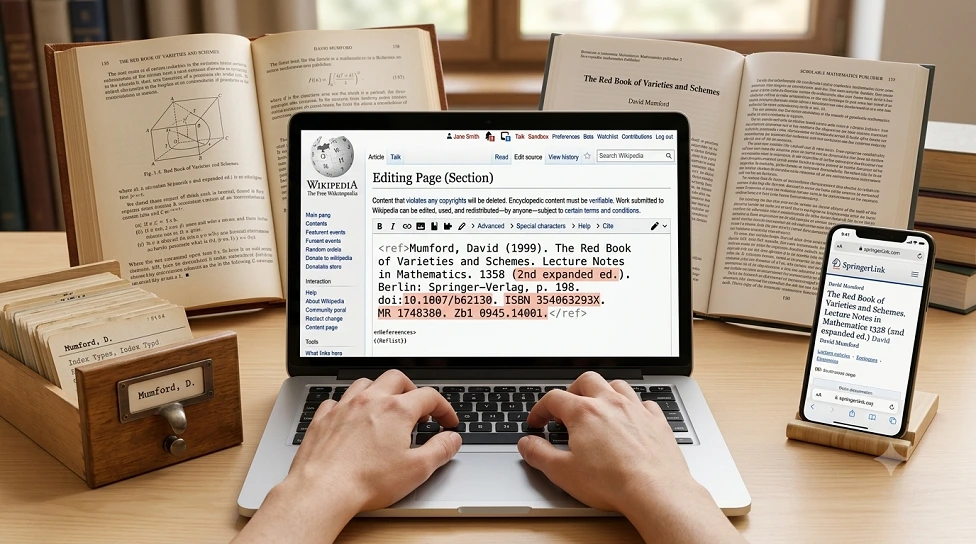
Wikipedia does not expect readers to accept a claim simply because an editor added it.
Important information should be verifiable through reliable, published sources. Citations allow readers and other editors to identify where the information came from and evaluate whether the source supports the claim.
Common source types include:
- Reputable newspapers
- Books from established publishers
- Peer-reviewed academic journals
- Professional or scholarly publications
- Government reports
- Respected industry publications
- Independent investigative reporting
The suitability of a source depends on the claim being supported. A respected sports publication may be useful for an athlete’s career statistics but unsuitable for a complicated medical claim.
Independent Sources Matter
A source can be factually accurate without being independent.
For example, a company website may provide the correct founding date, office address, and product list. However, it represents the company’s own description of itself.
Independent sources are important because they show that people outside the subject have examined, discussed, or reported on it.
Sources that are usually connected to a subject include:
- Official websites
- Press releases
- Executive biographies
- Company-controlled blogs
- Marketing materials
- Social media profiles
- Sponsored content
- Interviews based mainly on the subject’s own statements
These sources may sometimes support basic facts, but they usually cannot establish notability by themselves.
Wikipedia Does Not Publish Original Research
Wikipedia is not the place to announce a new discovery, present an unpublished theory, reveal private documents, or publish a conclusion reached by an editor.
Articles should summarize knowledge that has already been published by appropriate sources.
Even when an editor personally knows that a statement is true, it may still be removed if readers cannot verify it through a suitable published source.
What Does Neutrality Mean in Practice?
Neutrality is more than avoiding obviously positive or negative words.
Editors must also consider:
- Which facts are included
- Which facts are left out
- How much attention each viewpoint receives
- Whether criticism is presented fairly
- Whether praise is attributed to a source
- Whether the article gives excessive attention to minor events
- Whether the article resembles reputation management
A company article should not exist only to describe achievements. If reliable sources have substantially discussed controversies, legal disputes, criticism, business failures, or other important events, those subjects may also need appropriate coverage.
Likewise, criticism should not be included merely to embarrass a person or organization. It must be relevant, well sourced, proportionate, and written without sensationalism.
Neutrality is achieved by following the balance of reliable sources rather than the preferences of an article’s subject, supporters, critics, or editors.
Can Anyone Edit Wikipedia?
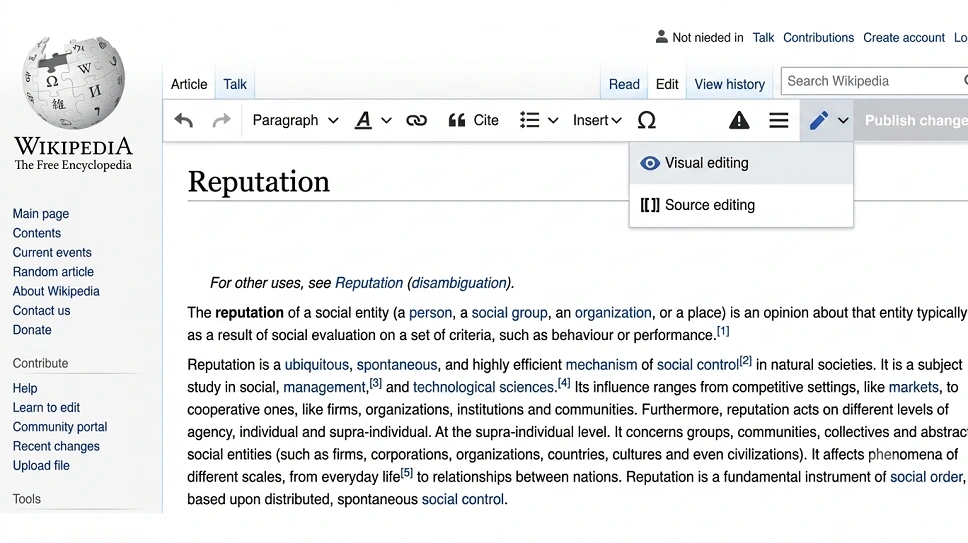
Most Wikipedia articles can be edited by almost anyone.
A person may often correct a simple error without creating an account. Registered accounts provide additional features, including a consistent editing identity, a personal watchlist, and access to certain functions after meeting the relevant requirements.
However, “anyone can edit” does not mean every edit will remain.
Editors are expected to follow Wikipedia’s policies. Unsupported, promotional, misleading, disruptive, or irrelevant changes may be reverted.
Some pages are protected because they receive frequent vandalism, involve sensitive subjects, or experience repeated disputes. Depending on the protection level, editing may be limited to registered, established, or specially authorized users.
A person who cannot directly edit a protected or sensitive page can usually propose a correction on its talk page. An independent editor can then review the request and supporting sources.
Should You Edit a Page About Yourself or Your Company?
Wikipedia discourages people from directly editing articles when they have a conflict of interest.
A conflict of interest can arise when someone edits an article about:
- Themselves
- Their employer
- Their company
- A client
- A family member
- A product they represent
- An organization they manage
- A competitor
A person with a close relationship to the subject may find it difficult to judge what is neutral, relevant, or proportionate.
The safer approach is usually to disclose the relationship and request changes through the article’s talk page. Paid contributors must also follow applicable disclosure requirements.
Creating a new page without understanding these rules can lead to rejection, deletion, account scrutiny, or damage to the subject’s reputation. Our guide to identifying unreliable Wikipedia page creators explains several warning signs to consider before hiring assistance.
How Does Wikipedia Correct Incorrect Information?
Wikipedia uses several overlapping systems to identify and correct problems.
Other Editors Review Changes
Every edit is recorded. Contributors can compare the new version with the previous one and undo a change when necessary.
Many experienced editors maintain watchlists containing articles they care about. When one of those articles changes, they can review the edit.
Recent Changes Are Monitored
Wikipedia provides feeds showing edits as they happen. Volunteers use these feeds to identify vandalism, spam, unexplained removals, and suspicious additions.
Automated Tools Help Detect Problems
Bots and anti-vandalism tools can identify common forms of disruption. Some clearly harmful edits may be reverted quickly, while uncertain changes are flagged for human review.
Readers Can Report Errors
Readers who notice a problem can edit it, raise the issue on the article’s talk page, or request assistance from other editors.
A useful correction request should include:
- The exact statement that is incorrect
- The corrected wording
- A reliable source supporting the correction
- A clear disclosure of any connection to the subject
Editors Discuss Disputed Claims
Not every disagreement has an obvious answer. Two sources may conflict, a publication may be outdated, or editors may disagree about how much attention an issue deserves.
In these situations, contributors discuss the evidence and apply Wikipedia’s policies. The goal is not to protect a preferred narrative. It is to represent the strongest available sources accurately and proportionately.
Page History Creates Transparency
Each Wikipedia article has a public revision history showing when changes were made and which account or IP address made them.
Readers can compare earlier versions, identify when a claim was added, and see whether an edit was later removed. This transparency is one reason Wikipedia’s open model can correct many problems over time.
Why Do People Trust Wikipedia?
People do not trust Wikipedia because every sentence is guaranteed to be correct. Wikipedia itself does not provide such a guarantee.
Its credibility comes mainly from the structure of its editorial process.
Citations Can Be Checked
Readers can open an article’s references and examine the original reporting, books, research, or documents behind important claims.
Changes Are Public
Wikipedia does not silently replace one version of an article with another. Its revision history allows readers to inspect how the page has changed.
Multiple Editors Can Review the Same Page
An article is not controlled by one permanent author. Other contributors can challenge unsupported claims, improve wording, update sources, and correct mistakes.
Disputes Are Often Discussed Publicly
Talk pages allow readers to see how editors reached important content decisions. On controversial pages, these discussions can provide useful context about disputed sources or wording.
Policies Apply Across the Encyclopedia
Wikipedia has established standards for neutrality, verifiability, reliable sourcing, biographies of living people, conflicts of interest, and original research.
These systems are not perfect, but they create a visible framework for improving information and holding contributors accountable.
Is Wikipedia Considered a Reliable Source?
Wikipedia can be extremely useful, but it should be used with judgment.
It is often a good starting point for:
- Learning the basic background of a topic
- Identifying important names, dates, and events
- Discovering terminology
- Finding cited books, research, and news coverage
- Understanding the main viewpoints surrounding a subject
- Locating sources for further investigation
However, Wikipedia should not automatically be treated as the final authority.
Because articles can change, quality varies from one page to another. A detailed and closely monitored article may be carefully sourced, while a short or neglected article may contain gaps.
For important research, readers should examine the original sources cited in the article instead of relying only on Wikipedia’s summary.
This is especially important for:
- Medical decisions
- Legal matters
- Financial decisions
- Academic papers
- Breaking news
- Controversial political subjects
- Biographies of living people
- Claims that have no citation
Many schools and universities do not accept Wikipedia as a primary academic citation. Nevertheless, its references can help students locate stronger sources that may be suitable for formal research.
How to Evaluate a Wikipedia Article
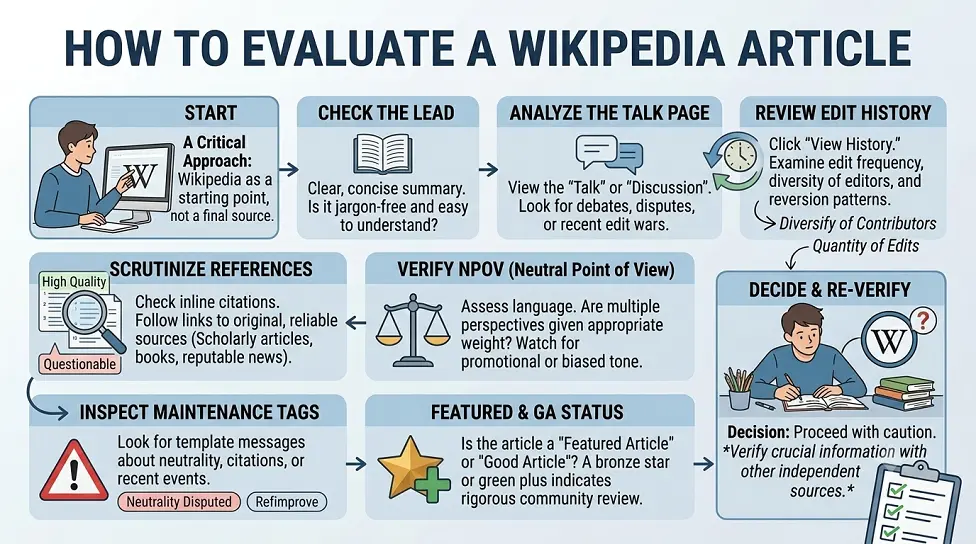
Before relying on an article, perform a quick quality check.
Check the References
Does the article cite reputable books, news organizations, scholarly publications, or official documents? Or does it rely heavily on blogs, company websites, and weak sources?
Look for Warning Notices
Wikipedia places notices at the top of articles that may have problems. These may warn about missing sources, promotional language, neutrality disputes, outdated information, or possible conflicts of interest.
Check the Publication Dates
A source may have been reliable when published but no longer reflect the latest information. This matters for company leadership, scientific research, laws, statistics, and current events.
Open the Article History
A page that has experienced repeated reversions may be affected by vandalism or an active editorial dispute.
Review the Talk Page
The talk page may reveal concerns about sources, neutrality, article structure, or unresolved factual disagreements.
Follow the Citations
For an important claim, open the cited source and confirm that it actually supports the statement.
Wikipedia becomes most valuable when it is used as a map to stronger evidence rather than as a replacement for evidence.
Frequently Asked Questions About Wikipedia
Is Wikipedia free?
Yes. Wikipedia can be read without paying a subscription. Its content is supported by the Wikimedia Foundation and the wider volunteer community rather than a conventional advertising-based publishing model.
Who owns Wikipedia?
Wikipedia is hosted by the Wikimedia Foundation, a nonprofit organization. The encyclopedia’s content is created and maintained by volunteer contributors and made available under open-content licenses.
Who controls what appears on Wikipedia?
Volunteer editors make most editorial decisions through policies, discussions, source evaluation, and consensus. The Wikimedia Foundation provides technical and legal support but does not normally write or control individual articles.
Can anyone create a Wikipedia page?
People can contribute to Wikipedia, but creating a new article does not guarantee that it will remain published. The subject must satisfy Wikipedia’s inclusion requirements, and the article must follow sourcing, neutrality, copyright, and content rules.
Can I create a Wikipedia page about myself?
Technically, a person may attempt it, but autobiographical editing is strongly discouraged because it creates a conflict of interest. Independent coverage and notability are still required, and the subject does not control the final article.
Can a company create its own Wikipedia page?
A company employee can provide information or suggest corrections, but directly writing a promotional company article is risky. A company should first assess whether it has enough significant coverage in reliable, independent sources.
Does every Wikipedia article go through approval?
Wikipedia does not use one universal approval system for all edits and articles. Some drafts are submitted through review processes, while other pages may be created directly by eligible editors. In every case, the community can review, challenge, revise, merge, redirect, or delete the content.
Can someone pay for Wikipedia writing assistance?
A person or company can hire someone for research, source evaluation, neutral drafting, or disclosed editing assistance. Payment does not purchase ownership of an article and cannot guarantee publication, approval, preferred wording, or permanence.
Can false information stay on Wikipedia?
Yes. Wikipedia’s monitoring systems correct many errors, but no open encyclopedia can guarantee that every error will be found immediately. Readers should check citations and use original sources when accuracy is especially important.
Why do Wikipedia pages sometimes disappear?
An article may be deleted when the subject does not meet inclusion requirements, the sources are inadequate, the content is promotional, the text violates copyright, or the page duplicates an existing topic. Pages may also be merged or redirected instead of deleted.
Is Wikipedia good for academic research?
Wikipedia is useful for understanding a topic and finding references, but it is usually better to cite the original scholarly, historical, journalistic, or official sources in academic work.
Final Thoughts
Wikipedia is a free online encyclopedia created through open collaboration. Volunteers write the articles, evaluate sources, discuss disagreements, monitor edits, and correct many errors.
Its openness does not mean that anything can be published without limits. Wikipedia has detailed expectations concerning notability, reliable sources, neutrality, copyright, conflicts of interest, and verifiability.
Readers trust Wikipedia not because it is flawless, but because its citations, revision histories, editorial discussions, and correction processes are largely visible. Used carefully, it can be an excellent introduction to a subject and a valuable path to stronger sources.
For individuals and organizations considering a Wikipedia article, the first question should not be, “Who can write the page?” It should be, “Does the subject qualify for a page?”
Next step: Read our Wikipedia eligibility guide to learn whether a person, company, brand, or organization has the independent source coverage needed for a Wikipedia article.
